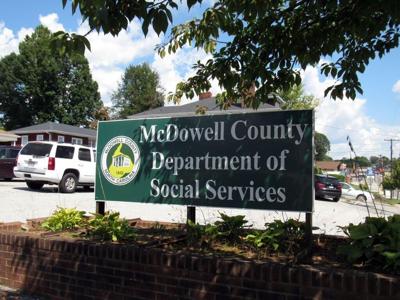

More than three months after McDowell County placed its Department of Social Services director on leave, officials have kept quiet about upheaval inside the office responsible for child welfare and a range of other public services. A letter obtained by Carolina Public Press revealed that McDowell DSS failed to alert law enforcement to evidence of child abuse — and violated other state policies, too.
The McDowell County Board of Commissioners placed former McDowell DSS director Bobbie Sigmon and child protective services program manager Lakeshia Feaster on paid administrative leave during a special session meeting on Feb. 3. Another child protective services supervisor resigned the following week.
Sigmon and Feaster resigned May 31.
County Commissioner Tony Brown told the McDowell News at the time that the county initiated an investigation into its DSS office and the state was involved, but did not provide any details about the cause for the investigation. County commissioners haven’t spoken publicly about the matter since.
People are also reading…
A Feb. 21 letter, sent by the N.C. Department of Health and Human Services to Brown and County Manager Ashley Wooten, offered previously undisclosed details about issues at the DSS office.

The McDowell County Department of Social Services was found to have failed to notify police about evidence of abuse and neglect.
State letter details DSS missteps
According to the letter, McDowell County reached out to the state with concerns that its DSS office hadn’t been notifying law enforcement when evidence of abuse and neglect was discovered in child welfare cases.
The letter didn’t say how or when the county first became aware of the problem, but District Attorney Ted Bell said that he had “raised issues” with the county about DSS prior to Sigmon and Feaster being put on leave. Bell’s office was not involved with the investigation into McDowell DSS.
The state sent members of its Child Welfare Regional Specialists Team to look into the claim. Their findings confirmed that McDowell DSS had failed in multiple instances to alert law enforcement to cases of abuse.
Additionally, the state identified several recent child welfare cases in which social workers failed to consistently meet face to face with children or adequately provide safety and risk assessments in accordance with state policy.
“Next steps will include determining how to work with (McDowell DSS) to remediate the service gaps identified in the case reviews,” the letter concluded.
That nearly four-month-old correspondence is the state’s “most recent engagement” with McDowell DSS, a spokesperson for the Department of Health and Human Services said.
Sometimes the state will initiate a “corrective action plan” when it finds a county DSS office in violation of state policy. If a county fails to follow through on its corrective action plan, the state may strip the DSS director of authority and assume control of the office.
Just last month, the state took over Vance County DSS when it failed to show improvement after starting a corrective action plan.
The state hasn’t taken similar measures in McDowell.
McDowell considers DSS overhaul
Wooten has served as the interim DSS director in Sigmon’s absence. He said Sigmon and Feaster resigned “to seek employment elsewhere” on May 31, after nearly four months of paid leave.
That Sigmon and Feaster resigned, rather than being fired, leaves open the possibility that they may continue to work in DSS agencies elsewhere in North Carolina. Carolina Public Press reported in 2022 on counties’ struggles to hire and retain qualified social workers and social services administrators.
Wooten would oversee the hiring of a new DSS director if the commissioners choose to replace Sigmon, but the county is considering an overhaul to its social services structure that may eliminate the director position entirely.
The restructure would consolidate social services and other related departments into one human services agency, Wooten said. The county may not hire a new DSS director in that case, but instead seek someone to lead an umbrella agency that would absorb the duties of a traditional social services department.
A 2012 state law changed statute to allow smaller counties to form consolidated human services agencies, which are typically a combination of public health and social services departments.
County DSS directors across the state opposed such a change to state statute at the time, but county managers and commissioners mostly supported it, according to a report commissioned by the General Assembly.
At least 25 counties moved to a consolidated human services model in the decade since the law was passed.
McDowell shares a regional public health department with Rutherford County, so it’s unclear what a consolidated human services agency there might look like. The statute does not define “human services” so it’s up to the county what to include in a consolidated agency.
Wooten said no decisions about such a transition have been made.
This article first appeared on Carolina Public Press and is republished here under a Creative Commons Attribution-NoDerivatives 4.0 International License.