
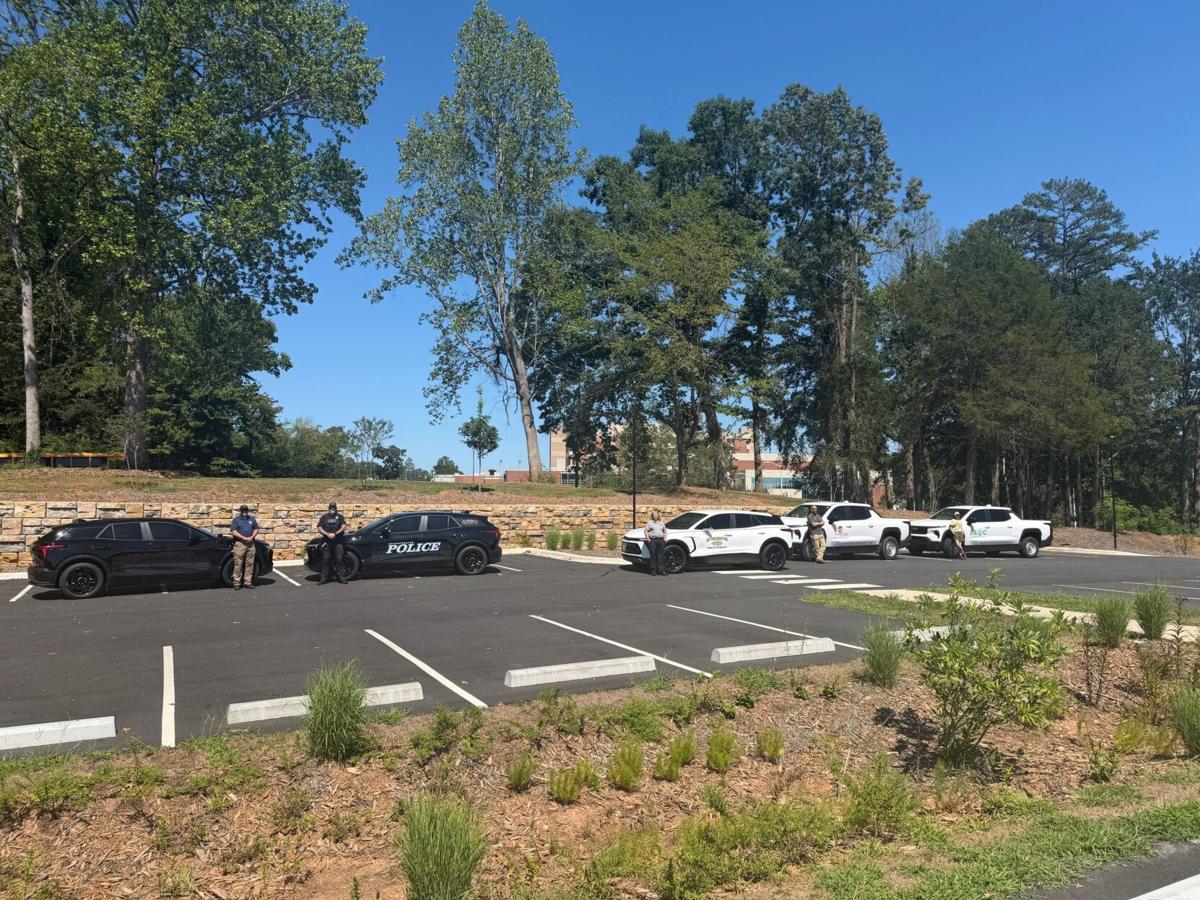
NCDOT Carbon Reduction Program helps the Town leverage planned vehicle replacement dollars into a five-vehicle test of cost, capability and reliability.
RUTHERFORDTON, N.C. — Five new electric vehicles are officially at work on the streets, job sites and parks of Rutherfordton as the Town begins a real-world pilot to determine whether electric vehicles can reliably do the work of rural local government and help reduce the long-term cost of providing those services.
The Rutherfordton Public Safety EV Pilot Program, NCDOT Project HN-0043, was made possible through the federal Carbon Reduction Program administered by the North Carolina Department of Transportation, with regional planning support through the Foothills Rural Planning Organization and Foothills Regional Commission. For Rutherfordton, the project is about both sustainability and fiscal responsibility.
People are also reading…
Like communities across North Carolina, the Town is continually looking for ways to provide high-quality services while containing the growing costs of doing business. Fleet replacement, fuel and vehicle maintenance represent significant recurring expenses. That makes vehicle technology an area where even modest savings can add up over time. Rutherfordton has already taken steps in that direction. The Police Department currently operates two Ford hybrid SUVs, including one assigned to its K-9 program. The next question was whether fully electric vehicles could work in appropriate areas of the Town’s fleet and whether they could ultimately save taxpayer dollars without sacrificing capability.
“Local governments are constantly being asked to do more with less, and we’re always looking for responsible ways to contain costs without reducing the level of service our community expects,” Town Manager Doug Barrick said. “Fuel and fleet costs are high on that list. We already have hybrid vehicles successfully working in our Police Department, so the next question was whether fully electric vehicles could work in portions of our fleet.”
“This was never about simply buying electric vehicles,” Barrick continued. “We wanted to put them into the same jobs where we would use a conventional vehicle and see what happens. Can they handle patrol and emergency response? Can they tow, haul and work in Public Works? Can we charge them without changing how our employees do their jobs? And ultimately, can this technology help us save taxpayer dollars over the life of the vehicle? We want to answer those questions with real experience and real data.”
EVs assigned to working municipal roles
Rutherfordton intentionally placed the five vehicles into working assignments rather than limiting the pilot to administrative travel.
Public Works Director Cory Hall operates a Chevrolet Silverado EV for Public Works and utility operations. Lindy Abrams, director of Parks, Art, Recreation and Culture, operates a second Silverado EV that supports PARC operations and is shared with Ruff’ton Roots Community Garden. Deputy Fire Chief Wendy Burch operates a Chevrolet Blazer EV for fire prevention, inspections and emergency response.
The Police Department operates two Chevrolet Blazer EV PPVs. Patrol Lt. Holland operates a ghost unit, while Sgt. Goodwin operates a fully marked patrol unit.
For Police, the vehicle choice was intentional. The department selected the Blazer EV PPV, or Police Pursuit Vehicle, because it is purpose-built for law-enforcement use rather than adapting a standard consumer EV for patrol service. The two units are already experiencing real police duty cycles, including extended operation with climate control, computers, radios and other equipment running. They have also been used during emergency and higher-speed operations, with officers reporting strong acceleration, handling and overall performance.
Early range and performance findings
One of the biggest surprises from the Town’s initial driver interviews has been battery performance. Lt. Holland’s Blazer EV PPV has accumulated approximately 560 miles. He reports that a full charge is providing approximately 300 miles of indicated range. Level 2 charging is adding approximately 17 to 20 miles of range per hour, and regenerative braking is helping recover energy during normal operation.
Those results are important in police operations, where a vehicle can remain powered throughout much of a shift while supporting air conditioning, computers, radios and other public-safety equipment. So far, officers report that those demands have not created the battery concerns they anticipated before deployment.
The early experience with the Silverado EVs tells a similar story. Abrams’ Silverado has accumulated approximately 874 miles. During a typical workday involving local travel and a full day of rounds throughout the community, the truck begins at 100 percent charge and rarely falls below 90 percent by the end of the day.
That experience provides an important early measure for the pilot. Maximum range is only one way to evaluate an EV. For a municipal fleet, the more practical question is how much battery capacity is actually required to complete a normal workday. In the PARC and Ruff’ton Roots assignment, the initial experience suggests that routine daily operations are using only a small portion of the truck’s available battery.
The Silverados have also been used for hauling, limited towing and off-pavement travel without significant concerns. Public Works Director Cory Hall summarized his initial experience simply: “I really can’t see any difference in it from a gas truck.”
Using EVs as mobile power sources
The trucks are also demonstrating capabilities beyond transportation. During a Town event, PARC staff used one of the Silverados to power a large speaker system for approximately two hours. Employees reported that the truck still showed approximately 94 percent battery afterward. Public Works staff have also used onboard electrical power for tools at job sites.
“It was like having a generator,” Abrams said during the Town’s initial driver interview.
The Town plans to continue evaluating that capability for Public Works projects, parks and community events.
Project scale and funding structure
The final pilot is larger than Rutherfordton originally envisioned. The initial project contemplated four vehicles, including Ford electric trucks. As the project moved toward implementation and availability of the originally contemplated trucks changed, Rutherfordton worked with NCDOT to revise the project and transition to Chevrolet Silverado EVs.
That adjustment created an unexpected opportunity. Without increasing the project’s federal funding ceiling, Rutherfordton was able to expand the pilot from four vehicles to five. The fifth vehicle allowed the Town to include its newly established Parks, Art, Recreation and Culture Department and provide shared vehicle capacity for Ruff’ton Roots Community Garden. The change also strengthened the pilot by adding another distinctly different municipal duty cycle.
The financial side of the project may ultimately be one of its most important lessons. NCDOT programmed the project at $291,415, including up to $233,132 in federal funding and $58,283 in local funding. Rutherfordton’s first reimbursement request documents $286,857.46 in total project expenses through June 30, 2026. After excluding sales tax, the Town reported $282,843.07 in eligible expenses and requested $226,274.46 in federal reimbursement, representing 80 percent of eligible costs. The corresponding eligible local share is approximately $56,568.61.
Those local dollars were not an unplanned expense. Rutherfordton had already allocated funding in its FY 2026 budget for normal fleet replacements. In practical terms, the Town has leveraged approximately the local investment associated with replacing one municipal vehicle into a pilot involving five new EVs and supporting project equipment.
“The grant gave us tremendous buying power on the front end, but that’s only part of the story,” Barrick said. “If we’re going to tell another community this technology makes sense, we need to know what it costs after the grant. We’re going to track electricity, maintenance, tires, repairs, downtime and everything else we can. The real test is whether the vehicle can do the job and whether it can do it more efficiently for our taxpayers.”
Ongoing data collection and next steps
Rutherfordton is not declaring the pilot successful based on its first few weeks of operation. The Town will track mileage, charging, electricity consumption and cost, maintenance, repairs, tires, brakes, downtime, towing and hauling, mobile-power use, warranty work and other operating information. Drivers will be interviewed again at approximately six months and one year, allowing the Town to compare their initial impressions with actual long-term experience.
Rutherfordton intends to share those findings with NCDOT, the Foothills RPO, Foothills Regional Commission and other local governments. The goal is not to tell every community that every municipal vehicle should be electric. It is to determine where EVs work, where hybrids make sense, where conventional vehicles may still be the better tool, and what each choice actually costs taxpayers.
For now, one employee’s advice to another rural community considering the technology may best summarize Rutherfordton’s early experience:
“Don’t be scared to try it.”
Rutherfordton will continue updating the pilot as additional operating data becomes available. The Town’s Initial Deployment White Paper provides more detail on the project background, vehicle assignments, early driver feedback, financial structure and the measures that will be tracked over the next year.