


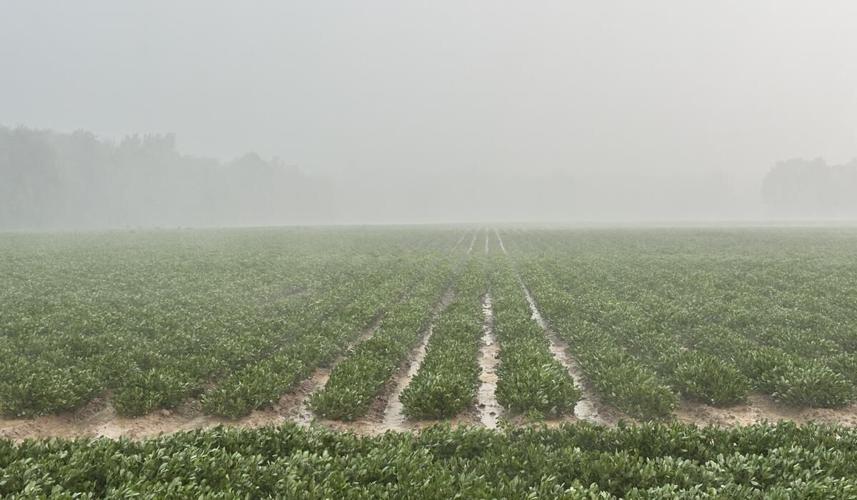
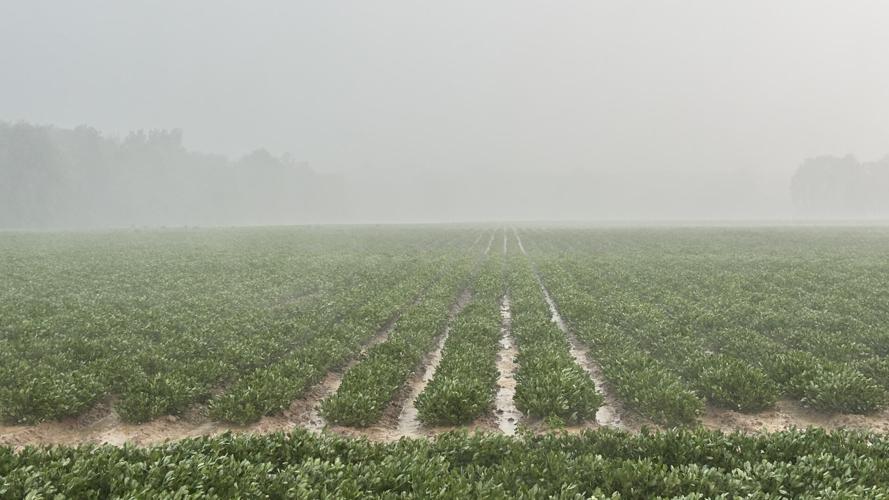
Peanuts in the Virginia-Carolina (V-C) region continue to receive sporadic and variable rain. While rainfall amounts presented in the table suggest modest rainfall, high amounts of rain have occurred in local contexts. For example, some farmers in central North Carolina received up to six inches of rainfall (152 mm) in a single event during the latter part of the week of July 6. Rainfall across the region is projected through the week of July 20.
Peanuts continue to bloom across the region with considerable pegging and pod development occurring over the past two weeks. The combination of high night temperatures and, in some areas, limited soil water has put some peanuts at risk due to negative impacts on pollination. However, peanuts are resilient, and the indeterminate growth habit of peanuts enables considerable compensation from previous stress.
Relative humidity in the peanut canopy and dew points are high across much of the region, favoring development of leaf spot disease. Growers in South Carolina are moving to their third spray for leaf spot and stem rot diseases, while North Carolina and Virginia growers are on their second fungicide spray for pathogens causing these diseases. In most cases, growers will continue their spray programs on 14- to 21-day schedules, depending on pathogen activity and products selected, through mid-September. Some fields are currently wet from rain, and growers will need to adjust fungicide selection to include curative action if delays between sprays are excessive.
People are also reading…
Tomato spotted wilt is present in fields. There is no management of this virus at this point in the season. Tomato spotted wilt virus is vectored by the insect pest thrips during April, May and early June when populations of this pest are high. As thrips feed on peanut plants, the virus is vectored. The amount of plant damage depends on when the plant is infected and the amount of tomato spotted wilt virus entering the plant. Tomato spotted wilt and southern stem rot are present in the V-C region but not to the extent experienced in the southeastern U.S. However, leaf spot and southern stem rot need to be addressed in all fields. Sclerotinia blight can be an issue later in the season in the upper V-C region when temperatures cool. This disease affects approximately 30% of fields in the upper V-C region.
Growers in some fields are applying the plant growth regulator prohexadione calcium to minimize vine growth. This product is applied when 50% of adjacent rows are touching. In some fields, growers will make a second application 14 to 21 days later if regrowth occurs. In addition to enhancing row visibility, prohexadione calcium reduces pod loss during digging and vine inversion.
With the considerable variation in rainfall across the region, growers are scouting fields for a wide range of insect pests and diseases. Weeds continue to be an issue in some areas. Growers have fewer options to control weeds at this point in the cropping cycle. Growers with escaped Palmer amaranth plants are removing these weeds by hand.
The Virginia-Carolina region needs consistent rain to maintain potential yield. Yield potential across the region remains 4,200 pounds per acre (4,704 kg/ha).


