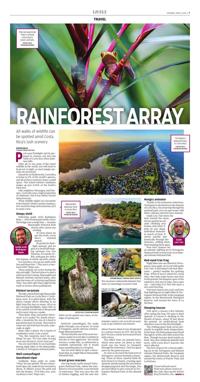


RAINFOREST ARRAY
All walks of wildlife can be spotted amid Costa Rica's lush scenery
Guide Luis Tuit
Guide Ariel Rodriguez Rojas
Anteaters need to visit up to 80 ant nests a day to get sufficient nourishment.
Sloths can be spotted near towns, on the edges of parking lots.
This tarantula in Manzanillo national Park relies on camouflage to protect itself.
Manzanillo national Park in Costa Rica
Tortuguero national Park in Costa Rica
The red-eyed tree frog is among Costa Rica's iconic animals.
TRAVEL
Pack your flashlight and be prepared to venture out into the wilds of Costa Rica when dark-ness falls.
After all, to see some of the rarest wildlife in the world, you will need to head out at night, as most jungle animals are nocturnal.
Famed for its biodiversity, Costa Rica is home to 6% of the world's species, and all of these creatures share a small space. The island nation's landmass makes up just 0.03% of the Earth's total area.
Like neighbors Nicaragua and Panama, Costa Rica has a high proportion of rainforest, but it has better tourist infrastructure.
What wildlife might you encounter in the thicket? Sloths, howler monkeys, red-eyed tree frogs and tarantulas, just to name a few.
Sleepy sloth
Following guide Ariel Rodriguez Rojas — who strode purposefully across the bridge over a small river — we enter Manzanillo National Park shortly after sunset one evening.
It's here where we saw the sloth, Costa Rica's national animal.
He points his flashlight upward, and we gaze at a small ball hanging between two tree branches. It is barely visible, with gray fur with a tint of green. A curled-up sloth, asleep. In Costa Rica, you can see sloths with two and three toes. "This one is a twotoed sloth," Rojas says.
These animals are active during the day and night. The best places to spot a sloth are in the Cahuita, Manzanillo and Manuel Antonio national parks, plus near the towns of La Fortuna and Puerto Viejo. You often spot them right by the roads or in trees above parking lots.
Patient tarantula
We hike onward through Manzanillo National Park on Costa Rica's Caribbean coast. It is pitch black, with the dense canopy above allowing in no light from the stars or moon. All of us are carrying flashlights. Rojas tells us to be careful, to look only at the ground and to never step on a snake.
Then Rojas stops and points downward. Is it a snake? No. Barely noticeable, a tarantula the size of a hand is perched in front of a hole. They tend to come out and wait here for prey, especially at night.
Rojas takes a photo. He is barely 10 centimeters away. Is he scared?
"No, this tarantula won't do anything," he says. "It's very calm. As long as no one attacks it, it just stays put."
You are most likely to see tarantulas during night hikes in the Manzanillo, Cahuita or Tortuguero national parks.
Well-camouflaged lancehead viper
Suddenly, Rojas pulls us aside. "Stop," he says quietly. We see a lancehead viper, the snake he just warned us about. It slithers across the path and into the bushes. "If it bites you, your vacation is over," Rojas says.
Perfectly camouflaged, the snake glides through a sea of leaves. Its head is triangular, and its skin has a brownbeige diamond pattern.
The lancehead is one of the most venomous snakes in Costa Rica's rainforest and also is very aggressive. You would survive a snake bite, as antivenom is available nationwide, but it would mean spending time in a hospital.
You are most likely to spot a lancehead viper on a night hike in Manzanillo National Park.
Great green macaws
Our trip heads north toward Tortuguero National Park, where the rainforest is crisscrossed by a vast network of waterways. This was once the site of intense logging, and the area was almost barren when it was designated as a nature reserve in 1975. But in the past 50 years, nature has bounced back with a force.
The tallest trees are almond trees, which were never cut down as their wood was too heavy to transport through the waterways. That was good news for the green macaws.
As soon as we reach the main port of Tortuguero, we hear the birds screeching. Three of these colorful birds fly from branch to branch, cracking open almonds and devouring the nuts before disappearing back into the jungle. You are most likely to spot a macaw in Tortuguero National Park, in the almond trees.
Hungry anteater
Thanks to the numerous waterways, Tortuguero is also known as the Amazon of Costa Rica. On a boat trip through the national park, you can spot many wild birds, caimans and even rarer animals.
Guide Luis Tuit steers the boat toward the shore. He has spotted an anteater climbing over bushes onto land. It feels its way along individual branches in search of food. It moves quickly and frantically through the branches, sniffing them, then breaking them open.
Your best chances for an anteater sighting are in Tortuguero National Park on boat tours or in Manuel Antonio National Park.
Red-eyed tree frog
Night hikes also are offered in Tortuguero. Once again, we're out with guide Luis Tuit. It had rained a bit that afternoon — perfect weather for spotting frogs. When it hasn't rained for a long time, they hide under leaves and close to the ground, the dampest spots of the rainforest. But once it rains, they come out — and today, it is Tuit who spots a red-eyed tree frog.
Your best chances for a red-eyed tree frog sighting are on night hikes in Tortuguero National Park, in the Sarapiquí region, in the Monteverde Biological Reserve, and around the town of La Fortuna.
Sleeping toucan
Tuit spots a toucan a few minutes after seeing the frog. His gaze is fixed upward. A toucan is sleeping in the thicket of leaves, about 10 feet above the ground. Its multicolored beak shimmers even in the dim flashlight.
The striking giant beak serves primarily to regulate body temperature. In the heat, the birds pump more blood through it; in the cold, they restrict the flow. Though toucans feed mainly on fruit, they also ruthlessly plunder bird nests, with Costa Rica's macaws the worst affected.
The best chances for a toucan sighting are in the Tortuguero and Manuel Antonio National Parks, the Sarapiquí region, the Monteverde Reserve and around the towns of Puerto Viejo and La Fortuna.
Travel well and smart: Point your phone camera at this code, then tap the link for EasyTravel101.com.