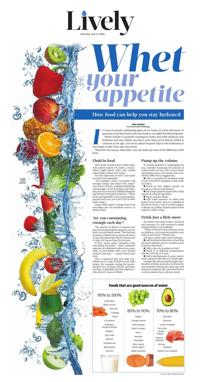


Whet your appetite
How food can help you stay hydrated
It's easy to guzzle a glistening glass of ice water on a hot afternoon; it quenches your thirst and cools your body as you fight the blistering heat.
What's harder is routinely reaching for water and other drinks to stay hydrated each day. Maybe you don't sense that you're thirsty (which is common as we age), you worry about frequent trips to the bathroom or you forget to take a few sips every hour.
Whatever the reason, take heart: you can make up some of the difference with food.
Fluid in food
Most foods contain at least a little water, even walnuts (about 3% water), a wholewheat bagel (about 38%) and cooked salmon filets (about 65% water).
But the superstars of water-rich foods are fruits and vegetables.
"For example, celery, cucumbers and romaine lettuce are about 95% water," says Nancy Oliveira, a registered dietitian and manager of the Nutrition and Wellness Service at Harvard-affiliated Brigham and Women's Hospital in Boston. "Other fruits and vegetables, such as green grapes, peaches and corn, are in the 70% to 90% water range."
Soups, milk, yogurt, cottage cheese and smoothies also are excellent sources of dietary fluid.
Are you consuming enough each day?
The amount of fluid to consume each day from food and drinks depends on your body size and health needs. The National Academy of Medicine recommends about 11 cups (88 ounces) per day for women and 15 cups (120 ounces) per day for men.
If that seems steep, remember that everything you drink — water, moderate amounts of caffeinated coffee or tea, juice, milk, or even drinks with a low alcohol content, like beer — counts toward this total.
Plus, a balanced diet may help contribute up to 2 cups of fluid to your daily intake. For example, eating the recommended two servings of fruits and three servings of vegetables each day might provide about 15 ounces of fluid.
Pump up the volume
If staying hydrated is challenging for you, consider increasing the amount of watery foods you eat. Don't worry about calculating ounces; just up the ante a bit. Oliveira offers these suggestions:
■ Have a smoothie for breakfast made of one or two fruits and plant or dairy milk (or water).
■ Snack on raw veggies, grapes, an orange or a slice of watermelon.
■ Eat a large salad for lunch with a wide variety of colorful vegetables.
■ Enjoy soup for dinner.
■ Add small amounts of water-rich foods to each meal, such as a handful of berries to cereal, a cup of cooked veggies to dinner or a dollop of plain nonfat Greek yogurt to chili or soup.
Drink just a little more
No matter how much water-rich food you consume, it's still essential to drink enough fluids to stay hydrated.
"Water is the best choice because it has no additives, so it's absorbed quickly. Have some at each meal," Oliveira says.
Her tips to make water more enticing:
■ Add fresh herbs like mint or basil (tap the leaves with the end of a wooden spoon to release the flavor).
■ Add a slice of cucumber or fruit.
■ Drink it at different temperatures (chilled, with ice or warm).
■ Add a small amount of a non-caloric water enhancer like Mio or Crystal Light.
It might take time to find the right combination of drinks and water-rich foods to stay hydrated. Hitting the sweet spot will keep you energized, alert and refreshed on a warm summer day or all year round.
Foods that are good sources of water
90% to 100%
Asparagus
Baby carrots
Broccoli
Cabbage
Celery
Cucumbers
Iceberg or romaine lettuce
Peppers
Skim milk
Spinach
Strawberries
Watermelon
Zucchini
80% to 90%
Apples
Cottage cheese
Green grapes
Navel oranges
Pears
Peaches
Pineapple
Plain nonfat Greek yogurt
Sweet potatoes
70% to 80%
Avocados
Bananas
Lentils (cooked)
Part-skim ricotta cheese
Salmon (cooked)
Shrimp (cooked)
Yellow corn (cooked)
Source: USDA FoodData Central