
A SPANISH COLONY?
How Native Americans changed course of North Carolina
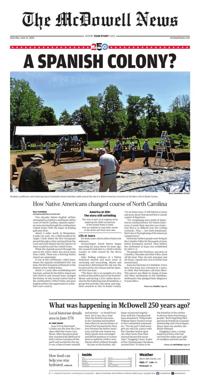
Students, professors and Exploring Joara Foundation board members walk around the site of a Native American structure at the Berry site in Burke County.
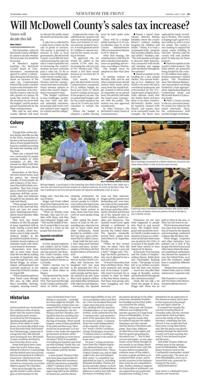
Exploring Joara Foundation board member Rob Hooks holds out a piece of Native American pottery found at the Berry site in Burke County.
Burn markings uncovered at a Native American structure site show where pillars in the structure were burned.
Michael Regehr, a participant in the Exploring Joara field school at the Berry site, holds out a nail that was found around the remains of a Native American structure at the Berry Site. The nail is believed to be from the period when the Spanish established a fort at Joara.
Two decades before English settlers attempted to establish a settlement off the coast of North Carolina, Spanish explorers were moving through the southeastern United States with the hopes of finding gold and silver.
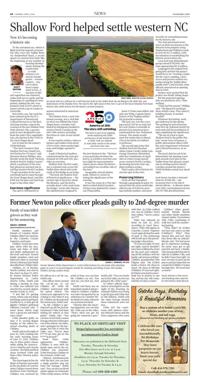
About 6 miles north of Morganton, 8 miles by road, sits a field bordered by Upper Creek where the first Europeans passed through as they ventured from the coast and went deeper into the interior of what would become the United States.
When the Spanish passed through the area in the 1500s, there was much more than a field. There was a thriving Native American community.
It was at this settlement, called Joara, where the Spanish established Fort San Juan, the first European settlement in the interior of the United States.
About 1½ years after establishing Fort San Juan, actions by the Native Americans who lived in and around Joara changed the history of who would control land in the southeastern United States and gave English settlers the opportunity to establish a new country.
Life at Joara
For many years, the location of Joara was unknown. Archaeologist David Moore began searching for Joara about 40 years ago. His research took him to a field in Burke County in 1986 owned by the Berry family.
After finding evidence of a Native American mound and more years of surveying and excavating, Moore and researchers determined the site was the location of the city of Joara and the Spanish Fort San Juan.
"The Berry site is an example of a slice in time in the earliest part of our frontier," Moore said during a 2021 online discussion for the Exploring Joara Foundation, a group that provides education and organizes research at sites in Burke County.
"As we learn more, it will inform us more and more about that period that is clearly a point of departure.
"It's a beginning and a point of departure in colonial history. For Native Americans, it sends their ancestors on a trajectory that is so difficult over the coming centuries. They … lost their homelands. But it also is the beginning of the American colonial story."
Historians believe people were living in the Catawba Valley for thousands of years before Europeans arrived. They believe the settlement of Joara was established by 1400 C.E.
The people who lived here, ancestors of Catawba, Cherokee and other tribes, lived off the land. They ate nuts and grew and ate beans, squash and corn in fertile land around Joara.
Joara was the home of a chiefdom. It was here that Joara was overseen by a mico, or chief, that historians call Joara Mico. This person was likely in charge of Joara and other settlements in the chiefdom, settlements that pledged their allegiance to Joara Mico.
America at 250: The story still unfolding
This story is part of an ongoing series exploring the 250th anniversary of the United States in 2026. Visit our website to read other stories in the series and share your own.
Though little written history details what life was like in the 1500s, researchers at the Berry site have found evidence of how people lived in Joara by carefully excavating the land and washing what they find.
There was a mound that was constructed by people pouring baskets or other containers of dirt. The mound was likely built after the Spanish left Joara, Moore said.
Researchers at the Berry site have found stones used for games, the charred remains of food people ate and evidence of the structures they built in their communities. They have found pieces of pottery made with soapstone, drill bits, arrowheads, pipes and materials brought by the Spanish, like nails and chisels.
"These people know how to live on this land and they lived out here for many years," Exploring Joara Foundation Board Member Mike Carpenter said.
They have also found evidence of who the people of Joara negotiated with in trade. During a recent field study session, where students come to help unearth artifacts hidden in the ground for hundreds of years, students found evidence of materials made with chert, a rock found in Tennessee.
Researchers have been able to learn more about what life was like by reading accounts of Spaniards who came through the area, said Rachel Briggs, an archaeologist, anthropologist and associate professor at the University of North Carolina at Chapel Hill.
"When (Spanish explorer) Juan Pardo came through this area, he talks about these incredible, thriving, complex, amazing towns," Briggs said. "And this was one of them."
Briggs said Pardo talked about how impressed he was with the resources he saw in the community.
"When he (Pardo) came through, they had 125 soldiers with them, and they were being fed," Briggs said. "This was the middle of winter. It seemed like it was not that big of a strain on the people that were here."
Spanish establish settlement
In 1566, Spanish explorers and soldiers, led by Pardo, traveled from Santa Elena, a site near present-day Beaufort, South Carolina. Santa Elena was the capital of the Spanish territory known as La Florida.
Pardo's mission was to explore, conquer and find a route to silver mines in Mexico.
The Spanish left the South Carolina coast on Dec. 1, 1566. They marched through South Carolina and the piedmont of North Carolina, claiming settlements for Spain and attempting to convert people to Catholicism, before arriving in Joara sometime later in December.
When Pardo arrived in Joara, there may have been 1,000 or more people living there.
After seeing the prominence of Joara in the surrounding area, where he was met by many chiefs from other settlements, Pardo decided to establish a fort, Fort San Juan, and a settlement that he called Cuenca.
Pardo built the fort and a 6-foot-deep moat between Cuenca and Joara. Archaeologists at the Berry site first found evidence of the fort in 2013.
Pardo established other forts in western North Carolina and Tennessee but imagined Fort San Juan as the principal fort. For a while, relations between the native people and the Spanish seemed to go well. Joara Mico took Spanish soldiers and raided other settlements with which he had disputes.
Eventually, the Spanish wore out their welcome. Briggs said the Spanish were demanding and, over time, put strain on the community.
In the spring of 1568, people in Joara and other settlements attacked and burned all of the Spanish forts in North Carolina, South Carolina and Tennessee. The Spanish would never again attempt a settlement in the interior of what would become the United States. The Spanish eventually moved their capital from Santa Elena to St. Augustine, Florida. "When we first started here, we asked, 'How did this fort only last a year and a half?'" Briggs said. "Perhaps the better question is, why was it allowed to last a year and a half? "It wasn't miraculous that they overthrew them. They were powerful and strong and, to be honest, it probably wasn't too hard. It's so counter to what we think of the time before America, that these were groups who were struggling and they were not."
Historians are not sure what happened to people who lived in and around Joara. The English immigrants who moved into western North Carolina make no mention of Joara or a settlement on the land where Joara was located in the 1700s. It is unclear if the people who lived there moved or were wiped out by disease.
In the book "Fort San Juan and the Limits of Empire," authors Moore, Robin Beck and Christopher Rodning wrote, "The people of Joara left us no written accounts that tell their own history much less describe their range of thoughts, actions and motivations throughout this colonial encounter."
Pardo did not talk a lot about the people at Joara, Briggs said. There was no gold or silver in the area, so there was not much to say.
What is known about Joara has come from documentation of travel by the Spanish and archaeology conducted at places like the Berry site.
What Briggs, Carpenter and other historians have pointed out is that if the people who lived in Joara and other towns where the Spanish established settlements had allowed the Spanish to stay, the United States, or at least the southeast, might have a completely different history.
"Maybe there would be no United States and no 250th anniversary," Carpenter said.
Billy Chapman is a reporter with the Hickory Daily Record. wchapman@hickoryrecord.com