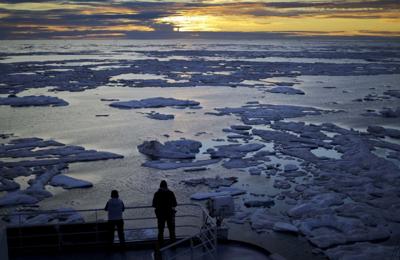

These awesome time lapse videos show the sheer power of icebreaking ships as they carve a path through the frozen Artic waters. Filmed by the chief officer of the Vaygach, a nuclear-powered ship purpose-built for use in waters covered with ice.
People are also reading…

Arctic sea ice coverage has been declining since satellite-based observations started in 1978.
5 key takeaways from the new UN report on climate change
1. Blaming humans

The report says almost all of the warming that has occurred since pre-industrial times was caused by the release of heat-trapping gases such as carbon dioxide and methane. Much of that is the result of humans burning fossil fuels — coal, oil, wood and natural gas.
Scientists say that only a fraction of the temperature rise recorded since the 19th century can have come from natural forces.
2. Paris goals

Almost all countries have signed up to the 2015 Paris climate accord that aims to limit global warming to 2 degrees Celsius (3.6 Fahrenheit) — and ideally no more than 1.5 degrees Celsius (2.7 degrees Fahrenheit) — by the year 2100, compared to the late 19th century.
The report's 200-plus authors looked at five scenarios and concluded that all will see the world cross the 1.5-degree threshold in the 2030s — sooner than in previous predictions. Three of those scenarios will also see temperatures rise 2 degrees Celsius above the pre-industrial average.
About the photo: In this Wednesday, Feb. 17, 2021 file photo, a floating dock sits on the lakebed of the Suesca lagoon, in Suesca, Colombia. The lagoon, a popular tourist destination near Bogota that has no tributaries and depends on rain runoff, has radically decreased its water surface due to years of severe droughts in the area and the deforestation and erosion of its surroundings.
3. Dire consequences

The 3,000-plus-page report concludes that ice melt and sea level rise are already accelerating. Wild weather events — from storms to heat waves — are also expected to worsen and become more frequent.
Further warming is "locked in" due to the greenhouse gases humans have already released into the atmosphere. That means even if emissions are drastically cut, some changes will be "irreversible" for centuries, the report said.
About the photo: In this Thursday, July 29, 2021 file photo, birds fly over a man taking photos of the exposed riverbed of the Old Parana River, a tributary of the Parana River during a drought in Rosario, Argentina. Parana River Basin and its related aquifers provide potable water to close to 40 million people in South America, and according to environmentalists the falling water levels of the river are due to climate change, diminishing rainfall, deforestation and the advance of agriculture.
4. Some hope

While many of the report's predictions paint a grim picture of humans' impact on the planet and the consequences that will have going forward, the IPCC also found that so-called tipping points, like catastrophic ice sheet collapses and the abrupt slowdown of ocean currents, are "low likelihood," though they cannot be ruled out.
About this photo: In this Tuesday, July 20, 2021 file photok the Staten Island Ferry departs from the Manhattan terminal through a haze of smoke with the Statue of Liberty barely visible in New York. Wildfires in the American West, including one burning in Oregon that's currently the largest in the U.S., are creating hazy skies as far away as New York as the massive infernos spew smoke and ash into the air in columns up to six miles high.
5. The IPCC

The panel is composed of independent experts put forward by governments and organizations to provide the best possible scientific consensus on climate change.
Scores of scientists provide regular reports on a range of aspects of global warming that governments draw on when discussing what countries can contribute to curb greenhouse gas emissions and adapt to the impacts of climate change.
About this photo: In this Friday, Aug. 6, 2021 file photo, smoke spreads over Parnitha mountain during a wildfire in the village of Ippokratios Politia, Greece, about 35 kilometres (21 miles), north of Athens. Thousands of people fled wildfires burning out of control in Greece and Turkey on Friday, as a protracted heat wave left forests tinder-dry and flames threatened populated areas and electricity installations.
"Weather Guys" Steve Ackerman and Jonathan Martin are professors in the University of Wisconsin-Madison department of atmospheric and oceanic sciences. Send them your questions at stevea @ssec.wisc.edu or jemarti1 @wisc.edu.