
If you make a purchase after clicking on links within this article, Lee Enterprises may earn affiliate commissions. The news and editorial departments had no role in the creation or display of this content. All opinions and views are of the advertiser.

Heating, cooling, and plumbing — from a team that's been doing this in the region for over 40 years.
- Available 7 days a week: HVAC Emergencies Don't Keep Business Hours
- Guaranteed in writing: Written estimate you approve before any work starts
Free estimates · Licensed & insured · Serving greater Omaha and surrounding areas
If your home was built before 1960, you likely already know the drill. One room may be too hot. Another is always freezing. The basement smells musty from October through April. And every time you turn on the heat, strange noises fill the house.
Welcome to the club. The Midwest is full of breathtaking older homes: Craftsman bungalows in historic neighborhoods, century-old farmhouses tucked along back roads, sturdy brick two-stories in urban centers that have been standing since before your grandparents were born. These homes all have a unique character that is difficult to replicate. But with that lived in veneer comes some issues: old house HVAC problems.
Why older homes may be so hard to heat and cool
Most homes built before the mid-20th century were designed around radiators, cast-iron registers, or simply open windows and good cross-ventilation. Central forced air wasn't really a thing yet. That means a lot of these houses either have no ductwork at all, or they have ductwork that was retrofitted decades ago. Either that, or the ductwork may be leaky, undersized, or routed in ways that make no logical sense by today's standards.
Add to that: minimal insulation, single-pane windows, and walls that are thinner than they should be in a Midwest winter. Getting HVAC in a farmhouse or older urban home up to modern comfort standards takes a different approach than a new build, and it takes a contractor who actually understands what they're dealing with.

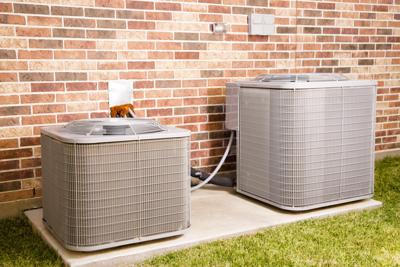
Two air conditioner units outside brick home. Service, construction industries.
When the old system just can't keep up
At some point, patching a decades-old furnace stops making financial sense. If your system is consistently breaking down, your energy bills are climbing year over year, or your technician is starting to use terms like "parts availability" or “special order,” it may be time to look at a full equipment replacement. A properly sized, high-efficiency unit installed in an older home can be a revelation, not just for comfort, but for your monthly utility costs. Aksarben ARS has been serving the region for more than 40 years and can walk you through what a replacement may actually look like for your home's layout and age.
The ductwork problem and a possible solution
Here's the thing about older homes with no existing ductwork, or ductwork that's too compromised to retrofit: you don't necessarily have to tear into walls and ceilings to get modern comfort. Ductless mini-split systems were basically built for this situation. They use small wall-mounted indoor units connected to a slim outdoor condenser with no ducts required. You can heat and cool individual rooms or zones, set different temperatures in different parts of the house, and do the whole installation with minimal disruption to your plaster walls and original woodwork. For HVAC in farmhouse settings especially, where the layout is often sprawling and irregular, mini-splits offer a flexibility that forced-air systems simply can't match.
Don't overlook the air quality issue
Older homes have another HVAC challenge that doesn't always get enough attention: indoor air quality. These older homes have it all. And we’re not just talking about character here. With age comes grime. Decades of dust, allergens, and whatever's been living in those original floor joists can make the air inside surprisingly poor, sometimes worse than what's outside. If anyone in your household has asthma, allergies, or just seems to get sick more during the winter months when windows are shut, it may be worth looking into indoor air filtration and purification options. Aksarben ARS can address that issue as well, offering a range of air-cleaning systems that can be integrated into your existing setup.
Getting it right
The bottom line with old house HVAC problems is often frustrating: there's no one-size-fits-all answer, which is exactly why it matters who you call. Aksarben ARS has been doing this for years, offers free estimates, 24/7 availability, and technicians who know the difference between what an older home needs and what a new subdivision needs. If your century-old farmhouse or your historic urban neighborhood bungalow deserves better than another winter of uneven heat and sky-high bills, it might be time to have that conversation.