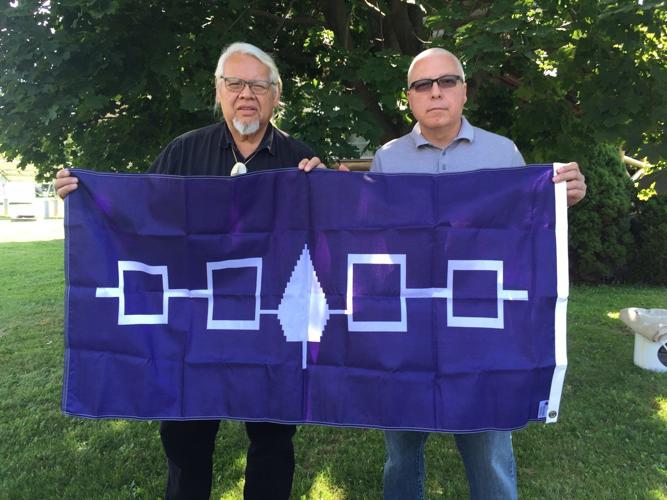
Rick Hill and Tim Johnson with the flag of the Six Nations: Hill, a Tuscorara, and Johnson, a Mohawk, were deeply involved with the genesis of what's become an iconic symbol of the Haudenosaunee, or Iroquois Confederacy. (Image courtesy Tim Johnson)
The flag of the Haudenosaunee, or Iroquois Confederacy, as created by Harold and Tim Johnson: BAsed on the Hiawatha belt, five nations, centered on a tree of peace. (Image courtesy of Tim Johnson)
The landscape of nations: Schematic of new memorial at Niagara-on-the-Lake to native military role in the War of 1812, creation of modern Canada. (Image courtesy of Tim Johnson)
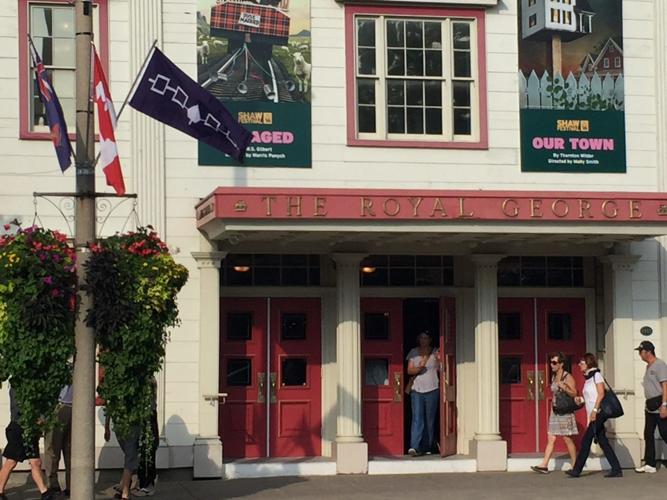
The flag of the Six Nations flies this week on Queen Street, in Niagara-on-the-Lake. (Image courtesy Tim Johnson)
Tim Johnson had a flash of pained boyhood memory as he watched the national debate over whether to stand for the flag, during the national anthem. Johnson is a Mohawk, a member of the Six Nations, raised in North Tonawanda. He remembers, as a child in public schools, standing for the Pledge of Allegiance and feeling concern about the absence of native history from what he was being taught.
Rick Hill and Tim Johnson with the flag of the Six Nations: Hill, a Tuscorara, and Johnson, a Mohawk, were deeply involved with the genesis of what's become an iconic symbol of the Haudenosaunee, or Iroquois Confederacy. (Image courtesy Tim Johnson)
The flag of the Haudenosaunee, or Iroquois Confederacy, as created by Harold and Tim Johnson: BAsed on the Hiawatha belt, five nations, centered on a tree of peace. (Image courtesy of Tim Johnson)
The landscape of nations: Schematic of new memorial at Niagara-on-the-Lake to native military role in the War of 1812, creation of modern Canada. (Image courtesy of Tim Johnson)