
Dancing in the deep
How one Minnesota school built a dynasty in nontraditional sport
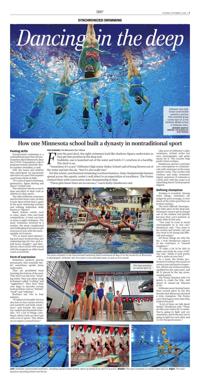
Stillwater Area High School synchronized swimmers practice their extended group routine April 14 at the Stillwater Middle School in Stillwater, Minn.
The team competes in the Synchronized Swimming State Invitational on May 22 at the University of Minnesota in Minneapolis. Stillwater won first place in the extended teams as well as first overall.
The team practices its routine April 14.
Right: The team practices launching Schmit into the air.
Middle: The team competes in a home meet April 23.
Left: Stillwater synchronized swimmers, including Captain Hailey Schmit, warm up ahead of an April 14 practice.
SYNCHRONIZED SWIMMING
From the pool deck, the eight swimmers look like shadowy figures underwater as they get into position in the deep end. Suddenly, one is launched out of the water and twirls 1½ rotations in a backflip. The show is on. "Sometimes it's scary," Stillwater High senior Hailey Schmit said of being thrown out of the water and into the air, "but it's also really fun." For this school, synchronized swimming is serious business. State championship banners spread across the aquatic center's wall attest to an expectation of excellence. The Ponies claimed their sixth consecutive state championship in May.
"These girls know there are no excuses," coach Kathy Henderson said.
Pooling skills
Synchronized swimming is a nontraditional sport that saw participation slip in Minnesota since the COVID-19 pandemic; only 13 programs remain statewide. Roster numbers dwindled, as well.
Still, the teams and athletes who participate are passionate advocates of a sport that requires a particular blend of skills.
"It's a mix of speed swimming, gymnastics, figure skating and dance," Schmit said.
The swimmers devote as much time and effort to their craft as athletes in other sports.
The older Stillwater swimmers practice four hours a day, six days a week. Most of that time is spent in the pool, rehearsing routines and refining individual skills known as "figures."
Meets feature events such as solos, duets, trios and team competitions. A team can have as many as eight swimmers. The more swimmers involved in a routine, the more complicated and challenging it becomes to get everyone in sync with the choreography set to music.
"It's so much more interesting and more involved than just swimming laps for two-and-a-half hours straight," said Henderson, who is in her 34th season with the program as either head coach or assistant.
Form of expression
Swimmers perform precise movements that resemble ballet, sometimes upside down underwater.
They are prohibited from touching the bottom of the pool. They don't use the term "treading water," they stay afloat using techniques called "sculling" and "eggbeaters." They have their own lingo to describe certain body positions such as "fishtail," "hook" and "tabletop."
Routines last two to four minutes.
"It's physical strength, but you also have to have insane artistry and creativity and body awareness," said Schmit, the state's top-ranked synchronized swimmer. "It's a lot of things combined, which I feel you don't get with a lot of sports. This allows you to express yourself more."
Like most of Stillwater's older swimmers, Schmit writes her own choreography and picks music for it. The coaches help perfect their routines.
Henderson and her assistants use a microphone to communicate with swimmers in the noisy aquatic center. The coaches stop routines and make swimmers repeat sequences if someone is a little slow with the count or if something doesn't look properly aligned.
Defining champions
Stamina is essential. Among other things, swimmers are judged by pool coverage, or how much of the entire pool they use in their routines.
The most difficult choreography takes place in the deep end. Swimmers want to get in and get out of the shallow end quickly because they can't perform as many skills in that area.
"You want to cram as much choreography in as you can," Henderson said. "You want to be creative and artistic, but you also want to be strong and difficult and unique."
All those things are why the No. 1 trait Henderson expects of her swimmers is "mental toughness."
"It takes a lot to be able to make your body do crazy stuff," she said. "Make it look pretty with a smile on your face."
As a team, the Ponies performed 23 routines this season of various sizes and levels of expertise. All but one of those routines qualified for the state meet, and all 22 placed in the top seven, earning points.
The Ponies finished with 179 points to claim the title, well ahead of runner-up Wayzata at 90.
Stillwater never finished lower than second place in the five decades that Minnesota declared a state champion. The Ponies carry that legacy every time they jump in the pool.
"A lot of times we talk about family," Henderson said. "These are like your sisters for 12 weeks. You're going to fight and cry sometimes, and in the end, you're going to fight for each other and cry for the good reasons."