

Bearing the brunt
Drought drives more bears to human areas, increasing encounters
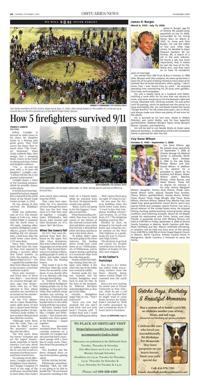
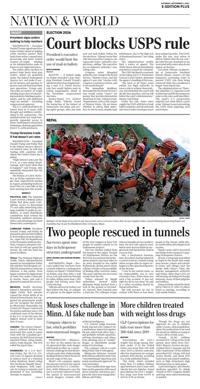
Authorities attempt to remove a bear from a tree Aug. 23 in a residential area in Denver.
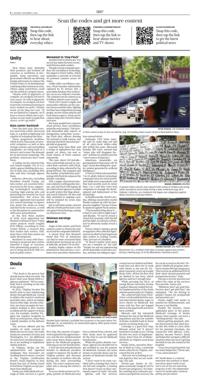
Above: A bear walks out holding an object Aug. 1 after sneaking into a fire station in Colorado Springs, Colo., in this frame obtained from CCTV footage.
Left: A bear stands in a tree Aug. 23 in a residential area in Denver.
Below: A bear lies in a cage Aug. 23 after being removed from a residential area tree in Denver.
A bear walks in a parking lot Aug. 13 in Santa Fe, N.M.
WILDLIFE
Matt Errico was sitting on the toilet when he heard noises in his Colorado home. The roofer got up and found two young bears about the size of golden retrievers standing in his hallway. After a staring match, they bolted out the front door.
Errico has had bears get into his garbage before but the home invasion was a first.
"I've definitely never heard of bears inside, you know, cubs inside someone's house," Errico said of bear encounters in his small mountain town of Granby, about 57 miles northwest of Denver.
The black bears, also spotted in a Granby vape shop, are among thousands heading into towns and cities across the U.S. West in record numbers.
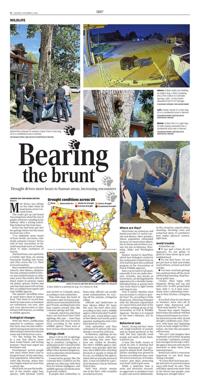
Bears wandered near a school in Santa Fe, New Mexico, climbed a tree near a farmers market in Denver and startled humans in other ways across the country after the driest winter in memory wiped out plants, grasses, berries and nuts that form about 90% of their diet, according to bear experts and state wildlife agencies.
The animals' incredible sense of smell draws them to human food. That leads to record bear deaths in some states as hundreds are euthanized, run over, shot and even electrocuted as they interact with humans, according to wildlife agencies.
Ecological changes
With the West's aridification expected to continue, experts fear bears may become habituated to human food and even stop hibernating if winters become too warm and wild food too scarce.
"It's like testing the bears in a way that they've never been tested before, and testing humans," black bear expert Jon Beckmann said.
Development moved people into areas where bears used to forage for food. At the same time, bear populations rebounded in states like Nevada, where they were largely wiped out more than a century ago.
Black bears are now the healthiest of the world's eight bear species, with between 17,000 and 20,000 in Colorado alone, according to state authorities.
That state bears the brunt of encounters after its human population more than doubled in the past 50 years, pushing homes into bear country around cities like Colorado Springs and Vail.
Colorado, which has only black bears, has had more than 7,000 sightings this year — more than the previous full-year record in 2019, according to the state's wildlife agency. There were at least six bear attacks in the state.
Killings climb
About 1.5% to 2% of sightings end in euthanization, according to Jonathan Livingston, a spokesperson for Colorado Parks and Wildlife. Bears typically are killed when deemed dangerous, such as when they attack humans or break into homes.
Conservation groups like the Colorado Bear Coalition say the animals too often pay with their lives for human negligence, and wildlife agencies should do more to prevent conflicts.
If people alert authorities to bears early, officials can usually avoid euthanizations by scaring off the animals, Livingston added.
Officials and landowners in New Mexico killed 187 bears this year, the most since 2011, according to that state's wildlife agency, which relocated 35 adults and 16 cubs. A bear killed a man in New Mexico last month, police reported, marking the state's first fatal attack in 25 years.
Utah authorities said they euthanized 39 animals this year, already a record for a full year.
In Montana, sightings are too numerous to count, with grizzlies moving into areas they have not visited in decades, the state's wildlife agency said. Twenty-four grizzlies died this year, most killed after attacking livestock or people or being hit by cars, according to the agency, which did not provide historical data. A man was killed by a grizzly in Montana's Glacier National Park in May.
Fatal bear attacks remain rare in the West, with a handful recorded each year.
Where are they?
Black bears are numerous and found across the U.S. and in Canada and Mexico. Most grizzlies, whose population rebounded because of conservation efforts, live in Alaska and northern Canada, but also in Montana, Wyoming, Idaho and Washington state.
Reuters turned to BearWise, which bear biologists started in the southeastern United States in 2018 and that grew into a national program of the Association of Fish & Wildlife Agencies.
Bears can be hard to tell apart, especially if you are under pressure. Grizzlies, also known as brown bears, are distinguished in appearance by a shoulder hump. Individual black or grizzly bears vary from black to light brown and range in size.
Does it matter whether what you encounter is a black or grizzly bear? No, according to Nate Bowersock, a black bear biologist with the Missouri Department of Conservation and chair of the BearWise working group of the Association of Fish & Wildlife Agencies. The key is to respond to the bear's behavior, not its species.
Behavioral cues
Smart, strong and fast, bears can weigh hundreds of pounds and are feared predators in the wild. But they typically avoid people and rarely attack them, scientists say.
A bear that huffs, moans or clacks its jaws is showing that it feels threatened and is prepared to defend itself. BearWise advises standing your ground in the face of a defensive bear, even if it moves toward you. If it makes contact, play dead, protecting your head, until it goes away.
While a defensive bear is noisy and obviously stressed, an aggressive or predatory bear is quiet and moves deliberately.
In this situation, experts advise shouting, throwing rocks and using bear spray. If a predatory bear makes physical contact, fight back.
Avoid trouble
Authorities say:
■ If you spot a bear, do not approach. Do not gather to gawk if a bear shows up in your neighborhood.
■ Do not feed bears. Do not put pet food or bird seed within reach of bears, or leave such food outside.
■ Use bear-resistant garbage bins and keep them off the street until pickup morning. Keep barbecue grills clean.
Clashes often begin with dumpster diving and can end with a 200to 400-pound black bear, with 3to 4-inch razorsharp claws confronting someone in their kitchen, Livingston said.
If you find a bear in your home or business, leave and call in expert help, Bowersock said. "Back away quietly," he said.
Nevada bear expert Heather Reich hopes the animals will find living around humans too stressful and return to the wild, should drought conditions ease. However, with bears just beginning to put on body weight for hibernation, she fears the encounters will increase.
"We can't even imagine what September and October are going to look like," said Reich, a former bear manager for Nevada's wildlife agency who now sells electric doormats to deter bears from entering homes.
Bowersock said it is even more important to not feed bears during a drought.
"If a bear finds food near people and starts to associate human areas with food," he said, "they will likely spend even more time in the future near people, even during non-drought times."