
War's worth? It's complicated
It could take years to assess full effects of the conflict with Iran
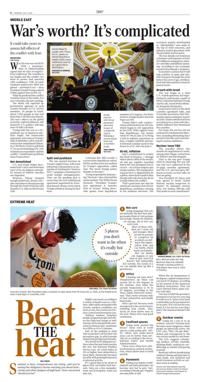
Senate Majority Leader John Thune, R-S.D., speaks as Senate Republican leaders hold a news conference June 16 on Capitol Hill in Washington.
Israeli security and rescue personnel work next to part of a projectile June 8 following a missile attack from Iran in northern Israel.
MIDDLE EAST
Was the Iran war worth it? With a memorandum of understanding signed and 60 days of negotiations underway, the ceasefire is too fragile and the conflict too fresh to answer that question with confidence. Still, an early rundown underscores what was gained — and what it cost — since President Donald Trump ordered strikes against Iran on Feb. 28.
While he predicted the conflict would last four or five weeks, it is now 4 months old and counting.
The death toll reported by government agencies in each country includes 13 U.S. service members, 26 people in Israel, about 3,500 people in Iran and more than 3,500 lives in Lebanon. The war's effects on the global economy, regional alliances and domestic U.S. politics will take years to fully calculate.
Trump hails the war as a triumphant use of American military might, but Democratic opponents and some of Trump's typical defenders call it a misadventure that emboldened Tehran. In a CBS News/YouGov poll June 17-19, an overwhelming 57%-21% of American respondents said the conflict "created more problems than it had solved."
Not demolished
U.S. and Israeli strikes decimated Iran's navy and destroyed most of its air defense network. Its arsenal of ballistic missiles was degraded.
However, Tehran retained enough small boats, drones, missiles and mines to disrupt passage through the Strait of Hormuz and threaten U.S. allies in the Persian Gulf.
Split and pushback
The war opened fractures in Trump's support base, with some influential commentators accusing him of violating his "America First" campaign commitment to avoid foreign entanglements. They say his pending deal is worse than the 2015 multilateral agreement negotiated by President Barack Obama, from which Trump withdrew during his first term.
Louisiana Sen. Bill Cassidy, a conservative Republican whose bid for another term was undone by Trump's opposition, called Iran "the worst foreign policy blunder in decades."
Trump responded by denouncing "the fools" who criticized the memorandum. The White House declared, "President Trump's Iran Agreement Is America First in Action," listing favorable quotes from Republican members of Congress, Fox News anchors, foreign leaders and even Pope Leo XIV.
Trump didn't seek congressional authorization for the war, which began to stir opposition in the GOP. With support from four Republicans, the Senate voted 50-48 on June 23 to bring a halt to military operations in Iran, a largely symbolic gesture. It followed a similar move by the House in a 215-208 vote June 3.
Strait, inflation
Iran's commitment to reopen the Strait of Hormuz — through which about a fifth of the world's oil and gas supplies transited before the war prompted Iran to close it — for 60 days helped calm energy markets. The average price of gas in the U.S. dipped below $4 a gallon, down from a peak in May though still well above the $2.96 average before the conflict.
That's good news not only for American consumers but also for Republican candidates running in the midterm elections. The economic anxiety shorthanded as "affordability" now ranks at the top of voter concerns, and inflation fueled discontent with the president and his party.
The war already cost American consumers and taxpayers at least $132 billion in rising prices, interest-rate hikes and military spending, according to the economic research firm Moody's Analytics.
Economists caution that it will take months of open and reliable transport through the strait before the costs of gas, fertilizer, food and other products return to prewar levels.
Breach with Israel
The war began as a joint U.S.-Israeli operation, but negotiating its end became a point of bitter contention between Trump and his ally, Israeli Prime Minister Benjamin Netanyahu.
Israel wasn't privy to the draft ceasefire agreement talks, and it includes provisions that Netanyahu argues endangers Israel's security. Israel continued attacks on Lebanon in a clash with Hezbollah militants that threatened the ceasefire.
For Israel, the war has not yet achieved its fundamental objectives, including eliminating Iran's arsenal of missiles and constraining its nuclear ambitions.
Nuclear issue TBD
The ceasefire allows two months for negotiations to settle, among other things, restrictions on Tehran's nuclear program.
That is the top goal Trump cited in launching the war but one that isn't addressed in the 14-page ceasefire agreement, and the U.S. and Iran gave different accounts on how talks on that are going.
Vice President JD Vance said Iran agreed to invite United Nations nuclear inspectors to inspect its damaged nuclear sites, but Iranian officials said they made no such commitment.