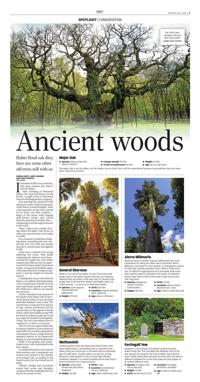


Ancient woods
Robin Hood oak dies; here are some other old trees still with us
SPOTLIGHT | CONSERVATION
I remember it like it was yesterday, that rainy summer day when I met the Major. After traveling to Newstead Abbey, the ancestral home of Lord Byron, I caught a bus to Sherwood Forest in Nottinghamshire, England..
The morning sky, plastered with dark gray clouds, made the greenery of the forest so much brighter. After a few moments on the trail I started to see them, one after another — kings of the forest with bulging dark-brown trunks and curved branches growing in all directions — whispering to me through the leaves in the wind.
Then I came across a large clearing where the Major Oak stood, no other tree around close to its height or width.
For a moment I stood there thinking about everything the tree witnessed, how the land and people around it transformed throughout its life.
There was a German tour group admiring the scene, their guide explaining the arduous task of preserving this fragile tree, how hotter summers just like the one we experienced at the time made it that much harder. As I gazed at the Major again, with many branches resting on supports, I saw the weight of centuries upon it.
Looking back on my visit with the Major, I was gifted a fleeting feeling: I was transported centuries back in time and found myself at one with the wilderness, with no one around but the trees.
Twelve-hundred years passed in the shade of the Major Oak of Sherwood Forest before it was declared dead after failing to come to leaf. The storied tree is treasured not only for its age, stature and beauty, but for connections to the legend of Robin Hood, said to have hidden along with his band of outlaws inside the trunk to escape the Sheriff of Nottingham. Today, the once sprawling forest is confined to a 1,000-acre reserve.
The tree was not appreciated only by human admirers; it provided food and shelter for countless generations of hundreds of insect, fungi, bird and mammal species in an impressive display of concentrated biodiversity.
Sadly, it was people, well-intentioned or not, who contributed to the tree's death.
A combination of poor soil, human interventions and a weakened root system were factors in the decline of the Major Oak, according to the Royal Society for the Protection of Birds.
Climate change and associated recent heat waves and droughts compounded the challenges the tree faced, the society wrote.
Major Oak
■ Species: Pedunculate Oak Quercus Robur)
■ Canopy spread: 92 feet
■ Trunk circumference: 36 feet
■ Height: 52 feet
■ Age: up to 1,200 years
The Major Oak is not the oldest, nor the largest tree on Earth, but it will be remembered among a treasured few. here are some other impressive ancients:
General Sherman
While it's not one of the oldest, it's one of the most well-known trees in the world. General Sherman is in sequoia National Park and about 2,200 years old. It's famed as the largest tree in the world by volume and weighs about 2.8 million pounds — as much as 15 adult blue whales.
■ Species: Giant sequoia (Sequoiadendron Giganteum)
■ Height: 275 feet
■ Girth: 103 feet
■ Location: sequoia National Park, California
■ Age: about 2,200 years
Methuselah
California boasts both the largest and oldest trees in the world. Methuselah, a bristlecone pine, is crowned as the oldest living non-clonal tree in the world with an estimated age of 4,850 years. It's been able to survive for so long because its slow growth in cold, dry and high-altitude conditions allowed it to create incredibly dense wood that is nearly immune to rot, fungi and pests.
■ Species: Great Basin bristlecone pine (Pinus longaeva)
■ Height: 32 feet
■ Girth: 3 feet
■ Location: Inyo National Forest, California
■ Age: about 4,850 years old
Alerce Milenario
Based on recent scientific research, Methuselah may have competition for being the oldest tree in the world. Alerce Milenario, also known as Gran Abuelo, is a Patagonian cypress in Chile that could be anywhere from 2,400 to 5,500 years old. It's difficult to age because of its extremely wide trunk that could be rotted or decayed in the center, so scientists haven't been able to drill to the center to get an accurate tree-ring count.
■ Species: Patagonian cypress (Fitzroya Cupressoides)
■ Height: 196 feet
■ Girth: 14 feet
■ Location: Alerce Costero National Park, Chile
■ Age: 2,400 to 5,500 years old
Fortingall Yew
Situated in a churchyard in Scotland could be Europe's oldest living tree: The Fortingall yew. Multiple trees of the yew species are vying for the rank of oldest, but scientists have trouble dating them because the trees split into several different hollowed-out trunks that make one tree appear to be several different trees.
■ Species: European yew (Taxus Baccata)
■ Height: 23 feet
■ Girth: 56 feet (as of 1771)
■ Location: Fortingall, Perthshire, Scotland
■ Age: 2,000 to 5,000 years old