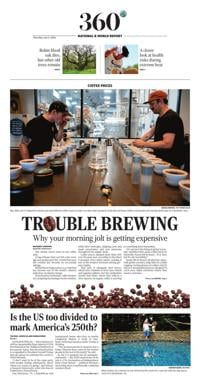

TROUBLE BREWING
Why your morning jolt is getting expensive
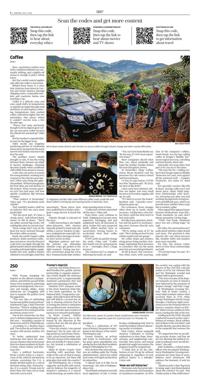
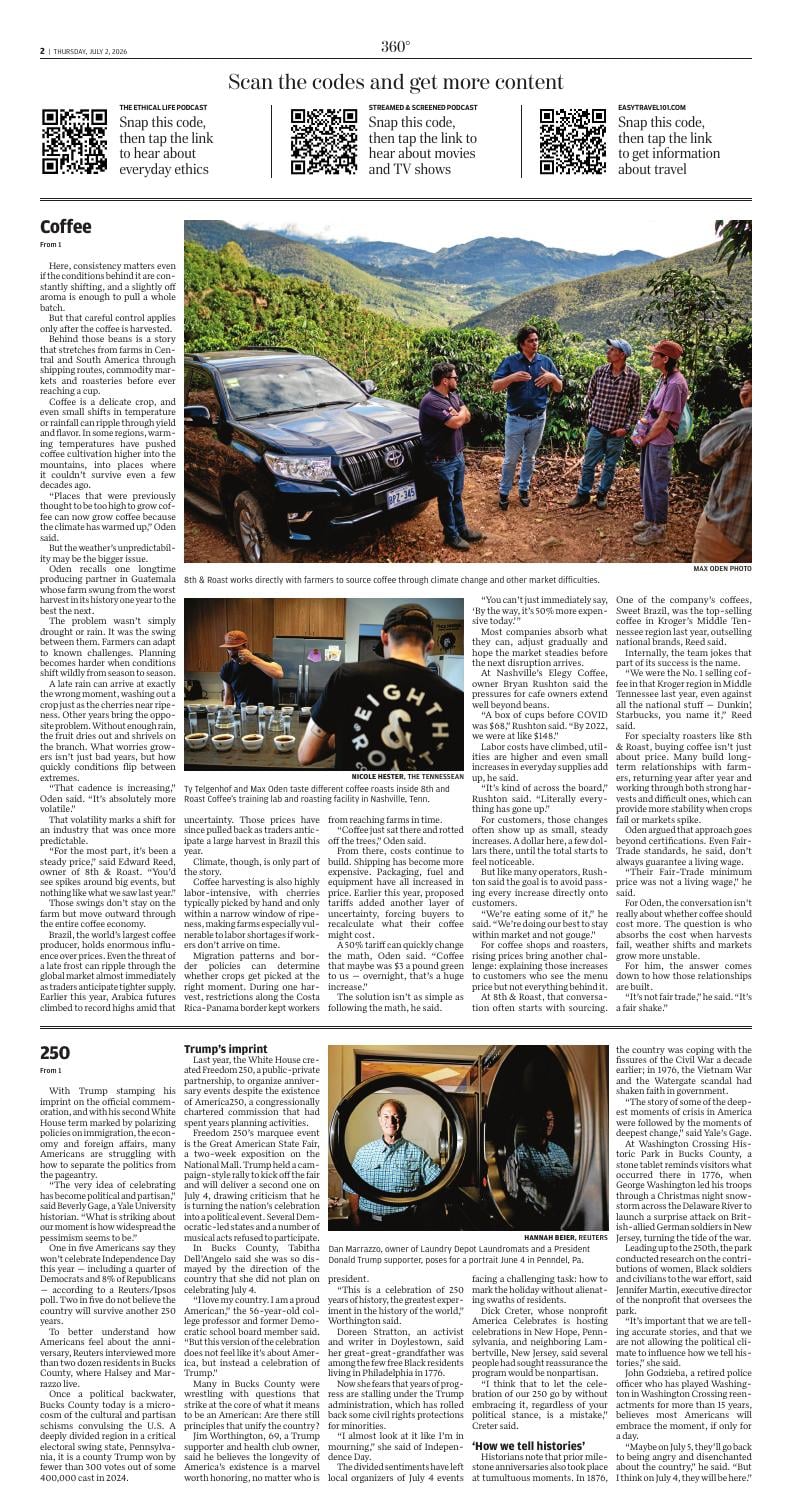
Max Oden and Ty Telgenhof evaluate and taste different coffee roasts to make sure they meet standards inside 8th and Roast Coffee's training lab and roasting facility May 19 in Nashville, Tenn.
8th & roast works directly with farmers to source coffee through climate change and other market difficulties.
Ty Telgenhof and Max Oden taste different coffee roasts inside 8th and roast Coffee's training lab and roasting facility in Nashville, Tenn.
COFFEE PRICES
The sticker shock starts in the coffee aisle.
A bag of beans that cost $16 a few years ago now pushes past $20. A latte that once felt routine has become an occasional splurge.
Behind those higher prices is a crop that has become one of the world's clearest indicators of climate change.
From Brazil to Guatemala, coffee farmers are navigating increasingly erratic weather, while labor shortages, shipping costs and trade uncertainty add new pressures throughout the supply chain.
Coffee prices jumped more than 18% over the past year, according to the latest Consumer Price Index report, making it one of the steepest increases among grocery staples.
That puts it alongside beef prices, which have climbed as herd sizes shrink and supplies tighten. But the similarities mostly end there; where beef reflects a slow squeeze on supply, coffee is reacting to something more immediate.
"It's not just this thing of global warming," said Max Oden, green coffee buyer for Nashville-based 8th & Roast. "It is that, but it's also instability."
Inside 8th & Roast's production space, staff gather around a long table for a daily cupping, tasting dozens of coffees side by side in a standardized process designed to catch even slight variations before they reach a customer.
Here, consistency matters even if the conditions behind it are constantly shifting, and a slightly off aroma is enough to pull a whole batch.
But that careful control applies only after the coffee is harvested.
Behind those beans is a story that stretches from farms in Central and South America through shipping routes, commodity markets and roasteries before ever reaching a cup.
Coffee is a delicate crop, and even small shifts in temperature or rainfall can ripple through yield and flavor. In some regions, warming temperatures have pushed coffee cultivation higher into the mountains, into places where it couldn't survive even a few decades ago.
"Places that were previously thought to be too high to grow coffee can now grow coffee because the climate has warmed up," Oden said.
But the weather's unpredictability may be the bigger issue.
Oden recalls one longtime producing partner in Guatemala whose farm swung from the worst harvest in its history one year to the best the next.
The problem wasn't simply drought or rain. It was the swing between them. Farmers can adapt to known challenges. Planning becomes harder when conditions shift wildly from season to season.
A late rain can arrive at exactly the wrong moment, washing out a crop just as the cherries near ripeness. Other years bring the opposite problem. Without enough rain, the fruit dries out and shrivels on the branch. What worries growers isn't just bad years, but how quickly conditions flip between extremes.
"That cadence is increasing," Oden said. "It's absolutely more volatile."
That volatility marks a shift for an industry that was once more predictable.
"For the most part, it's been a steady price," said Edward Reed, owner of 8th & Roast. "You'd see spikes around big events, but nothing like what we saw last year."
Those swings don't stay on the farm but move outward through the entire coffee economy.
Brazil, the world's largest coffee producer, holds enormous influence over prices. Even the threat of a late frost can ripple through the global market almost immediately as traders anticipate tighter supply. Earlier this year, Arabica futures climbed to record highs amid that uncertainty. Those prices have since pulled back as traders anticipate a large harvest in Brazil this year.
Climate, though, is only part of the story.
Coffee harvesting is also highly labor-intensive, with cherries typically picked by hand and only within a narrow window of ripeness, making farms especially vulnerable to labor shortages if workers don't arrive on time.
Migration patterns and border policies can determine whether crops get picked at the right moment. During one harvest, restrictions along the Costa Rica-Panama border kept workers from reaching farms in time.
"Coffee just sat there and rotted off the trees," Oden said.
From there, costs continue to build. Shipping has become more expensive. Packaging, fuel and equipment have all increased in price. Earlier this year, proposed tariffs added another layer of uncertainty, forcing buyers to recalculate what their coffee might cost.
A 50% tariff can quickly change the math, Oden said. "Coffee that maybe was $3 a pound green to us — overnight, that's a huge increase."
The solution isn't as simple as following the math, he said.
"You can't just immediately say, 'By the way, it's 50% more expensive today.'"
Most companies absorb what they can, adjust gradually and hope the market steadies before the next disruption arrives.
At Nashville's Elegy Coffee, owner Bryan Rushton said the pressures for cafe owners extend well beyond beans.
"A box of cups before COVID was $68," Rushton said. "By 2022, we were at like $148."
Labor costs have climbed, utilities are higher and even small increases in everyday supplies add up, he said.
"It's kind of across the board," Rushton said. "Literally everything has gone up."
For customers, those changes often show up as small, steady increases. A dollar here, a few dollars there, until the total starts to feel noticeable.
But like many operators, Rushton said the goal is to avoid passing every increase directly onto customers.
"We're eating some of it," he said. "We're doing our best to stay within market and not gouge."
For coffee shops and roasters, rising prices bring another challenge: explaining those increases to customers who see the menu price but not everything behind it.
At 8th & Roast, that conversation often starts with sourcing.
One of the company's coffees, Sweet Brazil, was the top-selling coffee in Kroger's Middle Tennessee region last year, outselling national brands, Reed said.
Internally, the team jokes that part of its success is the name.
"We were the No. 1 selling coffee in that Kroger region in Middle Tennessee last year, even against all the national stuff — Dunkin', Starbucks, you name it," Reed said.
For specialty roasters like 8th & Roast, buying coffee isn't just about price. Many build longterm relationships with farmers, returning year after year and working through both strong harvests and difficult ones, which can provide more stability when crops fail or markets spike.
Oden argued that approach goes beyond certifications. Even FairTrade standards, he said, don't always guarantee a living wage.
"Their Fair-Trade minimum price was not a living wage," he said.
For Oden, the conversation isn't really about whether coffee should cost more. The question is who absorbs the cost when harvests fail, weather shifts and markets grow more unstable.
For him, the answer comes down to how those relationships are built.
"It's not fair trade," he said. "It's a fair shake."