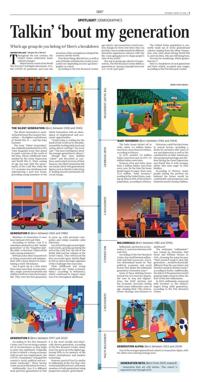

Talkin' 'bout my generation
Which age group do you belong to? Here's a breakdown
SPOTLIGHT| DEMOGRAPHICS
Throughout the last century, the United States underwent many cultural changes.
Major historic events from World War II to the Civil Rights Movement, 9/11, the COVID-19 pandemic and even the invention of the smartphone reshaped the country and the world.
How these things affected you, as well as your attitudes and behaviors on key issues, could vary depending on your age demographic or cohort.
According to the Pew Research Center, age cohorts "give researchers a tool to analyze changes in views over time; they can provide a way to understand how different formative experiences interact with the life-cycle aging process to shape people's view of the world."
One way to group age cohorts is by generation. The Pew Research Center defines a generation as "groups of people born over a 15to 20-year span."
The United States population is currently made up of seven generational cohorts ranging from the Silent Generation, who came about during World War II, and Gen Beta, who are still being born.
You may be wondering, which generation am I?
Here is a breakdown of each generation and their widely accepted year ranges, according to the Pew Research Center.
THE SILENT GENERATION(Born between 1928 and 1945)
The Silent Generation is sandwiched between the Greatest Generation — the fighters and laborers of World War II — and the baby boomers.
The term "Silent Generation" was originally popularized in a 1951 Time magazine essay that aimed to paint a picture of the youth of the time, whose childhoods were marked by the Great Depression and World War II. Their coming of age was met with the uncertainty of the Cold War while the U.S. economy was simultaneously experiencing a post-war boom, providing young members of the Silent Generation with an abundance of employment and economic opportunities.
"Youth today is waiting for the hand of fate to fall on its shoulder, meanwhile working fairly hard and saying almost nothing," the essay said. "The most startling fact about the younger generation is silence."
Though they were dubbed "silent" and described as cautious, particularly in terms of their finances, the Silent Generation did not remain silent with generational figures such as Martin Luther King Jr. leading massive movements for social change.
GENERATION X(Born between 1965 and 1980)
Members of Generation X were born between 1965 and 1980.
According to Forbes, Gen X is sometimes referred to as the "slacker generation" or the "forgotten middle child," as they have "fallen off the radar among marketers."
Brittanica describes Generation X as being resourceful and independent with a keen interest in maintaining a work-life balance.
Gen X grew up in a time when there were more dual-income families, single-parent households and children of divorce than the boomers did. They were the first generation to grow up with personal computers and widely available cable television.
Gen X lived through several significant events, growing up during the end of the Cold War, the fall of the Berlin Wall and the collapse of the Soviet Union. They witnessed the first successful space shuttle flight in 1981 as well as the tragic explosion of the Challenger five years later.
Their childhoods and young adulthoods saw "shaky economic times," according to Britannica, which continued to impact many Gen X'ers throughout adulthood.
GENERATION Z(Born between 1997 and 2012)
According to the Pew Research Center, Gen Z'ers are facing a unique set of circumstances as they begin to enter into adulthood. Originally in line to inherit a strong economy with record-low employment, the COVID-19 pandemic "reshaped the country's social, political and economic landscape." These factors create an uncertain future for Gen Z.
Additionally, Gen Z is different from previous generations in that it is the most racially and ethnically diverse generation, according to the Pew Research Center. Many Gen Z'ers grew up in the digital age, having little to no memory of life before smartphones and modern technology.
However, much of Gen Z is similar to millennials in the way they view social and political issues, with many members of both generations being progressive and pro-government.
BABY BOOMERS(Born between 1946 and 1964)
The baby boom kicked off in 1946, when 3.4 million babies were born, more than ever before, according to History.
In 1947, another 3.8 million babies were born and, in 1953, 3.9 million babies were born.
Between 1954 and 1964, more than 4 million babies were born every year. By the time the boom finally began to taper, there were 76.4 million "baby boomers" residing in the United States, making up almost 40% of the nation's population, according to History.
Historians credit the baby boom to several factors, including a desire for normalcy after years of war and depression as well as the combination of older Americans who postponed marriage and children during the Great Depression and World War II with younger adults who were eager to start families.
According to History, many people during the postwar era believed the future would be comfortable and prosperous and looked forward to having children.
MILLENNIALS(Born between 1981 and 1996)
Millennials, also known as Generation Y, were born between 1981 and 1996.
According to the Pew Research Center, the cutoff between millennials and their successors, Gen Z, was determined based on "key political, economic and social factors that define the millennial generation's formative years."
Some of these defining factors include the 9/11 terrorist attacks, the wars in Iraq and Afghanistan, the 2008 election and the economic recession during which many millennials came of age, shaping their "life choices, future earnings and entrance to adulthood."
The nickname "millennials" was coined by historians Neil Howe and William Strauss in 1991, choosing the name because "their research made it clear this generation … would be drastically different than the one before and therefore needed a distinct name," according to Forbes. Additionally, the oldest of the generation would graduate high school in 2000, the start of the new millennium.
In 2019, millennials surpassed baby boomers as the nation's largest living adult generation, according to the Pew Research Center.
GENERATION ALPHA(Born between 2013 and 2024)
One of the youngest generational cohorts is Generation Alpha, with the oldest now entering teenage years.
GENERATION BETA(Born from 2025 onward)
Generation Beta are still infants. This cohort is expected to last through 2039.