

Polar plunge
Exploring the icy fjords of Greenland
Scientist Liam Northfield describes the ecosystem to passengers on the expedition ship.
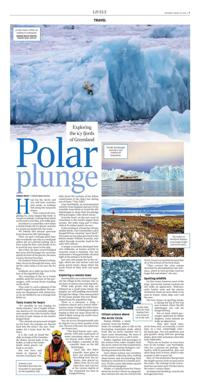
A polar bear hunts for food, leaping from one chunk of ice to the next.
The tundra in Harefjord displays surprisingly bright autumnal colors.
The MS Spitsbergen passing a vast iceberg off greenland.
A polar bears climbs an iceberg in Greenland.
TRAVEL
Head for the Arctic and you will hear crunches and creaks as icebergs bob along the turquoise waters.
They come in all sizes, gliding by, some shaped like birds or clouds or animals. Icebergs float about on the water, now blue, now milky gray.
And there is a sound like a shot when a chunk breaks off of a glacier and tiny ice shards are hurled into the water.
We behold this natural spectacle from aboard the MS Spitsbergen.
Then, we spot a teenage polar bear, who we initially saw only as a small pale yellow dot on a distant iceberg. He is busy using the floes and chunks of ice to work his way closer to the ship.
Shy at first, he stays several hundred feet away. But the longer the vessel lies quietly in front of the glacier, the more curious the bear becomes.
He clambers from iceberg to iceberg, takes shortcuts through the water, stirs up the calm surface as he uses the ice floes.
Suddenly, he is right up close to the bow of the expedition ship.
The crunching of the ice is barely audible amid the murmur of the passengers, with several dozen standing on the decks.
They want to catch a glimpse of the world's largest land predator. The animals are threatened with extinction, so we are thrilled to see a teenage bear before us.
Tasty treats for bears
"It's possible he was hoping for whale remains," says Jørgine Tobiassen, known as JJ. Occasionally, indigenous people come into Scoresby Sund by boat to hunt whales in the world's longest fjord.
"The animals are processed straight on the boat; the remains are thrown back into the water," she says. That makes for a tasty treat for the bears.
JJ is the cook on board the ship, in charge of the Greenlandic dishes served daily at the buffet, as well as the Greenlandic menu guests can book as an extra.
She was born and raised in Qaarsut in western Greenland. She talks about the customs of her fellow countrymen at the ship's bar during one of many "Tiny Talks."
Liam Northfield, an environmental scientist from England and part of the scientific team hired on board the MS Spitsbergen to share their knowledge with passengers, talks about nature.
Scoresby Sund, on the east coast of Greenland, is the world's largest fjord system: 186 miles long and 31 miles wide at its widest points, he says.
In the northwest, it branches off into smaller fjords. The Greenlanders call it Kangertittivaq, meaning "great fjord." The name we use today goes back to the British whaler William Scoresby, who sailed through Scoresby Sund in the early 19th century.
A unique ecosystem developed here over millennia, as human activity in Scoresby Sund is minimal. The last settlement is Ittoqqortormiit, situated right at the entrance to the fjord.
Just over 300 people live in the village, which has one tarmac road and many gravel tracks along which the locals travel in their 4x4s and quad bikes.
Exploring a remote town
Snowmobiles are scattered through-out the village in the summer rain, as are boats of various sizes and dog sleds.
While fully grown sled dogs are tethered on a small stone island, the puppies are still padding uncertainly through the village. They seem puzzled by the many people who just disembarked from the expedition ship.
There is a museum, a shop, a Lutheran church and a tourist information center, though the latter turns out to be locked, stymieing passengers hoping to find out more about life in what is likely among the world's most remote settlements.
You can access Ittoqqortormiit only by ship for two to three months of the year. The rest of the year, the waterways are frozen over.
"The fjord freezes over completely, with only small pools of water remaining where the sea ice freezes more slowly," says Zoe Walker, a member of the scientific team on the MS Spitsbergen.
Each day, the ship's scientific team gives at least one presentation, describing how the ice forms, how glacial ice differs from sea ice and what lives and survives at the various depths of the Greenland Sea here in Kangertittivaq.
Citizen science above the Arctic Circle
Heleen Middel, a whale scientist from the Netherlands, for example, gives a talk on the fascinating Greenland shark, which looks like an Arctic manatee but is much more threatening. We learn it takes 18 years to carry a calf to term.
Walker, together with passengers in the science boat, takes samples from the Arctic waters for later examination and to send to marine biologists conducting research in this field.
Such citizen science sees members of the public collecting data, making observations and documenting their findings to contribute to scientific projects. On this cruise, this makes up part of the onboard program.
Walker, a Canadian from the Yukon, wrote her master's thesis on copepods, tiny creatures she says are critical to the Arctic Ocean's ecosystem because they sit at the bottom of the food chain.
"They convert the solar energy absorbed by phytoplankton into biomass, which in turn provides food for larger fish and whales," she says.
Spotting wildlife
On this cruise, however, most of the large, spectacular marine creatures do not make an appearance. Walruses, seals, harbor seals and the elusive Greenland shark are more likely to be seen in winter, when ships can't sail the area.
The best chance of spotting whales is during the leg of the trip near Iceland, where the MS Spitsbergen sets sail for Kangertittivaq.
But on land, which passengers approach in rubber dinghies, some animals do make an appearance.
They spot musk oxen, arctic foxes and, occasionally, a snow hare, in a vast, surprisingly colorful landscape. The red sandstone and gray granite, along with low-growing plants, glow with autumnal colors this early September.
"There are no bushes or even trees here in the tundra," says Northfield, who has a passion for geology. The tundra, with its permafrost, does not allow deep roots to form, which is why no plant is able to grow tall.
Here, it's the mountains that provide the height anyway, both on land and in the water. The icebergs in the Greenland Sea can tower up to 300 feet above the water's surface alone.
An impressive backdrop, even for the teenage polar bear.