

Info becomes harder to find
Trump administration lacks consistent data reporting on key policy

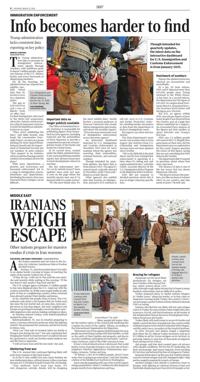
U.S. Immigration and Customs Enforcement officers detain a person Jan. 27, 2025, in Silver Spring, Md.
IMMIGRATION ENFORCEMENT
The Trump administration likes to promote its immigration enforcement agenda through numbers, with ambitious goals to deport 1 million people, report zero releases at the U.S.-Mexico border and arrest thousands of alleged gang members.
For all the boasting, the administration has released less reliable, carefully vetted data than its predecessors on a signature policy.
The gap in information and a loss of figures from an office that tracked immigration data back to the 1800s left researchers, advocates, lawyers and journalists without important statistics to hold the Republican administration to account.
"They aren't publishing the data," said Mike Howell, who heads the conservative Oversight Project, an advocacy group pushing for more deportations. Instead, Howell said, the Department of Homeland Security put out numbers in news releases "that purport to be statistics with no statistical backup and the numbers have jumped all over the place."
With mass deportations a priority, new restrictions and increased enforcement led to a surge in immigration arrests, detentions and deportations. But finding the metrics that once measured those changes can be difficult.
Important data no longer publicly available
The Office of Homeland Security Statistics is responsible for publishing figures from Homeland Security agencies, including removals and the nationalities of those deported, to provide a comprehensive picture of immigration trends at the border and inside the United States.
In its current form, created under the Biden administration, it also started publishing monthly reports that allowed researchers to track developments almost in real time.
But key enforcement metrics on its website haven't been updated since early last year. A note on the page where the monthly reports were says it "is delayed while it is under review."
"It's the most timely data. It's the most reliable data," Austin Kocher, a research professor at Syracuse University who closely follows immigration data trends, said about the monthly reports. "It has the most omniscient view of immigration enforcement across the entire agency."
An interactive dashboard launched by U.S. Immigration and Customs Enforcement in December 2023 once let users examine whom the agency was arresting, their nationalities, criminal histories and removal numbers.
Though intended for quarterly updates, the latest data is from January 2025. The agency's annual report, typically released in December, hadn't been published as of mid-March.
Other agencies also publish data that touches on immigration, and parts of it continue to roll out, such as U.S. Customs and Border Protection statistics detailing border encounters or data from the Department of Justice's immigration courts.
But experts say other data has slowed.
The State Department's most recent visa issuance data is from August. Key statistics from U.S. Citizenship and Immigration Services have not been updated since October.
"We're all a little bit in the dark about exactly how immigration enforcement is operating at a time when it's taking new and unprecedented forms," said Julia Gelatt, associate director of the U.S. Immigration Policy Program at the Migration Policy Institute.
DHS did not respond to detailed questions about why it was no longer releasing specific data.
Patchwork of numbers
Figures the administration has released are inconsistent and unverifiable.
In a Jan. 20 news release, DHS said it deported more than 675,000 people since Trump returned to the White House. A day later, in a second release, the department put the figure at 622,000. In congressional testimony March 4, Homeland Security Secretary Kristi Noem said the figure was 700,000.
But ICE, an agency within DHS, also releases figures on how many people it has removed from the country, part of a large data release mandated by Congress. An Associated Press analysis of the figures put that number at about 400,000 over Trump's first year.
DHS says 2.2 million people who were in the U.S. illegally have gone home on their own, but the department gave no explanation for the count. Experts question the source of that figure, saying this was not something that DHS historically tracked.
The department didn't respond to questions about where that data came from.
The absence of data is one of the few issues that has drawn bipartisan criticism.
"We deserve to know the numbers, just like we deserve to know who's in our country and who needs to leave," Howell said.
Though intended for quarterly updates, the latest data on the interactive dashboard for U.S. Immigration and Customs Enforcement is from January 2025.