
Afghan allies seek protection
Veterans among those pushing US to honor pledge to interpreters

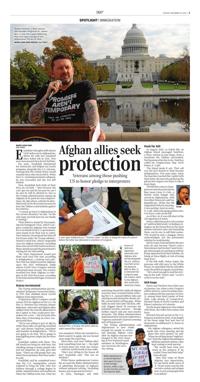
Robin Matthewman, a retired diplomat who spent 35 years in the Foreign service, holds a sign as she marches across the National mall.

Samuel Port, a 33-year-old army veteran, walks toward the Capitol.

Scores of veterans, diplomats, advocates and Afghans who served alongside the U.S. military marched across the National mall on Nov. 11 to demand that Congress keep the nation's word to the Afghans who stood with American troops.

A man signs #Afghanevac's "Promise Letter" on Nov. 11 along the route of a march before the letter was delivered to members of Congress.

Crow

Shawn Vandiver, a Navy veteran who founded #Afghanevac, speaks Nov. 11 near the Capitol reflecting Pool and urges passage of the Afghanistan TPs act of 2026.
SPOTLIGHT| IMMIGRATION
Ezadullah's thoughts drift almost 7,000 miles east to Afghanistan, where his wife has remained since Kabul fell in 2021. Five years have passed since he last held her.
For years, Ezadullah interpreted for Americans and helped run youth programs alongside the U.S. mission, trusting that the United States would stand by those who stood with it. When the U.S.-backed government collapsed, he was evacuated and she was left behind.
Now, Ezadullah feels both of their lives are on hold — hers because she can't get out and his because he can't be sure he will be allowed to stay as the Trump administration sweeps up Afghans in its push for mass deportations. He, like others, asked to be identified only by his first name because he fears the Taliban could retaliate against his relatives.
"I cannot go back to Afghanistan in the current situation," he said. "So the only hope we both have for our family is waiting."
Their limbo is shared by thousands. Special Immigrant Visas, which Congress created for Afghans who worked for or on behalf of the U.S. government, were meant to be their way to safety. Since January, the program has been all but frozen under the Trump administration's travel ban, which suspended visas for Afghan nationals, including those who served with American forces. Many already passed the government's vetting but are still waiting.
The State Department issued just three such visas this year, according to #AfghanEvac, a veteran-led coalition that has helped resettle Afghans since the 2021 withdrawal, while almost 6,000 visas Congress already authorized went unused. The country resettled just three Afghans as refugees in the 2026 fiscal year, according to the International Refugee Assistance Project.
Status terminated
The Trump administration also terminated Temporary Protected Status, or TPS, that shielded about 12,000 Afghans from deportation.
A bipartisan bill in Congress would restore TPS for Afghans in the U.S. On Nov. 11, Veterans Day, veterans, former diplomats, advocates and Afghan allies walked from the Lincoln Memorial to the Capitol so they could press lawmakers for a vote — the last push after three days of knocking on every congressional door.
"We're not willing to just sit idly by while these folks are getting snatched up," said Shawn VanDiver, president and founder of #AfghanEvac. "We're not going to do that. We're going to keep fighting every single day for these folks."
Ezadullah walked with them. The bill would not bring his wife here, but standing among so many people who had not forgotten, he said, gave him hope. "There are still people that care about those promises that they made," he said.
Ezadullah said he completed every step the U.S. immigration system required to bring his wife, who was halfway through a college degree in public administration and healthcare when the Taliban took over. Only her visa remained. When she traveled to a third country to apply, she was turned away under the travel ban.
Since then, each new Taliban edict took something from her — the right to travel alone, her work, her classes — until her world shrank to four walls.
"She's just sitting in the house all day," Ezadullah said. "She has no freedom."
White House spokesperson Lauren Bis accused the Biden administration of admitting thousands of Afghans without adequate vetting, "including known and suspected terrorists."
In 2022, Pentagon and DHS watchdogs found that while all Afghan evacuees were screened before entering the U.S., unused military data and missing records during the chaotic airlift caused initial vetting gaps. When fuller records were later checked, officials flagged about 50 evacuees for potential security concerns — though neither report said any were known terrorists. The Biden administration maintained that everyone underwent a "rigorous and multi-layered screening and vetting process."
The Trump administration said Afghanistan is now stable enough for people to return, and pausing Afghan cases after an Afghan evacuee was charged in the 2025 shooting of two National Guard members in Washington was necessary for security vetting.
Push for bill
In August 2021, as Kabul fell, an Afghan friend messaged VanDiver, a Navy veteran in San Diego, from a mountain the Taliban surrounded. Not knowing what else to do, VanDiver called his congressman, Rep. Scott Peters, D-Calif.
The friend made it out. That call was the first thread of what became #AfghanEvac. Five years later, when the marchers reached the Capitol with their letter, the man who picked up the phone that August was there to take it from them.
The bill they came to champion was introduced in July by Rep. Jason Crow, D-Colo., a former Army Ranger who served in Afghanistan, with two other Democrats and two Republicans. When the bill languished without a hearing, Crow and Rep. Sam Liccardo, D-Calif., filed a discharge petition Nov. 9 to force a vote on the bill.
As of Nov. 16, it was still short of the 218 signatures it needs.
Peters called the push to 218 a matter of "political field work," or finding colleagues on the House floor in the slack minutes between votes and reminding them, one by one, to add their names. TPS would be only a stopgap, Peters acknowledged, not the permanent solution he would prefer.
But he wants it passed before the year ends, he said, because "there's such a time element and we don't want to forget what people are putting up with by being separated from their families, by being on these flights at risk of losing their lives."
If the bill stalls, Peters hopes the pressure will still carry to the White House, to a president who he said often reads the political signals around him.
"He's smart enough to read the writing on the wall," Peters said, "so let's write it on the wall."
Still hope
Peters and VanDiver have their eyes on January, too, when a new Congress will be sworn in. Some incoming members walked with the marchers on Nov. 11, among them Brad Lander of New York, Luke Bronin of Connecticut, Richard Ojeda of North Carolina and Eileen Laubacher of Colorado.
For the former diplomats who walked with them, the stakes have names and faces.
Richard Driscoll served at the U.S. Embassy in Kabul in 2010, at the height of the troop surge that sent tens of thousands of additional U.S. forces to Afghanistan.
His Afghan colleagues carried his words into every meeting and his plans into every project, he said. When two of them found "night letters" from the Taliban threatening to kill them and their relatives, they kept coming to work anyway.
"We would have been just stuck in the embassy if we couldn't have had their help," Driscoll said.
Now that some of those Afghans face deportation, he can barely make sense of it. "It just seems exactly why we have asylum and refugee laws: to not send people back to be killed."