

ONLY A LIGHT-DAY AWAY
Voyager 1 spacecraft reaches milestone in cosmic journey

Voyager 2 approaches Saturn in 1981

A photo of Jupiter taken Feb. 1, 1979, by Voyager 1

Engineers in 1977 secure the cover over the voyager 1 Golden Record.

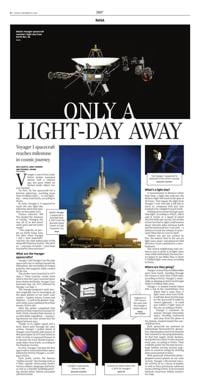
NASA's voyager 1 spacecraft is launched Sept. 5, 1977, from the Kennedy space Center at Cape Canaveral, Fla.

The Voyager 2 spacecraft is depicted in this artist's concept

NASA's Voyager spacecraft reached 1 light-day from Earth Nov. 18.
NASA
Voyager 1, one of two iconic NASA probes launched almost half a century ago, has gone where no human-made object has ever reached.
On Nov. 18, the spacecraft hit a historic milestone, reaching more than 16 billion miles — or one light-day — away from Earth, according to NASA.
Its twin, Voyager 2, is expected to reach the one light-day milestone about nine years later, in November 2035.
Science educator Bill Nye lauded the missions as having "changed the way all of us feel about outer space and our home world."
"The majority of people on Earth today were not alive when Voyager 1 and 2 were launched," said Nye, the chief ambassador to the nonprofit Planetary Society. "But all of us — everyone on Earth — have been touched by these missions."
What are the Voyager spacecrafts?
Voyager 1 and Voyager 2 are the only spacecraft ever to venture beyond the heliosphere, the vast bubble of charged particles and magnetic fields created by the sun.
The probes were launched in 1977 atop a Titan-Centaur rocket from what is now the Cape Canaveral Space Force Station in Florida. Voyager 2 was launched Aug. 20, 1977, followed by Voyager 1 on Sept. 5.
The Voyager program's main mission originally was to investigate all the giant planets of our outer solar system — Jupiter, Saturn, Uranus and Neptune — as well as the planets' magnetic fields and a combined 48 of their moons, NASA said.
After the probes completed that portion of their respective journeys by 1989, NASA retooled their mission as an interstellar expedition — journeying beyond our solar system into the region between stars.
Thanks to its higher speed and a more direct path through the solar system, Voyager 1 pulled ahead of Voyager 2 just months after launch. It flew past Jupiter in 1979 and Saturn in 1980. In 1998, it surpassed Pioneer 10 to become the most distant humanmade object from Earth, according to the Planetary Society.
In 2012, Voyager 1 became the first spacecraft to reach interstellar space, followed in 2018 by Voyager 2, according to NASA.
Each probe carries the famous "golden record," functioning both as a time capsule showcasing Earth's various cultures, languages and more, as well as a friendly Earthling greeting should either vehicle encounter extraterrestrials
What's a light-day?
A measurement of distance rather than time, a light-day indicates the distance light will travel in the span of 24 hours. That means the light from Voyager 1 now will take a full day to reach us, compared with just over 8 minutes for sunlight to reach Earth.
Nothing moves faster through space than light, according to NASA, which said it travels at a speed of about 186,000 miles per second. For an idea of how fast that is, light could traverse about 240,000 miles between Earth and the moon in about 1.3 seconds — a distance it took the Artemis II astronauts three days to cover in April.
"Before you get too excited by this, the nearest stars to the sun are light years away," astrophysicist Neil deGrasse Tyson cautioned in a Facebook post.
The closest neighboring solar system to ours is about 4.24 light-years away, while Andromeda, the next closest galaxy to our Milky Way, is about 2.5 million light-years away, according to NASA.
Where are they going?
Voyager 1 is more than 16 billion miles away from Earth, traveling through the cosmos at more than 37,800 mph, according to NASA. Voyager 2, meanwhile, is whizzing at about 34,000 mph while 13.4 billion miles away.
Voyager 1 is headed toward Gliese 445, a star in the constellation Ursa Minor that is more than 17 light-years away from Earth. It will take about 40,000 years for the spacecraft to make its closest approach — it could pass within 1.7 light-years of the star, according to NASA.
Voyager 2 continues its journey through interstellar space, traveling southward and away from the plane of the planets, headed toward the constellation Pavo.
Both spacecraft are powered by radioisotope thermoelectric generators, which produce electricity from the heat released by decaying plutonium. As that fuel supply slowly declines, each probe loses about 4 watts of power every year, according to NASA. Their available power has become increasingly limited, forcing mission engineers to conserve energy by shutting down nonessential systems.
Both spacecraft extensively photographed several planets in our solar system. Voyager 1 discovered volcanic activity on Io, a moon of Jupiter, as well as three previously unknown moons orbiting Saturn. It also revealed intricate structures within Saturn's icy rings.