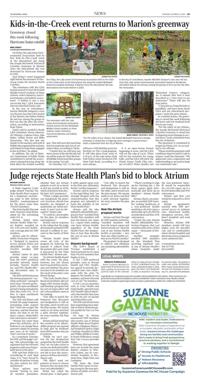
A Wake Superior Court judge denied Tuesday the State Health Plan's request for a temporary restraining order to halt Atrium Health's counterproposal for the plan's more than 750,000 members.
The State Health Plan and state Treasurer Brad Briner asked for the restraining order Oct. 8.
Atrium, which owns Atrium Health Wake Forest Baptist, unveiled on Oct. 6 its own 2027 healthcare coverage plan for SHP members.
Atrium said its Affordability Protection Program is "designed to preserve access, patient choice and affordability" for about 130,000 enrolled SHP members.
Atrium claims its plan provides lower co-pays than the SHP's preferred provider network, which includes Novant Health Inc. and UNC Health offering discounted rates to members.
The SHP said that because the Atrium proposal is "creating confusion" among its more than 750,000 participants, the open enrollment period is being extended by nine days from Oct. 30 to Nov. 8. Open enrollment began Monday.
The SHP and Briner said in their 148-page temporary restraining order request that "state law assigns the treasurer, and the treasurer alone, the duty to set the plan's copays, deductibles and coinsurance amounts."
"Atrium has never been given this authority, yet it believes it can change these amounts simply by posting new ones on its website. That's not how it works."
In a statement Tuesday, the SHP said the judge's ruling "did acknowledge our argument that the (Atrium) program could cause irreparable harm to the plan."
SHP said that while it is considering its next legal steps, it is "now forced to consider all options to keep the plan solvent for 2027 and beyond."
Those options may include "having to raise all member premiums, whether they are Atrium patients or not, by as much as $50 per month in 2028, which could more than double their 2027 premiums."
"When a single provider can manipulate the plan's cost structure, dictate how benefits are designed or undermine our tiered network, it won't just be disruptive," Briner said.
"It could be catastrophic for the plan, its members and taxpayers."
Atrium said in response to the ruling that the judge determined a potential SHP lawsuit is unlikely to succeed on the merits of their case.
"Atrium Health alone covers all costs of the program by reducing the amount it collects from the patient after each claim is processed by the State Health Plan," Atrium said.
"As Atrium Health shared with the court, the plan, however, has not shown how it reached that conclusion and whether the price increases to its members are the result of the plan's own flawed design.
"The State Health Plan's financial problems did not begin with Atrium Health, and blaming a program that has not yet taken effect will not solve problems years in the making.
"Our offer to match the Preferred Tier discounts and designation is still on the table, and it would save the Plan money. We remain ready to sit down and find a path forward together, for every member the Plan serves."
Atrium said last week that the creation of its affordability program was spurred in large part by feedback from SHP members who are its patients.
"While we can't control the tier designation assigned by the State Health Plan, we can take action to ensure our dedicated public servants across the state are not left to face the consequences of these decisions," Smoot said.
"We didn't want our patients to have to choose between the care team they trust and affordability."
Briner has called the Atrium plan "a shell game: it shifts agreed-upon costs to the Plan and, ultimately, North Carolina taxpayers."
Atrium said in response to the legal filing that "we strongly disagree with the characterization that this program was intended to harm the stability of the State Health Plan."
Atrium said the idea behind its affordability proposal is that "enrolled State Health Plan members will have the lowest cost-share (i.e., copay) when seeking care from Atrium Health, regardless of the State Health Plan's tier designation or how they describe the cost of care at Atrium Health."
Dispute background
The SHP's Board of Trustees established a tiered network for its more than 750,000 members that begins on Jan. 1.
A Tier 1 SHP preferred provider, such as Novant Health and UNC Health, has agreed to provide discounted rates and collaborate with the state "to improve the health of our members and lower the total cost of care" for members.
A Tier 2 access provider, such as Cone Health and Duke Health, agreed to have 2027 benefits almost identical to the benefits they have in 2026 for out-of-pocket and deductible costs.
The SHP and Atrium have been negotiating since midJuly on which Atrium hospitals qualify for Tier 1 or Tier 2 status.
On Sept. 18, Atrium announced SHP members who receive care at Atrium Health Wake Forest Baptist affiliates Alleghany Memorial Hospital in Sparta, Hugh Chatham Hospital in Elkin and Wilkes Medical Center in North Wilkesboro would have Tier 2 access provider status.
However, that agreement does not include the main Baptist campus in Winston-Salem, nor its community hospitals in Bermuda Run, High Point and Lexington.
"We share the State Health Plan's goal of staying strong for the next generation of public servants," Smoot said.
"Our offer to match the Preferred Tier discounts and designation is still on the table, and it would save the plan money. We remain ready to sit down and find a path forward together, for every member the plan serves."
How the Atrium proposal works
Atrium said that through its SHP member initiative, "enrolled members will have the lowest copays and lowest overall cost-share for care at any Atrium Health facility or provider — less than any other health system across North Carolina."
The program "is designed to address and eliminate any remaining affordability gap."
"There's nothing to sign up for. Starting Jan. 1, the lower copays apply automatically and show up on members' Atrium Health bills."
Atrium cited as an example, an enrolled SHP member seeking healthcare at a non-preferred facility would face a $1,000 copay, a deductible up to $5,000 for an individual and then 30% coinsurance.
"Under the new Atrium Health Affordability Protection Program, that cost would be reduced to a $400 copay — thousands of dollars less."
Another example: enrolled SHP members on the Standard Plan receiving inpatient care at one of Atrium Health's urban hospitals under the non-preferred benefit would be responsible for a $1,500 copay, up to a $5,000 deductible and 30% coinsurance.
Atrium said that cost would be reduced to a $500 copay.
Atrium agreements reached with SHP preserved access to primary care, behavioral health, emergency services, children's hospitals and rural hospitals.
However, Atrium SHP members would still face higher costs for specialty care and in communities where Atrium hospitals and physicians were assigned to a non-preferred tier.
rcraver@wsjournal.com 336-727-7376 @rcraverWSJ