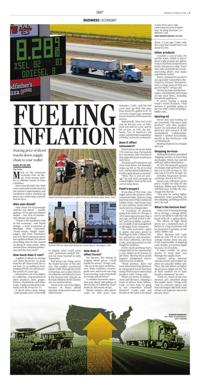


FUELING INFLATION
Soaring price of diesel travels down supply chain to your wallet
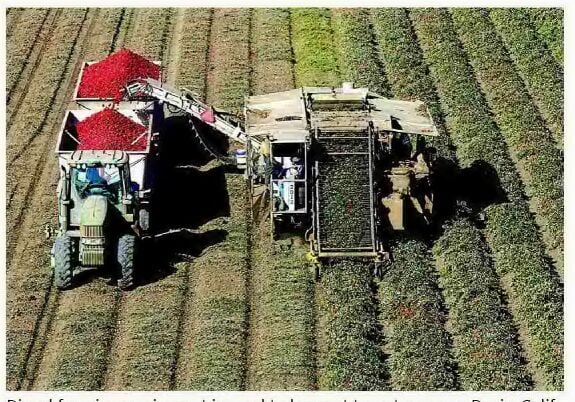
Diesel farming equipment is used to harvest tomatoes near Davis, Calif.
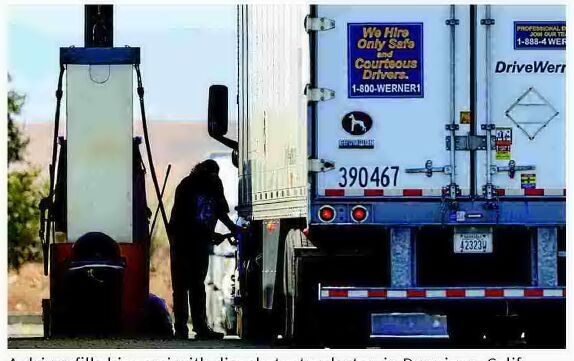
A driver fills his semi with diesel at a truck stop in Dunnigan, Calif.
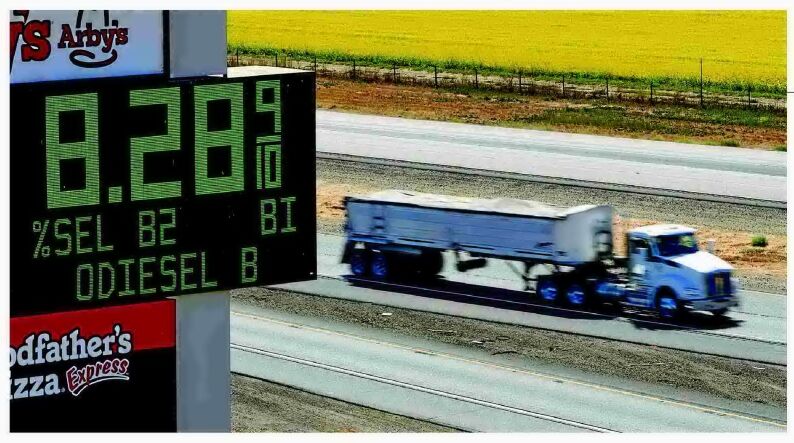
A semi drives past a sign advertising the price of diesel Sept. 28 along Interstate 5 in Williams, Calif.
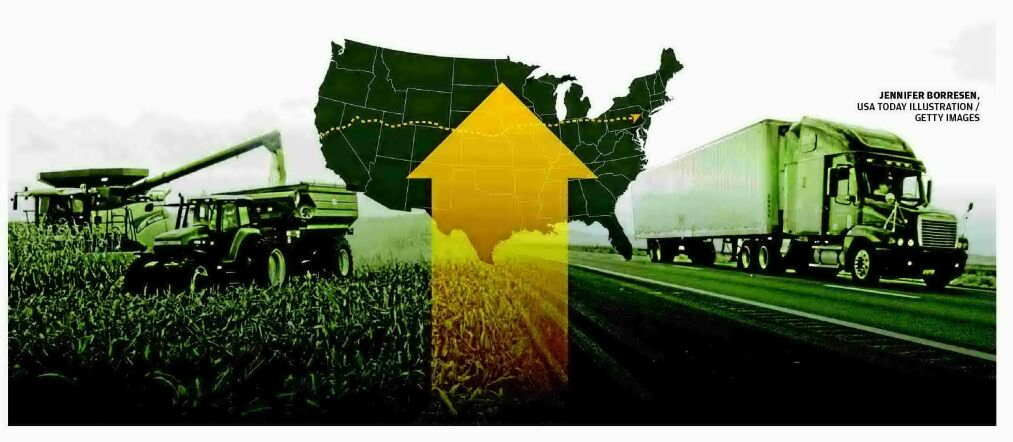
BUSINESS| ECONOMY
Much of the American economy runs on diesel, from tractor trailers to delivery trucks to farm combines.
Here's how the fuel's sky-high costs eventually trickle down to the nation's supermarkets and warehouse stores, pushing up prices on a wide range of goods and services.
Who uses diesel?
Only about 3% of passenger vehicles use diesel — mostly pickups, SUVs and used import sedans — but 76% of commercial vehicles use diesel.
"Diesel is the workhorse fuel of the economy," said David Ortega, a food economist at Michigan State University. "Semi-trucks, freight trains, barges, and farm machinery run on it. Most consumers never buy a gallon of diesel, but almost everything they do buy moved on diesel at some point, often several times, between production and the store shelf."
How much does it cost?
A gallon of diesel on average cost about $6.28 Oct. 13, down from the all-time record, $6.53, set Sept. 22, according to AAA, compared to $6.20 a month earlier and $3.65 a year ago.
Diesel prices are even higher in California, a top producer of dairy products, nuts, grapes, lettuce, strawberries and other crops. A gallon of diesel in California cost $8.39 on Oct. 13.
If diesel prices keep rising, "some pumps aren't even built to display what could come next," petroleum analyst Patrick De Haan tweeted in early September.
Fuel prices are rising across the board because of the Iran war. The conflict constricted tanker traffic through the Strait of Hormuz and seeded attacks on refineries and infrastructure in the Persian Gulf. Attacks on Russian refineries in the Ukraine war are another factor.
Diesel costs run even higher because of heavy global demand, steep excise taxes and other factors.
How does it affect farms?
For farmers, the timing of surging diesel prices "could hardly be worse," Ortega said. "We are in the heart of fall harvest, when combines, tractors, grain carts and trucks run long hours moving crops from fields to storage and elevators."
A combine harvester operation uses about 300 gallons of diesel a day. In California, that's about $2,500 worth of fuel.
Wayne Gularte, who grows crops on 600 acres near Gonzales, Calif., said his fuel costs were up 40% this year, from about $5 a gallon to $7. To cut costs, he put a gas-powered tractor from the 1950s back into service.
Nationwide, farm fuel costs rose by $18 per acre, or 82%, from last year for corn, and by $11 an acre, or 79%, for soybeans, two of America's top crops, said Michael Langemeier, a Purdue University economist.
Does it affect consumers?
Diesel prices are up by about 75% from last year. Fortunately for consumers, only a fraction of that spike will reach warehouses and stores.
The fuel used to transport and store food items, for example, makes up 4% to 7% of its total cost, said Bernhard Dalheimer, a Purdue agricultural economist.
"Now, this is just an average," he said. Fuel can make up a much higher share of the total cost of some items.
Food transport
If you dine at Five Guys, you might notice the potatoes often come from Idaho. Idaho is a long way from most of the continental United States, and trucks have to carry potatoes many miles to reach your local burger joint.
"A truckload of potatoes going from Idaho to Chicago is 40% more expensive now than a year ago, and half of that is diesel," said Jason Miller, a professor of supply chain management at Michigan State University.
The same economics apply to apples and pears grown in Washington State's Yakima Valley, and lettuce and strawberries from California, said Dean Croke, principal analyst at DAT Freight & Analytics.
Pretty much anything that's refrigerated at the supermarket is also chilled on its journey to get there. Moving those goods requires refrigerated trucks, which use lots of diesel.
"Fresh produce, dairy and meat often travel long distances in refrigerated trucks that burn energy both to move and to keep products cold," Ortega said.
When you factor in refrigeration and distance, shipping a truck of lettuce from Salinas, Calif., to New York "is going to run somewhere around $10,000," Croke said, and $4,200 of the total is for diesel alone. A year ago, Croke said, the same fuel would have cost about $2,700.
Other products
Consider a case of soda. It's mostly water, which is heavy: about eight pounds per gallon. Soda is relatively inexpensive to bottle, but pricey to ship. That's why soda companies have manufacturing plants near major population centers.
Heavy, inexpensive products are especially vulnerable to diesel prices, because "transportation is a large share of what you pay for them," Ortega said.
The list includes bottled beverages, canned goods and a range of non-food items, including household appliances.
If you're buying a dump truck's worth of mulch, "that nursery is probably going to hit you with a fuel surcharge," Miller said.
Heating oil
Diesel fuel and heating oil are essentially "the exact same product," said Alex Jacquez, senior vice president of policy, advocacy and research at the Groundwork Collaborative. Almost 5 million households, mostly in the Northeast, still use heating oil.
Heating oil prices rose sharply this year.
Shipping services
Spiking diesel prices prompted shipping services to boost fuel surcharges, which rise and fall with per-gallon diesel prices.
At UPS, the domestic ground surcharge crept up from 25% on July 6 to 29.25% on Sept. 21. The rate rose to 30.25% on Sept. 28.
At FedEx, the ground-service surcharge stood at 28.75%.
Diesel costs will drive up the prices of gifts we ship for the holidays, Miller said. Retailers will find ways to bake the surcharge into the tab.
"You may be seeing higher minimum-order quantities for free shipping, and things of that sort," he said.
What's the bottom line?
Unless you're buying heating oil or driving a vintage BMW, you're not likely to take the full brunt of $6.28-a-gallon diesel.
The effects of high diesel prices on a clamshell pack of lettuce or a bag of potatoes will be measured in pennies on the dollar, Miller said.
Why? Because fuel costs make up only 5% or so of the average sticker price you pay at the supermarket. If shipping costs double, a $1 potato might become a $1.05 potato.
It takes months for price shocks to work their way through the supply chain.
Contract prices between manufacturers and retailers are often set annually, Miller said. Thus, the full effects of higher diesel prices might not hit "for at least another six to nine months, minimum," he said.
"Early on, much of the cost increase gets absorbed along the supply chain," Ortega said. "But as contracts reprice and fuel surcharges take hold, more of that cost makes its way to the grocery store."