

Hands-on deck experıence
On US aircraft carrier, young sailors adjust to conflict with Iran

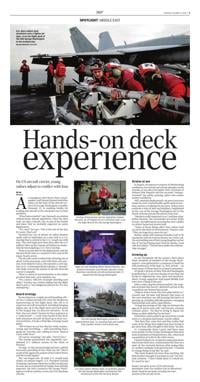
U.S. Navy sailors load munitions onto a fighter jet Sept. 11 on the flight deck of the USS George Washington in the Arabian Sea.

Aviation Ordnanceman Airman Apprentice Damon Dennard, 23, of Virginia sits on a munition Sept. 11 on the flight deck of the USS George Washington.

Night Aircraft Handling Officer Breana Royston, AE1 Andrew Schmucker, and elevator operator Araya Klockman coordinate aircraft positioning Sept. 13 aboard the USS George Washington.

The USS George Washington conducts a replenishment Sept. 14, receiving food and supplies from another vessel in the Arabian Sea.

U.S. Navy sailors attend a Sept. 12 ceremony aboard the USS George Washington marking the 25th anniversary of the 9/11 terrorist attacks.
SPOTLIGHT| MIDDLE EAST
An emergency alert blares from a loud-speaker, and Damon Dennard and other sailors on the deck of the aircraft carrier USS George Washington scramble. Dennard, 23, is readying bombs for loading onto aircraft as his crewmates race to their positions.
"It has been eventful," says Dennard, an aviation ordnanceman airman apprentice. Once the alert ends, he takes a breath, sits on one of the bombs and jokes that he probably expected an easier deployment.
"It's crazy," he says, "but at the end of the day, it's work. That's all."
Dennard was one of dozens of sailors Reuters spoke with in September on a rare visit to a U.S. warship that is central to the U.S.-Israeli war with Iran. The visit began just three days after the U.S. military blew up five Iranian oil tankers in retaliation for Iran targeting a U.S. Navy warship.
There is no end date for the deployment, and the mission itself came as a surprise to the crew of the Japan-based carrier.
The aircraft carrier is effectively a floating city of about 5,000 personnel, each with their own mission, from Majesta Ochoa, who operates a cash register, to Lt.Commander Brody Samaha, a "shooter" who helps oversee the launch of aircraft from the carrier's catapults.
There's a sense of synchronization as the sailors go about their jobs, crew members say.
"It's a dance, with lots of people checking each other," Samaha says, before adding that the flight deck is also a "very dangerous place to be. It's very unforgiving."
Board strategy
Breana Royston, a night aircraft handling officer has a unique perspective over the dangerous maneuvering on the flight deck. Her job is to supervise aircraft movement, including bringing fighter jets up to the flight deck and back down to the hangar bay via massive elevators. To do that, she uses what's known in Navy parlance as a "ouija board" — a real-time model of the deck, with miniature aircraft all lined up in their current positions. It looks a little like a strategy board game.
"We've been on our toes the last week, maneuvering and everything — with everything that's going on," Royston says, adding it's been "kind of crazy, really busy."
"It's nerve-wracking," she adds, "but it's fun."
The Iranian government has repeatedly condemned U.S. military actions in the Strait of Hormuz.
On Sept. 25, the Iranian foreign minister said the insecurity prevailing in the strait was the "direct result of the aggressive actions of the United States and the Israeli regime."
The war began Feb. 28 with U.S.-Israeli joint strikes on Iranian targets. U.S. President Donald Trump has said many times the conflict would soon be over, but as it persisted for longer than initially expected, the Navy turned to the George Washington to relieve another carrier, the USS Abraham Lincoln.
Strains at sea
In August, in response to reports of deteriorating conditions, low morale and suicide attempts on the Lincoln, at sea since November 2025, Secretary of Defense Pete Hegseth said the accounts "misrepresented" the reality, praising sailors who endure austere conditions.
Still, extended deployments can pose enormous strain on crews' mental health, particularly in wartime, and are a challenge for any navy. Sailors must maintain a state of alert and readiness, heightened in the case of the George Washington due to the threat of drone and missile attacks from Iran.
"Morale is really important to us," said Rear Adm. Jeffrey Heames, the commander of Carrier Strike Group 5. He talked about ensuring the crew's ability to contact home and receive mail.
"Some of those things affect how sailors hold up out in this kind of environment," Heames said. "They are huge focus areas for me."
Reuters spoke with Seaman Deandre Cook as he checked in with his wife back home on a video call. She was holding one of their young daughters on her hip. It was hard being away from his family, Cook said, but added: "The distance makes the relationship stronger."
Growing up
As jets thundered off the carrier's deck above them, hundreds of members of the George Washington's crew gathered for a ceremony to mark the 25th anniversary of the Sept. 11, 2001 attacks — an event many of them were too young to remember.
Al Qaeda's attacks on New York and Washington propelled the U.S. into two decades of war that sent troops to Afghanistan, Iraq, Syria and elsewhere. Many Trump supporters had hoped Middle East wars were a thing of the past.
After a sailor sang the national anthem, the chaplain on board, Ben Garrett, delivered a prayer as the assembled crew bowed their heads.
"Help us honor those who have gone before us," Garrett said. He later told Reuters that many of the crew members are still learning the basics of growing up, including skills like patience, managing relationships and career expectations.
"A huge percentage of this ship are between the ages of 19 and 24 years old," said Garrett, a Roman Catholic priest. "So they're trying to figure out being an adult while they're out here."
Sometimes sailors enlist to get away from a small town or a situation back home, Garrett added.
"But then they come here and they realize that some of the things they might have been trying to get away from, they brought it with them," he said.
Lt.Commander Brian Lasley said there were more people on the George Washington than back in his hometown of Fredericktown, Mo., which had a population of 4,429 in the 2020 census.
Camren Pollard, 24, an interior communications electrician third class, said he joined the Navy in a spur-of-the-moment decision after seeing older co-workers unhappy in his previous job. "I wanted to change things in my life," he said.
"My mom freaked out more than anything. My little brother thought it was kind of cool." For Pollard, however, "I don't think about it a whole lot. It's work for me."
Reuters was given access to the USS George Washington under the condition that no operational details would be disclosed, including the exact location of the aircraft carrier.