
True to you
Homeowners are rejecting picture-perfect rooms. Designers offer advice for making it personal
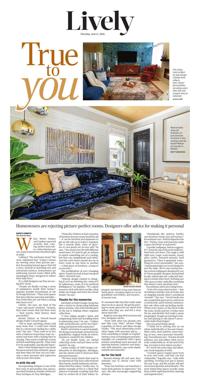
Designer Joel Baird's living room features family pieces, including original art by his grandfather and children, and souvenirs of favorite trips.
Neutral walls show off dramatic art and textured furniture in this striking room by Rachel Nelson of Concetti in Detroit.
This living room project by GHK Design Collaborative reflects their clients' personalities, including colors they love and artwork they've collected.
When Better Homes and Gardens reported recently that cata-log-perfect and cook-ie-cutter interiors are out, many homeowners breathed sighs of relief.
Calling it "the real home trend," the story explained that "today's homes are moving away from picture-perfect decorating toward spaces that tell a story. Instead of matching sets and untouched surfaces, homeowners are embracing layered rooms filled with meaningful items designed to reflect their daily lives."
It's a shift designers say they are seeing first-hand.
"People are finally craving a sense of uniqueness inside their homes," explains Jennifer Kasselmann of Art by Design Interiors. "They want spaces that feel collected, personal and reflective of who they are, not what a catalog tells them to be."
Clients, she says, are tired of the "copy-and-paste" aesthetic. "Instead, they want rooms that tell their story — their travels, their history, their personality."
Rachel Nelson of Detroit-based design studio Concetti agrees.
"We've been watching clients pull away from that 'I could have found this in a showroom' feeling for a while now," she says. "They come to us less with a Pinterest board they want recreated and more with a feeling they're chasing. They want to walk into a room and feel something specific. They want it to be undeniably, specifically them."
Here's what design experts say about the move toward more authentic spaces and their ideas for how you can cultivate a more personal and expressive style in your own home.
In with the old
Incorporating antiques is one of the best ways to personalize your spaces, says Brad Stanwick, founder of Parson's Nose Antiques in Troy, Michigan.
"Honestly, I believe at least one piece of furniture in every room should be old — it can be involved and expensive to get an old sofa up to today's standard, but a console table, chest of drawers or case goods are an easy add," he says. "You need to be OK with different wood tones; it's hard to get an antique to match something out of a catalog, but they can complement each other. And the color black should also be in every room in one form or another — a dark piece of furniture, a lamp or accessories."
The proliferation of ever-changing micro-trends has had at least one good effect, Stanwick says.
"Interior design content is changing at such an alarming rate, some of it by influencers, some of it by (artificial intelligence)," he explains. "It's a great reason to stick with what you like, what makes you happy and worry less about trends," he says.
Thanks for the memories
Joel Baird of Baird Design Group has seen a return to showcasing heirloom pieces at home. One of his favorite parts of the job is helping others organize collections.
"I love taking people's items and categorizing them and installing them in interesting ways," he says. "Gallery walls and bookcases can be very interesting and layered with memories."
Baird's own home is a good example. His living room includes artwork by his grandfather, original works by artists, and pieces created by his children.
"In our family room, we started collecting clocks and put them on the mantel," he says.
Lauren Guidry of GHK Design Collaborative in Birmingham, Michigan, says her clients want to showcase their personal treasures.
"We have many clients that want to incorporate art they have collected from their travels, family heirlooms and furniture that they adore," Guidry says. "A perfect example of this is a client that asked us to include a rocking chair that they've rocked all of their babies in.
It's moments like that that really make what we do so special. We get the privilege to create spaces for our clients that reflect who they are, and tell a story about their life."
Begin by assessing what you have and love, designers advise.
"Start with what you already own and take your time," advises Paige Loperfido of Décor and More Design Studio. "The most interesting rooms often begin with personal pieces. … Even something as simple as reupholstering a chair or framing personal photography can completely shift a space toward something more personal. By layering textures, patterns and materials with intention, you create depth, warmth and character."
Go for the bold
Beyond mixing old and new, Kasselmann says to choose color with intention.
"Even one bold hue can transform a room from generic to expressive," she says. She also encourages supporting artisans.
"Handmade tile, pottery, textiles and furniture bring soul and texture," Kasselmann says. And let imperfection live: "Patina, wear and character make a space feel lived-in and loved."
Consider wallpaper, Nelson suggests. It's "honestly one of the most underutilized tools out there. The range is wild right now. Large-scale murals, classic grass cloths, textured naturals, bold geometrics. There is genuinely something for every personality," she says. "And people forget you're not limited to just the walls. We've also started having custom wallpapers designed by our in-house graphic designer and printed locally, which takes the 'collected' feeling to a whole other level. Nothing says 'this space is mine' quite like something that doesn't exist anywhere else."
Kasselmann advocates being brave.
"A lot of it comes down to fear — fear of making a mistake, fear of resale, fear of stepping outside what's considered 'normal,'" she says. "Social media has also created this pressure to conform to a certain look, and it rewards sameness. But safe often ends up feeling sterile. When every home on the block looks the same, inside and out, it strips away the joy and identity that make a space meaningful. People are starting to realize that playing it safe doesn't necessarily make them happy."
She sees good things ahead.
"I think we're moving into an era where individuality is the new luxury. More color, more pattern, more mixing of eras, more personal storytelling," Kasselmann says. "A home should embrace you and reflect what you're truly comfortable in. At the end of the day, you have to love where you live."
It's worth the extra time and effort, says Susie Kapadia of GHK.
"Curated spaces require more trust in your own taste, and that can feel vulnerable," Kapadia says. "Like with anything, trusting your gut is always the way to go, and the results will feel much more genuine and authentic. The most interesting spaces usually come from a little experimentation, layering and imperfection."