

FLYING HIGH, LOW RISK
Study looks at dangers of flight compared to other daily activities
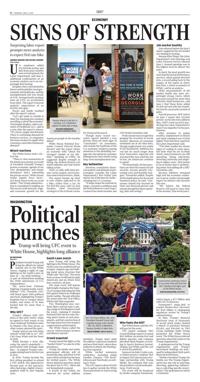
Alaska Airlines planes are seen May 12, 2025, at Seattle-Tacoma International Airport in SeaTac, Wash.
AIR TRAVEL SAFETY
If you're worried about flying on a plane, you've probably heard this statistic before: It's safer than driving in a car.
But you may not have heard these: The risk of fatal injury during a commercial flight in the U.S. is significantly lower than the risk associated with scuba diving, running a marathon or even drowning during a bath.
Those findings come from a study researchers at Embry-Riddle Aeronautical University published May 28. It analyzed data over the last decade to compare the risk associated with commercial air travel in the U.S. to the risk of everyday activities, such as going to work or recreation.
Fatal aviation incidents are rare, but because they are highly publicized and touch on fears of flying, the traveling public can't accurately assess the risk, said Mihhail Berezovski, an associate professor of mathematical sciences at Embry-Riddle and the study's lead author.
The low number of fatal crashes also makes it a difficult statistical problem, Berezovski said. A year with zero aviation-related deaths does not mean there is zero risk in flying, and one crash with dozens of fatalities can significantly shift the data.
Recent incidents
The study wasn't inspired by recent tragedies, Berezovski said, but the deadly collision between an American Airlines passenger plane and a U.S. Army Black Hawk helicopter in Washington, D.C., last year led the researchers to ask if the risk level of flying changed.
That followed a midair panel blowout on an Alaska Airlines Boeing plane in January 2024. In 2018 and 2019, two fatal 737 MAX crashes in Indonesia and Ethiopia led to scrutiny of the safety of flying.
The Embry-Riddle Center receives funding from Boeing but operates as an independent organization, university representatives said. Boeing and other aviation industry stakeholders did not participate in the study.
Robert Sumwalt, executive director for the Embry-Riddle Center and former chair of the National Transportation Safety Board, said media attention on the aviation industry added to the perception that aircraft catastrophes are more common than they are.
He was a source of media coverage of recent aviation accidents, including an Air India 787 crash last year that killed 260 people.
"We are often asked by the media and by the traveling public, 'What's going on? Is flying still safe?'" Sumwalt said at the news conference. "We wanted to have our own study … to show there's no major anomalies."
The metrics
The study aimed to measure risk with several metrics a person may intuitively use to define their risk tolerance, mainly how risky is a trip, and how much risk accumulates over an extended time period?
It measured risk per passenger mile traveled, per trip and per hour of exposure, as well as annual risk of fatal injury and lifetime odds of death. The report included data from 2016 to 2025, with some data sets ending in 2023 and 2024.
It found the risk associated with commercial aviation is much lower than that of many recreational activities. A day of skiing, for example, was 73 times more risky than boarding a commercial aircraft. Running a marathon was 200 times riskier, and climbing Mount Everest was 1 million times more dangerous.
The risk of a fatal aircraft accident was much lower than other deadly hazards an individual may encounter in day-to-day life, including being bitten by a dog, stung by a hornet or struck by lightning.Commercial aviation was also less risky than some occupations, such as logging, farming or police duty.
"Boarding a U.S.commercial aircraft is among the least dangerous discrete activities an individual can undertake," the authors wrote.
Commercial aviation had a fatality rate of 1.1 deaths per 100 billion miles traveled, while a highway bus had a fatality rate of 9.9 per 100 billion miles. Lightduty vehicles, which include most cars, SUVs and pickup trucks, had a fatality rate of 6.9 per 1 billion miles.
Accident, fatality rates
A 2024 Massachusetts Institute of Technology study found the risk of fatality from commercial air travel decreased — from 1 per 350,000 boardings globally between 1968 and 1977 to 1 per 7.9 million boardings between 2008 and 2017, to 1 per every 13.7 million boardings between 2018 and 2022.
The trade group International Air Transport Association similarly found the number of aircraft accidents recently decreased. However, the number of fatal accidents and the fatality risk increased, according to it annual safety report published in March.
There were 51 accidents last year among 38.7 million flights, compared to 54 accidents in 2024 among 37.9 million flights. Both years were higher than the fiveyear average of 44 accidents.
There were eight fatal accidents globally in 2025, compared to seven in 2024 and a five-year average of six fatal accidents.