
SIGNS OF STRENGTH
Surprising labor report prompts more analysts to expect Fed rate hike
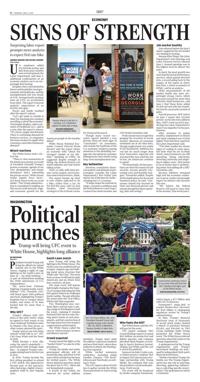
People attend a job fair in Georgia. U.S. employers added 172,000 jobs in May.
ECONOMY
U.S. employers added 172,000 jobs in May, and data from prior months were revised upward, the Labor Department said June 5, additional confirmation of an economy analysts say is on surprisingly firm footing.
Job gains were concentrated in leisure and hospitality, local government and healthcare, and the unemployment rate was steady at 4.3%. Average hourly earnings were up 0.3%, an acceleration from April. The report trounced analysts' expectations of an 85,000-jobs gain.
Stocks and bonds tumbled after the report's release.
"Let's get ready to rumble is what the shocking jobs numbers are telling us about the economy," Christopher Rupkey, chief economist of FwdBonds LLC, said in a note after the report's release. "It's classic supply and demand. There is continuing demand for business services, so companies hire more workers to supply what consumers and other businesses demand."
Mixed reactions
The White House took a victory lap. "There is clear momentum in the American economy as a result of President (Donald) Trump's proven economic agenda of tax cuts, deregulation, and energy abundance that's unleashing the private sector," White House Senior Deputy Press Secretary Kush Desai wrote on social media. "The Trump administration is committed to building on this success with more job, wage, and economic growth for the American people in the months ahead."
White House National Economic Council Director Kevin Hassett said the report shows an economy with "about the strongest market of my lifetime." Speaking on CNBC, he suggested despite strength in hiring, the Federal Reserve can watch inflation and wait before taking action.
That's at odds with what private-sector analysts, not to mention some bond investors, think.
The report bumps up what is now widely expected to be a hike, rather than a cut, by the Fed this year, said Liz Ann Sonders, chief investment strategist at the Schwab Center for Financial Research. Though many recent economic reports painted a rosy picture, there are some signs of "constraints" on consumers, who remain the backbone of the U.S. economy. Sonders is paying attention to the dwindling savings rate, the uptick in consumer delinquencies and a slowly rising long-term unemployment rate.
Key bellwether
Investors, economists, financial analysts and all kinds of policymakers consider the Labor Department's first-Friday jobs report one of the keys for understanding the U.S. economy.
"It helps shape the outlook for wages, consumer confidence and the Federal Reserve's next steps," ConnectOne Bank Founder and CEO Frank Sorrentino said. Professionals had a tough time gauging the economy in recent months. Measures of consumer sentiment are at all-time lows, though employment was stable if not blockbuster. Inflation has run hot for much longer than most forecasters expected and worsened this year amid the war in Iran, yet Americans continue to spend.
"For households, the key questions are what this means for job security, income growth, borrowing costs and monthly budgets," Sorrentino added. Despite all the implications for fiscal and monetary policy, he said, "consumers should stay focused on their own financial picture and remain thoughtful about spending, debt and savings."
Job market healthy
Data released before the June 5 report suggested the job market was finding its footing.
Among other things, the Labor Department's Job Openings and Labor Turnover Survey, released June 2, showed openings rose to the highest level in almost two years.
In April, the most growth was seen in professional and business services, which gained 668,000 jobs, a record going back to the origins of the report in 2000, Ken Kim, a senior economist at KPMG, said in an analysis.
Other measurements of job market health also were surprisingly strong. Gusto, which processes payroll for more than 500,000 small businesses, said June 2 that those firms added 83,900 net new jobs last month, the fourth consecutive month of gains.
Payroll processor ADP said in its June 3 report that 122,000 private-sector jobs were added in May. ADP's track record in predicting the Labor Department's report was imperfect in the past, however.
After revisions to earlier months, employment in March and April combined was 93,000 higher than had been reported, the Labor Department said.
"The labor market has shown signs of cooling in some areas, but from what we see on Main Street, many businesses are still operating, hiring selectively, investing cautiously and adapting to higher costs. That points to an economy that is moderating rather than falling off a cliff," Sorrentino said.
Because inflation remained high and the economy continues to grow, traders increasingly expect an interest rate increase this year.
"We believe the Federal Reserve will need to raise rates in the autumn," Kim wrote June 2.