

How western North Carolina's economy progressed from the American Revolution to now
A year after the American War of Independence started, Congress signed the Declaration of Independence on July 4, 1776.
It took another seven years before the war officially ended and the original 13 colonies became the United States of America.
Winning independence meant the new country had to go it alone, including economically.
At the time, North Carolina was agrarian, but what sustained its economy could depend on the region of the state, much like today.
Western North Carolina economy in 1700s
Like most of North Carolina, the western part of the state started with a farming economy, and a big component of farming was based mainly on forestry, said Mike Walden, Ph.D., a retired professor of economics at N.C. State University and Reynolds Distinguished Professor Emeritus.
Pine trees were the key lumber in the state. The state was known for pine trees, he said.
And the lumber harvested was used for warships and sailing ships, Walden said. As the state developed and population and housing grew, the trees were also used in construction. Lumber was the major component of building prior to the 20th century, when concrete and other materials began to be used, Walden said.
The access to lumber also played a large role in the region’s production of furniture in the late 19th and early 20th centuries, Walden said.
Enter the link between access to lumber, manufacturing textiles and furniture and the ability to create cheap power with the creeks and rivers, along with farming. That combined to power western North Carolina’s economy for 100 years, Walden said.
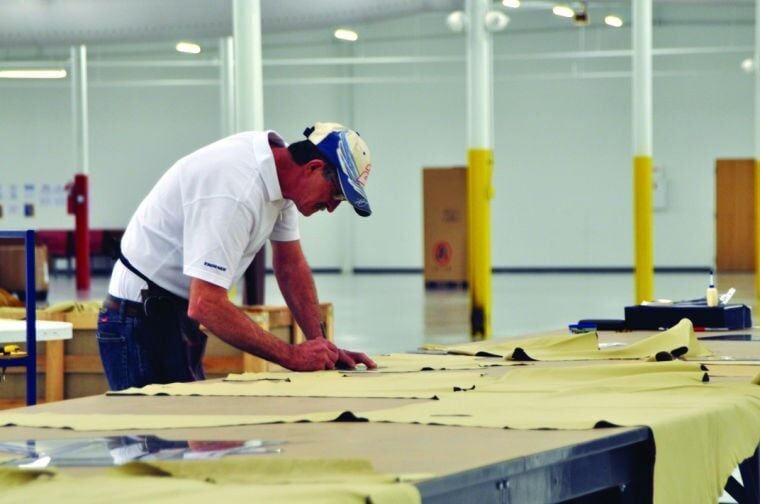
In this 2012 photo, Harley Cooke measures and cuts upholstery for sofas at Ekornes production facility on Wamsutta Mill Road in Morganton. Furniture has played a large part of the economy in western North Carolina since the turn of the 20th century.
Henry River Manufacturing Company in the Hildebran area of Burke County, commonly known as Henry River Mill, is a primary example of that. The textile mill started just after the turn of the 20th century and produced its own power with a dam until it later switched to power from the grid.
Railroad
The next major development in the economy of western North Carolina was the arrival of the railroad.
Walden said the railroad in western North Carolina helped send lumber to buyers outside the region and allowed more people and businesses to easily reach the region. Asheville exploded as a city and became the hub of a new “mountain region,” he said.
Walden said rail travel was major for the western part of the state, which was inaccessible if people were traveling from the major population centers in the state. People living in the 19th century had a long way to go to get to western North Carolina, but then along came the railroad. It made access to the foothills and mountains much easier, he said.
“So I think that was the final technological change that helped western North Carolina grow,” Walden said.
As the state moved into the 20th century, the economy and personal income allowed the average person to take vacations, Walden said.
Walden said people, particularly in the South, would look for somewhere a little cooler in the summer. North Carolina was a key in that, and the railroad provided access to the foothills and mountains, he said.
Further into the 20th century, highway access caused western North Carolina, centered around the Asheville and Hickory areas, to take off and boom, Walden said.
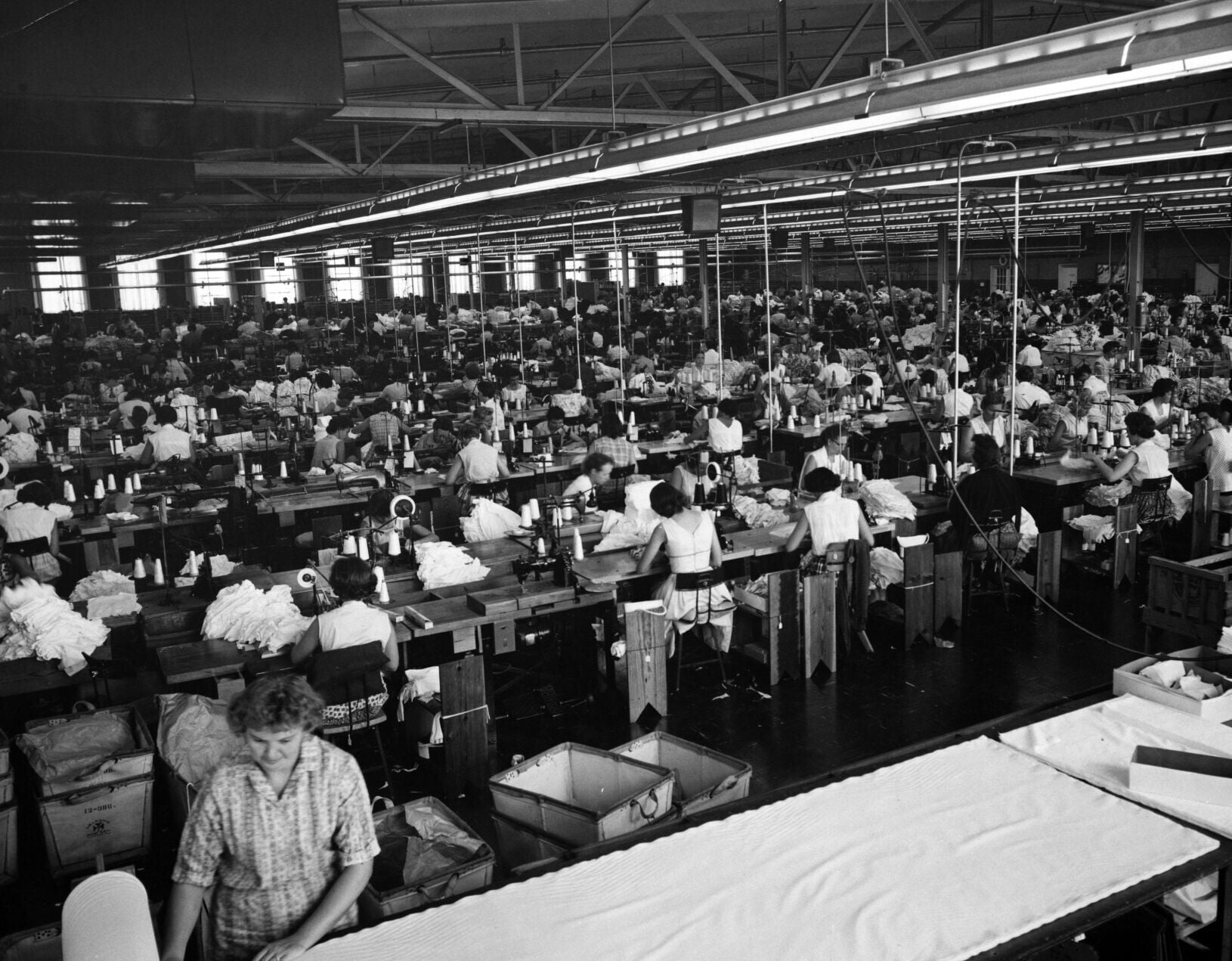
The “Dignity of Work” was an exhibition of the Workers’ Legacy Project in 2022 that featured photos of furniture, textile and hosiery mill workers in Burke County, along with video histories and artifacts. Textiles have been a large part of the economy of western North Carolina since around the turn of the 20th century.
Passenger rail in the region ended in 1975. However, Amtrak and the North Carolina Department of Transportation are proposing bringing back passenger rail between Salisbury and Asheville, with stops in between, including in Morganton.
Tourism
As western North Carolina moved into the 20th century and income grew for the average person, more people were able to take vacations, Walden said. And people in the south were looking for something a little cooler.
With railroad access, that meant more people visiting the foothills and mountains of North Carolina, Walden said.
The first railroad came through Hickory around 1859, according to Britannica. While work on the railroad to Morganton started around the same time, it was halted because of the Civil War. After the war, work on the line resumed and Morganton got its depot in 1870, according to the History Museum of Burke County.
The line reached Old Fort in McDowell County by 1869, according to the museum.
It wasn’t until 1880 that the line reached the city of Asheville to what is now known as Biltmore Village, according to the North Carolina Arboretum.
Walden said even though we face some economic challenges in the country, people still want to take vacations and western North Carolina still draws people in for its beauty, nature and cooler temperatures.
In 2025, North Carolina saw record tourism spending of more than $37.2 billion, according to the state.
Walden said areas used to attracting tourists are in danger of becoming homogenized. He said the country has already become much more homogenized in air and interstate travel. He said he expects the things that make western North Carolina stand out will not be as great in the future because it is becoming homogenized with things like the same stores, restaurants and shops.
He said even over the last 20 years, he can see how things have become similar everywhere he goes.
“I like going to another city where it's very different,” Walden said. “You got different restaurants, etc. You can still see that, but you don't see it as much as you used to.”
Walden said he thinks western North Carolina still stands out as somewhere very different than the rest of the state and it still has special features.

Pictured is the Eastern white pine (Pinus strobus). Pines were a commodity in western North Carolina in the early part of the country's birth.
“But I'm just trying to articulate, I just don't think they'll be as unique or as much of it will be as unique as it was in the past,” Walden said.
Modern economy
Western North Carolina is in touch with the modern economy, Walden said.
He said Hickory now has a very strong technology sector and has for a couple of decades. It is home to some commodities that are very important to technology throughout the world.
The western portion of the state has large data centers, with Apple in Catawba County, Google in Caldwell County and Meta in Rutherford County. Microsoft is planning four data centers in Catawba County.
In addition, Walden said Spruce Pine, in Mitchell County, has the largest natural pure silicon mine in the world.
Z2Data, an information systems company in California, said two mines in Spruce Pine produce 70-90% of the world's high-purity quartz for semiconductors. It says quartz is a key part of the manufacturing process for semiconductor chips used in industrial and commercial technology, including laptops, smartphones, industrial robots and 5G network infrastructure.
Walden said western North Carolina is also home to another commodity pertinent to our current economy: lithium, used in the production of batteries for electric vehicles, he said.
AI
You can’t do a simple search on the internet without AI making suggestions. It is fast becoming a part of a lot of people’s everyday lives.
Walden said he believes AI will affect the economy in two ways, one good and one potentially bad.
The positive side of AI, Walden believes, is going to be improved productivity, meaning things will be made faster, quicker and cheaper.
And usually the economy does well, and people do well, when productivity is rising, he said.
The potential negative side of AI is its impact on the job market.
Walden said there are going to be some jobs that are going to be eliminated for people and will be done by AI.
There could be other jobs where people will pair up with AI and maybe even get better salaries, because they would be more productive, he said.
Walden said that AI will likely create some completely new jobs that don’t currently exist.
“We really don't know what the mix of those three components will be,” Walden said. “My tendency is to think that probably AI is going to be a net plus, even for the labor market, but it will require people, a lot of people, potentially, to get retrained.”
He said it will require universities and community colleges to likely change some of their teaching.
“I taught at N.C. State for 43 years and retired now, but I can see where a lot of the programs at N.C. State will likely have to be altered in some way to include AI,” Walden said.