
THE PRICE OF FREE SPEECH
Settlements pile up after shooting death of activist Charlie Kirk
Kirk
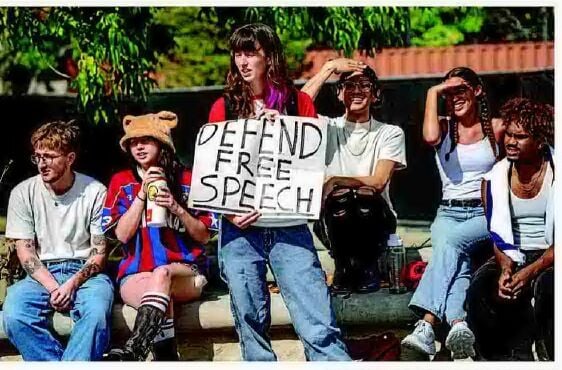
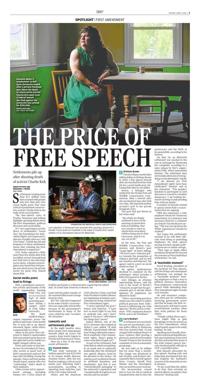
Students participate in a demonstration supporting free speech sept. 24 at Ball state university in Muncie, Ind.

Larry Bushart, a Tennessee man arrested after posting a picture of a Donald Trump quote on Facebook in the wake of Charlie Kirk's death, settled a First amendment lawsuit for $850,000.

Suzanne Swierc's employment at Ball State University ended after a private Facebook post about the death of conservative activist Charlie Kirk went viral. A federal lawsuit she filed against the university was settled for $225,000.
SPOTLIGHT| FIRST AMENDMENT
Settlements totaling more than $1.5 million have been reached with people who lost their jobs over social media posts that were critical of prominent conservative activist Charlie Kirk in the wake of his assassination.
The free-speech cases in Florida, Tennessee and Indiana highlight a growing debate about the First Amendment, political discourse and social media.
It's "not surprising to see this flurry of settlements," Aaron Terr, the Foundation for Individual Rights and Expression's director of public advocacy, told USA Today. "I think the size and frequency of these settlements shows that violating the First Amendment is expensive."
USA Today reported a little more than two weeks after Kirk was killed, at least 50 people had lost their jobs in the education sector alone. A Reuters investigation also found that 600 people were fired across the private sector for posts they shared about Kirk.
Social media posts lead to firings
Kirk, a prominent conservative activist and founder of the youth organization Turning Point USA, was assassinated Sept. 10 while answering questions during a campus event at Utah Valley University.
His death sparked impassioned responses across the political spectrum. Some lauded the 31-year-old as an almost messianic figure, while others compared him to a Nazi.
Many of the posts that criticized or failed to memorialize Kirk were picked up by those on the right and used as fodder in a highly charged culture war.
Front and center in that battle was Vice President JD Vance, who served as guest host of Kirk's eponymous podcast five days after his killing. During the episode, Vance said that people should report anyone who was "celebrating" Kirk's death to their employer.
Other events led to speechbased outrage, including Hamas' Oct. 7, 2023, attack on Israel and the police murder of the unarmed Black man George Floyd in 2020.
But Terr said what happened in the wake of Kirk's assassination was especially noteworthy because of the government's involvement in many of the cases, which he said, "escalates the situation."
Lawsuits and settlements pile up
In the eight months since Kirk's death, First Amendment lawsuits piled up across the country, from South Dakota to Florida and Tennessee to Texas.
Here are a few of the most recent settlements:
1 Suzanne Swierc
Ball State University in Indiana agreed to pay $225,000 to its former health director, Suzanne Swierc, after she was fired for making a critical social media post following Kirk's assassination, according to reporting from IndyStar, part of the USA Today Network.
Swierc and the American Civil Liberties Union sued Ball State President Geoffrey Mearns last September in federal court, claiming her firing violated her First Amendment rights.
"I never regretted the post," Swierc told IndyStar. "I have just as much right to say that as anybody else, and I don't regret it because I still believe the things that I wrote."
Joshua Bleisch, one of the ACLU attorneys who worked on Swierc's case, added, "If state officials, if government officials aren't being sufficiently respectful of somebody's First Amendment rights, there's going to come some kind of legal cost."
As part of the settlement, Ball State did not admit wrongdoing. In an email sent to university leadership after the settlement was agreed, Mearns stood by his decision to fire Swierc. He said her post resulted in threats to withhold donations and enrollment, and that it was "extraordinarily damaging" to the university's reputation and "exceptionally disruptive to our mission and our people."
2 Brittney Brown
Florida will pay nearly half a million dollars to Brittney Brown to settle a free speech lawsuit after she was fired from her state job for a social media post criticizing Kirk after he was killed.
Brown, a biologist who worked for the Florida Fish and Wildlife Conservation Commission, filed a lawsuit after she was fired just days after Kirk was slain. She reposted another account's post to her private Instagram story.
The post that got Brown in hot water read:
"the whales are deeply saddened to learn of the shooting of charlie kirk, haha just kidding, they care exactly as much as charlie kirk cared about children being shot in their classrooms, which is to say, not at all."
At the time, the Fish and Wildlife Conservation Commission said Brown's post "made light" of Kirk's killing. "We have a zero-tolerance policy towards the promotion of violence and hate, and we will not stand for such behavior," the agency said in a post on social media on Sept. 15.
An agency spokesperson declined to comment on the settlement, which includes a $485,000 payout to Brown.
Gary Edinger, an attorney representing Brown, said the case is the result of Brown's "refusal to accept that the government gets to decide which opinions its employees are allowed to hold."
"These concerning practices underscore the extent to which political pressure from Tallahassee is influencing our state agencies," Brown said in a statement. "FWC employees deserve better, and so do Floridians."
3 Larry Bushart
A settlement was reached in the case of Larry Bushart, a former police officer in Tennessee who was arrested Sept. 22 and charged with making threats of mass violence after posting a photo of a quote from President Donald Trump in the Facebook comments of a local community group page.
He was held on $2 million bail for more than a month. The charge was dismissed in late October, and Bushart subsequently filed a lawsuit against Perry County, Sheriff Nick Weems and the investigator who secured the arrest warrant.
His incarceration caused him to lose his job in medical transportation and to miss his anniversary and the birth of his grandchild, according to his lawyers.
On May 20, an $850,000 settlement was reached in the case in exchange for dismissing the complaint, according to a news release by Terr's organization FIRE, which represented Bushart. The settlement does not include admission of wrongdoing on the defendants' behalf.
"I am pleased my First Amendment rights have been vindicated," Bushart said in the statement. "The people's freedom to participate in civil discourse is crucial to a healthy democracy. I am looking forward to moving on and spending time with my family."
A number of lawsuits related to speech about Kirk's assassination that are ongoing.
FIRE also represents a state employee whom the Tennessee Department of Commerce and Insurance fired for a comment on a friend's Facebook post saying, "The way you tap dance for White Supremacist should be studied!"
Terr hopes the settlements reached so far will deter officials from firing or punishing employees for their speech moving forward, despite political pressure or online outrage.
"That type of ripple effect would pay dividends far beyond the amounts of these individual settlements," he said.
A 'teachable moment'
David Keating, president of the Institute for Free Speech, said the firings and subsequent settlements can perhaps be a "teachable moment" leading employers to find a way to publicly distance themselves from employees' controversial speech while defending their First Amendment rights to make such remarks.
He said insurance companies often pay for settlements involving government actors and that he hopes the Kirk-related lawsuits will lead to more constitutional scrutiny when they write policies for those clients.
"Simply asking those questions might help us gain knowledge on the local level on the First Amendment, which unfortunately seems to be sorely lacking," he said.
Speaking more broadly, Keating also referenced Republicans' free speech platform in the 2024 election and noted that many of the Kirk-related speech lawsuits involved public officials in GOP-controlled states.
Kirk himself advocated for free speech, Keating said, and Erika Kirk proclaimed that she had forgiven her husband's assassin at his memorial service in Arizona.
"If she could find the ability to do that, then certainly an elected official can pattern that behavior," Keating said.