
BEE INSPIRED
Team studies flying insects to improve how drones navigate

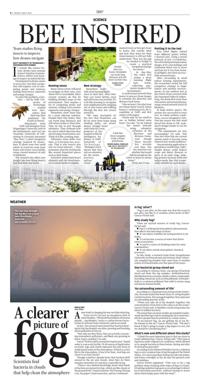
A Bee-Nav drone navigates inside a flower greenhouse.


Despite their tiny brains, honeybees can travel long distances and still return to their hive.
SCIENCE
It sounds like science fiction: drones buzz around, inspect tomatoes in green-houses, deliver your package or inspect an industrial site.
Development in drones seems to move fast, but their navigation still requires a lot of computing power and memory, making them heavy, expensive and energy-hungry.
To solve this problem, scientists — led by Delft University of Technology — studied how honeybees find their way, then published the results in Nature. Roboticists from Delft and biologists from Wageningen University, both in the Netherlands, and Carl von Ossietzky University of Oldenburg in Germany presented "Bee-Nav," a robot navigation strategy inspired by honeybees. It allows even very small robots to travel far away from home and return successfully, using a neural memory of only 42 kilobytes.
The research also offers new insight into how flying insects may find their way home.
Homing sense
Many future robots will need to navigate on their own, even where GPS is unavailable. Most current systems do this by building detailed maps of the environment. That requires a lot of computing power and memory, making such systems expensive and energy-hungry.
Honeybees show there may be a more efficient solution. Despite their tiny brains, they can travel long distances and still return home to their hive. They do this in part through odometry: They estimate how far and in which direction they moved using visual motion cues. Think of it like counting steps.
Odometry alone drifts over time, so it becomes less accurate. That is why insects also rely on visual memory — they remember what the world looks like around important places such as their home.
Scientists understand insect odometry well, but visual memory is much harder to explain.
New strategy
Honeybees begin with short learning flights close to their hive. After that, they can travel farther away and still return successfully. It's a bit like learning to recognize your neighborhood by stepping out of your house and walking through the first few streets around it.
"We were fascinated by the fact that honeybees can fly far away from home along winding paths, yet return almost straight back," said Guido de Croon, professor of bioinspired artificial intelligence for drones at Delft University of Technology. "Biologists have shown that bees rely on odometry for the return journey, and use visual memory more as they get closer to home. But exactly what and how they learn for their visual memory is still not fully understood. That was the gap we needed to bridge to create a practical navigation strategy for robots."
In Bee-Nav, the robot first makes a short learning flight near home, collecting panoramic images of the environment.
A small neural network then learns to process those images to estimate the direction and distance back home.
"Like an insect, the robot may not always know exactly where home is," said Dequan Ou, Ph.D. candidate at Delft and first author of the paper.
"Home may be too small to see, or hidden behind some trees," Ou said. "So we trained the neural network using odometry estimates of the direction and distance home, even though these become less accurate over time. The key question was whether that would still be enough for the robot to learn to return home."
Turns out, it was.
Putting it to the test
Four robot flights started from different points within a learned area. Using a neural network of just 3.4 kilobytes, the robot interpreted panoramic images of its surroundings and estimated which way to move and how far it was from home. In all flights, the robot successfully returned home.
After succeeding in small indoor homing experiments, the researchers tested the full navigation strategy in larger indoor and outdoor environments. In one outdoor test at the Dutch drone research field lab Unmanned Valley in Valkenburg, the drone flew more than 600 meters and returned home, using a neural network of just 42 kilobytes.
In large indoor spaces, the system was successful in every test. In windy outdoor conditions, success dropped to 70%. One key reason was that wind forced the drone to tilt, making its images harder to use for navigation.
"The experiments are very encouraging," Ou said. "But they also show that our current system needs to become more robust in real-world conditions."
One promising application is greenhouse monitoring. Lightweight drones could inspect crops and detect diseases or pests at an early stage, helping growers increase yield and reduce waste. Bee-Nav is especially suitable for such drones.