
A whale of a tale
'Call Me Ishmaelle' offers a new spin on 'Moby-Dick'


BOOKS| REVIEW
Reinterpreting the classics has always been in vogue.
Whether it's modern classics like "James" by Percival Everett and "Demon Copperhead" by Barbara Kingsolver, or books that have stood the test of time and become classics themselves such as "The Wide Sargasso Sea" by Jean Rhys and "Rosencrantz and Guildenstern are Dead" by Tom Stoppard, authors have always adored taking an established piece of the literary canon and putting their own twist on it.
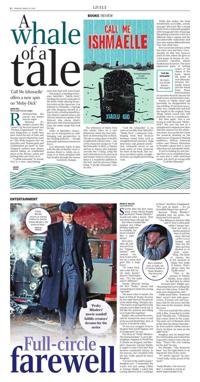
"Call Me Ishmaelle" by Xiaolu Guo is a new, entertaining entry into that well-worn trend.
The book is a retelling of Herman Melville's "Moby-Dick," retelling the novel's main plot to the letter while off ering inventive twists on the characters. Our Ishmael is Ishmaelle, a teenage girl who disguises herself as a man to join a whaling expedition. Our Ahab is Captain Seneca, the African American captain of the Nimrod, who shares Ahab's obsession with destroying Moby Dick, the white whale that took his leg.
Other of Melville's characters are re-interpreted as well, bringing new perspectives to the whaling industry — though Ishmaelle and Seneca remain our focus.
Guo obviously wants to play with the idea of duality: man vs. woman, Black vs. white, yin vs. yang, us vs. them, and plays with that duality through the various backstory changes.
The whiteness of Moby Dick (the whale) takes on a new dimension when the man hellbent on destroying him is Black. The yin vs. yang aspect of duality is explored in a literal sense — one of the characters unique to "Call Me Ishmaelle" is Muzi, a Chinese advisor to Seneca who regularly consults the I Ching, using the text's divinations to try and corral and temper Seneca's obsessions. Muzi is a wonderful addition to the text, and his presence helps bring "Call Me Ishmaelle" into its own.
"Call Me Ishmaelle" is far more accessible than Melville's "Moby Dick," a famously challenging book that bounces between varied styles such as straightforward narrative, stage directions and general nonfiction. Ishmaelle serves as our main point-of-view character for most of the book. Her sections are told in a plain, straightforward, uncomplicated writing style.
While this makes the book wonderfully accessible, certain passages feel more like a young adult novel as Ishmaelle grapples with teenage girl rites of passage like gaining a massive crush on a diff erent ship's captain and the uncomfortable realization that men view women diff erently than they view other men.
But Guo lets herself have a little fun every now and then. Occasionally we dive into Seneca's point of view, where she gives us a few pages of stream-of-consciousness narrative almost Faulknerian in nature. The most impressive piece of writing comes at the climax of the book, where the point of view alternates between Ishmaelle, Seneca and the whale itself. These brief moments of narrative flourish elevate the book in new and inventive ways.
Purists of "Moby-Dick" will inevitably be disappointed by this retelling. It's far more accessible, less complicated and half the length of the original, three things which casual fans will probably view as a compliment.
But then again, Guo is not trying to write the next "MobyDick." She uses the text as a springboard to explore new ideas and new avenues for the adventure novel. You can tell she's done her research, drawing on the experiences of Japanese whaling traditions, African American sailors and Chinese divination to broaden a genre that is, more often than not, remarkably white.
If you're looking for new perspectives on an established text, or even just a solid adventure novel, you won't go wrong with "Call Me Ishmaelle."
'Call Me Ishmaelle'
By Xiaolu Guo (Grove Atlantic, 448 pages)