

Latest attack shows need for readiness
Killing of military professor at Old Dominion University is urgent, unmistakable warning
ANOTHER VIEW | VIRGINIAN-PILOT
A Virginia man previously convicted of terrorism charges opened fire in an Old Dominion University classroom recently, killing one person and wounding two others, plunging the region into mourning. Were it not for the swift, courageous action of students who ended his life, this tragedy could have been much worse.
Details are coming to light, though questions remain, and federal authorities should be forthcoming with what they learn in the coming days. For now, our focus should be on comforting the family and friends of the victims, the care and wellbeing of the Old Dominion community, and the need for greater precautions throughout a military region as international conflict makes Hampton Roads, Virginia, an attractive target for violent extremists.
Investigators say that an ROTC class at Constant Hall in Norfolk was interrupted by a gunman who first confirmed that students there were part of the military training program and then began shooting.
Lt. Col. Brandon Shah, the head of the Old Dominion ROTC program and a professor of military science, was fatally wounded, and two students were injured. Members of the class bravely engaged and killed the shooter, later identified as Mohamed Bailor Jalloh.
Shah was a decorated Army officer who served tours in Iraq and Afghanistan, and was awarded two Bronze Stars.
Jalloh was the opposite. A former Army reservist, he traveled overseas in 2016 in an aborted attempt to join the Islamic State of Iraq and the Levant, also known as ISIS. According to the Department of Justice, he returned to the U.S. and purchased an AR-15 at a gun store with the intention of attacking an Independence Day parade.
Instead he was arrested and pleaded guilty to attempting to provide material support to a designated foreign terrorist organization. Sentenced to 11 years in prison, he was released in December 2024 after serving fewer than eight.
His early release, apparently due to completing a drug treatment program in prison, needs further exploration. It was reported that the firearm was stolen and sold to him illegally. Was he again in contact with foreign terrorists? Was he on the radar of authorities?
What's already clear is that this attack sends an urgent and unmistakable warning about the need for greater awareness and readiness.
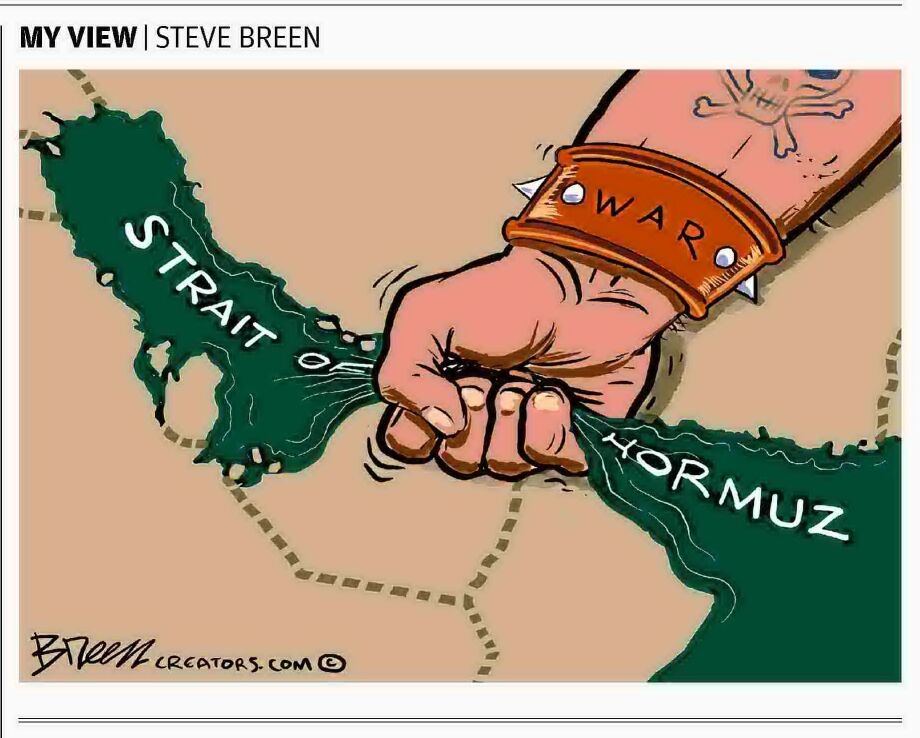
That's not alarmist. Rather, it's a practical approach when the U.S.-Israeli war on Iran has already inspired domestic terror attacks.
On March 1, a gunman wearing clothing with the Iranian flag opened fire in downtown Austin, Texas, killing three and injuring 15 others. And hours after the Old Dominion shooting, a man whose family members were reportedly killed in an Israeli attack on Lebanon drove a truck into a Michigan synagogue; mercifully, the attacker was the only casualty.
In this environment, it is deeply concerning that FBI Director Kash Patel recently fired a dozen agents and staff focused on counterterrorism, and President Donald Trump fired the head of Homeland Security days after hostilities with Iran began. The need for experience in those critical offices is obvious.
As we await answers to many questions, we must understand this climate asks more of us all.
The evidence is clear why America needs immigrants

GEORGE WILL
Two dissimilar government agencies have inadvertently combined to clarify the immigration debate. Stomach turning excesses by Immigration and Customs Enforcement have turned many Americans' abstract political preference into something uncomfortably concrete. And the Census Bureau has demonstrated that the nation needs immigrants as much as they need the blessings of American liberty.
Given a clear binary choice — for or against deporting immigrants who are here illegally — most Americans favor deportation. However:
One Sunday, a moderately pro-deportation American goes as usual for brunch at the neighborhood diner. Jose, who has put waffles in front of this American for 20 years, and who regularly exchanges pleasantries with him about their families, is gone. He has been deported for America's improvement. Suddenly, the immigration issue has a face, and complexity.
President Joe Biden's choice not to enforce immigration laws poisoned the immigration debate, and led to government behavior today that is deepening distrust of government. The influx during Biden's four years (8.3 million, more than in the preceding 12 years), torrential and dispersed, has clouded the picture. But this seems true:
The foreign-born portion of the U.S. population (15.8%) is higher than at any time since at least 1850. But as of 2023, only 27% were not authorized to be here. More than half of all immigrants (52%) have become U.S. citizens. Prior to the Biden inundation, most undocumented immigrants had arrived before 2010, 43% as of 2020 had been here at least 20 years, about onethird were homeowners, and their 5 million children born here were citizens. Talk of sending them "home" is nonsensical.
They are home. For which, give thanks:
The Census Bureau reports that between July 2024 and July 2025, the U.S. population grew by just 0.5%, 1.4 million less than in the previous 12 months, primarily because of less immigration. According to the Pew Research Center, during the first six months of the Trump administration, the foreign-born population shrank by more than 1 million, the first decline since the 1960s. According to the Migration Policy Institute, between 2022 and 2023, for the first time since relevant census data began being collected in 1850, immigration accounted for the entire U.S. population growth.
As the U.S. population ages, those leaving the workforce enter Social Security and Medicare. The nation's birth rate is below the replacement rate, so immigration must replenish the workforce whose tax contributions fund the entitlements.
Immigrants are 23.6% of STEM (science, technology, engineering, math) workers. Nurses (15.9% foreign born) and health aides (28.4% foreign born) are crucial to an aging America.
A recent Cato Institute report says: Immigrants "generated more in taxes than they received in benefits from all levels of government." They "created a cumulative fiscal surplus of $14.5 trillion in real 2024 U.S. dollars," including $3.9 trillion in savings on interest that did not need to be paid on debt that was not added.
Immigrants were, on average, more than 12% more likely to be employed than the U.S.-born population. Cato: "In 1994, the immigrant share of government expenditures was 18% below their share of the population; in 2023, it was 25% below."
In 2023, immigrants constituted almost 18% of the civilian labor force, and more than a third of them were in management, professional and related occupations, almost double the 21% in service occupations. In 2023, immigrant median household income ($78,700) was slightly above that of U.S.-born households ($77,600).
The Cato data comes from static, not dynamic, accounting: It does not, for example, gauge immigration's dynamism injection: Immigration — risk-taking for improved opportunity — is an entrepreneurial act. Unsurprisingly, immigrants' workforce participation rate (66.5%) is higher than that of the U.S.born population (61.7%), and immigrants' portions of U.S. patents and start-ups exceeds immigrants' portion of the population.
As Cato notes, many illegal immigrants who are employed under borrowed or stolen identities have taxes withheld by employers but are ineligible for many government benefits. And they are less likely than others to file returns to claim refunds. This is another reason why Cato says:
"Immigrants have created an enormous fiscal surplus for the U.S. government … The $14.5 trillion in savings from immigrants is the equivalent of 33% of the total inflation-adjusted combined deficits from 1994 to 2023 without immigrants."
That fellow having brunch at the diner will still get his waffles. But he will miss Jose, and millions like him, in more ways that he can easily imagine.
Will writes for The Washington Post.
How I hit the jackpot with all those trips to the casino

JERRY DAVICH
I didn't want to go. I never wanted to go. I ended up going every time anyway. This is what a good son does, isn't it?
Nearly every week for several months, I drove with my mother from our homes to a local casino. And each week I dreaded it.
Along with hundreds (possibly thousands?) of other casino "members," we'd loiter in the lobby hoping our lottery-type ticket got picked to win a new car, vacation getaway, cash jackpot or whatever.
"This could be our lucky day," chimed my ever-hopeful mother on the way there.
"Yeah, it could be," I'd mutter, wondering what I could do more productively with her.
I would pick up my mother at her home, typically on a weekend night, and we'd cruise down to the flashing, sparkling casino near the lake. We'd talk about all sorts of subjects along the way, and then I'd drop her off at the front entrance while I parked my car.
Inside, we'd wander around with all the other hopefuls waiting for our names to be called out loud. "And the winner is!!! ... " the enthusiastic announcer would boom into the microphone.
But they never called our names, not once. Not even to win a complimentary watered-downed drink or stupid T-shirt, even though we entered hundreds of entries collectively. So along with all the other hopeful losers, the two of us would limp back to the car while playfully cursing the name of the winner that night.
During our drive back home we'd continue our conversation, whether it was about national politics, new TV shows or quantum physics (one of my late mother's favorite subjects).
We also would talk about other colorful subjects, including my mother's married days to my father (he died nearly 40 years ago), her upbringing as a teenage mom, and what it was like to raise three young kids in the turbulent 1960s.
She would tell me what I was like as a child — a wayward, awkward and backward boy who didn't aspire to be anything much, but an adult. Of course my mother didn't use the words "wayward, awkward and backward," but that's how I remember things.
No, my mother instead prattled on about my hidden highlights, not my obvious shortcomings. But then again, that's what good mothers do, isn't it?
Come to think of it, my mother had always been my number one fan, my constant confidant and my proudest cheerleader. And she was always in my corner no matter who the opponent or what the circumstance. That's not an easy task, I've learned as now a parent of four adult children.
Not once do I remember her abandoning this tough-to-emulate stance as a parent. She was always there for me, encouraging, praising and supporting me. Until her last words, literally.
I thought of these insights about her while driving back and forth to that casino on those rather uneventful, and definitely unprofitable, weekend evenings.
I'd jot them down in my notebook, or on a napkin, or in my daily planner, promising myself to someday write a column about it. About her. About her love, devotion and nurturing ways. I still have those notes.
It may have taken me a few decades to realize this, but it turns out I am a jackpot winner after all. The jackpot all along was her.
Davich writes for The Times of Northwest Indiana: Jerry.Davich@ nwi.com.