This content is unavailable. Please contact customer service for more information.
Already a subscriber? Login or Activate your account.
You've reached the end of the standard E-Edition.
This content is unavailable. Please contact customer service for more information.
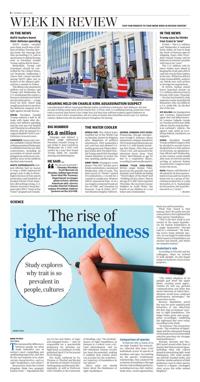
NATO leaders boost their defense spending
IN THE NEWS
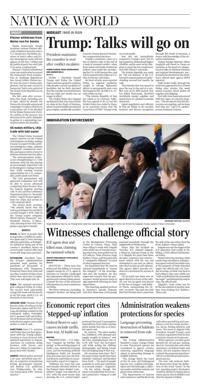
NATO leaders unveiled arms deals worth tens of billions of dollars Tuesday, driving home the message that they are heeding U.S. calls to spend more to defend Europe even as President Donald Trump said he felt let down.
Meanwhile, Trump said Greenland should be controlled by the United States, not Denmark, reaffirming a stance that caused tensions among NATO allies just as leaders of the alliance gathered for a summit in Turkey.
The alliance also announced military aid to Ukraine, and Trump said Wednesday the U.S. would grant the country a license to manufacture Patriot missile interceptors — a huge boost for Kyiv, which long sought permission to produce the defensive weapons in its fight against invader Russia.
SPAIN: President Donald Trump ordered a halt to all trade with Spain after disputes over defense spending and the Iran war, but Madrid said Thursday he softened his rhetoric after he learned of a surge in Madrid's NATO contributions in recent years.
CANDIDATE: Democratic Senate candidate Graham Platner of Maine promised Wednesday to withdraw from the race after controversies, including an accusation of sexual assault, plunged one of the most competitive races in the midterm elections into turmoil.
WHITE SUPREMACISTS: Federal officials had no reason to stop a white supremacist group's July 4 rally in Washington because of free speech protections and hundreds of masked Patriot Front members did nothing wrong, U.S. Interior Secretary Doug Burgum told CNN's "State of the Union" program last Sunday.
HEARING HELD ON CHARLIE KIRK ASSASSINATION SUSPECT
law enforcement officers stand guard Monday before a preliminary
hearing for Tyler Robinson, the man accused of killing conservative
activist Charlie Kirk, in Provo, Utah. In a weeklong hearing,
prosecutors have tried to convince Utah district Court Judge tony
Graf they have sufficient evidence against Robinson to warrant a
trial in Kirk's assassination, one of a series of attacks that
intensified concern over U.S. political violence. Widow Erika Kirk
has been present throughout the hearing.
JIM URQUHART, REUTERS
BIG NUMBER
$5.8 million Damages and interest a federal judge authorized President Donald Trump to pay writer E. Jean Carroll on Wednesday for a 2023 civil verdict by a jury that found Trump liable for sexually abusing and defaming her.
HE SAID …
"We are not at present."
— Treasury Secretary Scott Bessent on Monday, telling Spectrum News that the Treasury Department no longer plans to have Africa American anti-slavery crusader Harriet Tubman replace President Andrew Jackson on the $20 bill.
THE WATER COOLER
WORLD CUP: The United States tumbled out of the World Cup on Monday, beaten by Belgium after allegations of political interference. FIFA suspended a red-card ban and allowed U.S. leading goalscorer Folarin Balogun to play after President Donald Trump asked FIFA President Gianni Infantino to review the ban, sparking a global uproar.
EMMY NODS: Emergency room drama "The Pitt" led this year's Emmy nominations, announced Wednesday, with 25 nods. The final season of "Hacks" earned 24 nominations, a record for a comedy in a single year. Winners will be announced Sept. 14 at a Los Angeles ceremony broadcast live on NBC and streamed on Peacock. "Law & Order: SVU" star Mariska Hargitay will host.
GEORGE JOHNSON (1927-2026): Pioneering Chicago entrepreneur George E. Johnson, whose eponymous company founded in 1954 transformed Black haircare in the U.S. with brands including Afro Sheen, Ultra Wave and Classy Curl, and sponsored the television music show "Soul Train," died Monday at age 99 due to a respiratory illness, according to news media reports.
BONNIE TYLER (1951-2026): British singer Bonnie Tyler, known for her gravelly tone and dramatic rock ballads including "Total Eclipse of the Heart"and "Holding Out for a Hero," died at the age of 75, BBC News reported Thursday. She was born Gaynor Hopkins in south Wales, the fourth of six children of a coal miner and a homemaker.
Trump says he thinks Iran truce is 'over'
IN THE NEWS
DUBAI — The U.S. military said Wednesday it launched fresh strikes on Iran to keep the Strait of Hormuz open to shipping, hours after President Donald Trump said he believed an interim ceasefire with Iran to be "over."
The U.S. military said its latest strikes were aimed at keeping the strait open after it said Iran struck three tankers in the area. While Iran did not claim responsibility, analysts say Tehran uses such actions as leverage for negotiations.
In return, Iranian armed forces launched attacks on U.S. military infrastructure in Persian Gulf states Thursday — the day Iran buried its slain Supreme Leader Ayatollah Ali Khamenei, who was killed in a U.S. strike Feb. 28, the first day of the war.
ICE KILLING: An Immigration and Customs Enforcement agent shot and killed motorist Lorenzo Salgado Araujo on Tuesday in Houston while officers tried to stop the Mexican national's vehicle, the agency said, amid an escalating federal crackdown on migrants.
SYRIA: President Donald Trump notified Congress that he decided to rescind Syria's designation as a state sponsor of terrorism, an administration official said Wednesday, so the country could rebuild after years of civil war and the ousting of autocrat Bashar Assad in 2024. Congress must review the move.
GAZA: Hamas said Monday it dissolved its de facto government in Gaza and was ready to hand over to a group of Palestinian technocrats as a step forward in a U.S.-backed plan for the enclave, but Israel dismissed it as a "stunt."
— Reuters
The rise of right-handedness
Study explores why trait is so prevalent in people, cultures
DREW PITTOCK USA Today
SCIENCE
The innumerable differences between people are what make humanity one of nature's most compelling and spellbinding tapestries. But why do the vast majority of us share certain characteristics, such as right-handedness, over others?
Researchers from the United Kingdom think two uniquely human traits — bipedalism (the use of two rear limbs, or legs) and enlarged brains — may be responsible for a specieswide preference for favoring our right hand, according to a study published April 27 in the journal PLOS Biology.
The study, authored by Dr. Thomas A. Püschel and Rachel M. Hurwitz at Oxford's School of Anthropology and Museum Ethnography, as well as Professor Chris Venditti at the University of Reading, says "the predominance of right-handedness in humans is a robust cross-cultural phenomenon, and no left-dominant human society has been documented, making it unlikely that culture alone can account for the evolutionary trajectory of handedness in our species."
Here's what you should know about the dominance of right-handedness.
Comparison of species
To find out why so many of us are right-handed, the researchers collected data from 2,025 individuals across 41 species of monkeys and apes. Accounting for the species' evolutionary relationships, they analyzed the evolution of handedness through the lens of prevailing hypotheses, including tool use, diet, habitat, body mass, social organization, brain size and locomotion.
What they found is that humans don't fit neatly into the same patterns that explained the other species' handedness.
"This is the first study to test several of the major hypotheses for human handedness in a single framework," Püschel said in a statement. "By looking across many primate species, we can begin to understand which aspects of handedness are ancient and shared, and which are uniquely human."
Evolution's role
According to Püschel and his colleagues, when we evolved to walk upright, we also began using our hands for a host of new purposes.
"The initial adoption of an upright gait freed the upper limbs, creating novel opportunities for tool use, gestural communication and other fine motor behaviors in which lateralization would have conferred performance advantages," the researchers wrote.
Because bipedalism paved the way for more sophisticated behaviors, it was effectively the first step on humans' journey to right-handedness. Our larger brains grew and reorganized accordingly, solidifying the rightward bias seen today, according to the study.
"In humans," the researchers wrote, "the evolution of bipedalism and the subsequent freeing of the hands may have intensified selective pressures for stronger hand preferences."
Püschel, Hurwitz and Venditti noted several other lines of inquiry that their research opens, including what role culture played in normalizing right-hand dominance, why some people are still left-handed today, and whether similar patterns of limb preference seen in other species "point to a deeper, convergent story across the wider animal kingdom."
Click and hold your mouse button on the page to select the area you wish to save or print.
You can click and drag the clipping box to move it or click and drag in the bottom right corner to resize it.
When you're happy with your selection, click the checkmark icon next to the clipping area to continue.