
Home advantage
Tariffs, inflation drive consumers to domestic resale, salvage shops
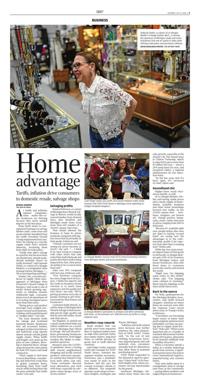
Deborah Slobin, co-owner of le Shoppe Modern in Keego Harbor, Mich., is among the operators of Michigan resale and reuse businesses that saw an uptick in sales amid shifting trade policy and persistent inflation.
Leah Paige Cooley says tariffs and overall inflation make resale business like STEP thrift Stores in Michigan more appealing to budget-strapped shoppers.
Le Shoppe Modern sources most of its home furnishing inventory from Michigan homes and luxury businesses.
Le Shoppe Modern specializes in antiques and other previously sold items, so the business isn't affected much by tariffs or rising material costs.
BUSINESS
As tariffs and inflation squeeze companies, some under-the-radar businesses are thriving because they never needed imports in the first place.
From thrift stores to consignment boutiques to salvage lumber yards, some reuse and resale retailers benefited from the tariffs President Donald Trump implemented last year. How? By relying on a circular supply chain that's entirely domestic, insulating them from shifts in trade policy.
"Tariffs only affect vintage in a positive way because these are already here, already made, already available, there's no tariffs involved," said Deborah Slobin, co-owner of Le Shoppe Modern, a consignment store in Keego Harbor, Michigan. "… We're not importing anything."
Stanley Lim, associate professor in supply chain management at Michigan State University's Broad College of Business, said resale is one of retail's fastest-growing segments as inflation remains stubbornly high. Consumer prices rose at an annual pace of 4.2% in May, the highest rate in more than three years.
"Rising prices and product shortages have nudged consumers toward used furniture, clothing and household goods as 'budget relief,'" Lim said.
The same dynamic holds for salvage and reclaimed materials dealers. Businesses that sell recovered lumber, salvaged architectural fixtures and industrial scrap operate almost entirely outside global supply chains. When tariffs and freight costs push up the price of new cabinets, flooring or imported décor, salvage shops become the value option for both DIY buyers and small contractors.
"Their supply is tied more to local demolition, remodeling and industrial scrap than to global container flows, insulating them from tariff shocks while letting them ride the price umbrella that tariffs create," Lim said.
Salvaging profits
Kendra Patterson, co-owner of Michigan Barn Wood & Salvage in Mason, retails locally sourced lumber from downed trees, plus furniture and Michigan-made items from more than 100 vendors at a 30,000-square-foot store.
That model allowed the business to keep its prices moderate compared with bigbox stores that faced tariffs on their goods, Patterson said.
"Overall, customers are not seeing our prices increase as much," she said. "… I think if we were trying to compete with other stores that only order their stuff wholesale and maybe all of their stuff is being impacted by that, their prices are going to be so much more than ours."
Sales rose 35% compared with last year, Patterson said.
"Our furniture company has seen a huge boost in business. I think the exports and the tariff on furniture (from) overseas is so much more expensive, but the quality just isn't there," she said. "We're getting questions every day of people wanting to get furniture made for their homes and businesses."
Customer Burke Heiselt, 21, said he shops at Michigan Barn Wood & Salvage to find reasonably priced, high-quality oak that he saws into tables, stools and other pieces.
Jen Wagoner, 55, picked out a small, handcrafted white and yellow sunflower on a recent visit to Michigan Barn Wood & Salvage. She said she prioritizes patronizing businesses in her hometown, from bigger retailers like Meijer to independent operators.
Research since the COVID19 pandemic shows a lasting shift toward neighborhood shopping and locally sourced products, with most consumers saying they intend to buy local more often, Lim said. "Some customers discover local alternatives and stick with them, especially in categories where design, story, or service matter."
Resellers reap rewards
Small retailers that can quickly pivot from imported lines to regional makers have an edge when national chains face empty shelves, long lead times or volatile pricing on goods tied to tariff-affected countries.
Leah Paige Cooley, regional retail sales manager for STEP Thrift Stores, watched the segment weather recessions, hurricanes and a pandemic over nearly 25 years in the business, and she says the current economic climate is no different. The nonprofit operates resale shops in Dearborn Heights, Southgate and Wayne, Michigan.
"Inflation and tariff-related price increases may further reinforce the value proposition of thrift retail," Cooley said. "As the cost of new clothing, housewares, furniture, imported goods and craft materials rises, consumers naturally look for alternatives that allow them to maintain purchasing power."
STEP Thrift responded to the demand in April by opening a "Value Vault" at its Dearborn Heights store, where customers can buy merchandise by the pound.
Southeast Michigan Salvation Army stores also saw sales growth, especially at the charity's By The Pound store in Clinton Township, which is expected to gross more than $1 million this year — about a 20% jump from last year, said Jacqulynn Idzior, a regional administrator for the Salvation Army.
"In the few years that it's been open, it's increased 10-fold," Idzior said.
Secondhand chic
Higher-brow resale businesses benefit, as well.
At Le Shoppe Modern, Slobin said having stable prices and a steady supply of immediately available furniture and other home furnishings boosted foot traffic. In her 25,000-square-foot boutique, shoppers can browse art, vintage pottery, lamps, sofas, chairs, tables and more at prices ranging from $50 to $500,000.
"Because it's available right now, people before who were not open to buying 'second hand' are seeing now the advantages to it: the craftmanship, quality is far superior than what they're making now," Slobin said.
While big-box chain retailers import many of their goods to sell locally, Le Shoppe Modern gets 95% of its inventory from Michigan homes and luxury businesses, then sells those items to customers across the country and around the world.
"Right now, I'm shipping some chairs to Abu Dhabi," Slobin said. "I'm shipping some cabinets to Germany." Buyers pay for shipping, so the store avoids those costs.
Back to the source
Vic Veda, spokesperson for the Michigan Retailers Association, said tariffs focused shoppers' attention on where items are sourced, even after the Supreme Court struck down some of Trump's levies in February.
"Consumers are becoming hyper-aware of where their goods originate and how much embedded cost they are paying due to supply chain friction," Veda said. "When a new imported sofa or a bundle of standard dimensional lumber jumps 20% in price, alternative local channels suddenly look incredibly attractive."
When a consumer spends a dollar at a retailer importing goods from overseas, a significant portion leaves the state to cover international logistics, manufacturing and customs duties.
That same dollar spent at a consignment shop or salvage yard stays in the community — paying fellow residents and supporting local businesses.