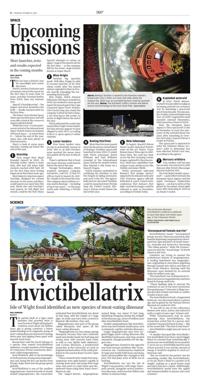

Upcoming missions
More launches, tests and results expected in the coming months
SPACE
This has been a historic year for spaceflight and cosmic discovery. NASA's Artemis II mission sent astronauts toward the moon for the first time in more than 50 years, and they traveled farther from Earth than any humans ever.
SpaceX's Starship rocket — the largest and most powerful ever built — finally reached orbit for the first time.
The Nancy Grace Roman Space Telescope reached space and will soon offer a look at the cosmos in unprecedented detail.
While the Crew-13 astronauts' recent arrival at the International Space Station means no humans will reach space — or return from it — before the end of the year, space fans still have plenty to look forward to.
Here's a look at seven space missions coming up before the end of this year.
1 Starship
Tech mogul Elon Musk founded SpaceX in 2002. Its Starship rocket, which is more than 400 feet tall when fully stacked, reached orbit Sept. 28 for the first time since testing began more than three years ago.
Most industry observers expect Starship, designed for crewed missions to the moon and Mars, could launch one more time this year. Musk also said Starship's next launch, its 15th flight test overall, could be the first where
SpaceX attempts to return an upper-stage to the launch site for the first time — as the company did for the lower-stage booster known as Super Heavy.
2 Blue Origin
Another big question mark: Will Blue Origin be able to resume launches of its New Glenn rocket after the launch vehicle exploded in May in Florida, heavily damaging the surrounding launch pad?
Blue Origin, which Amazon billionaire Jeff Bezos founded in 2000, has worked to clean up and repair the launch pad at the Cape Canaveral Space Force Station. CEO David Limp also stated the company’s intent for New Glenn, a 322-foot heavy-lift rocket, to return to flight before the end of the year.
NASA indicated the rocket may launch Blue Origin’s lunar lander, but that mission appears to have slipped to early 2027, according to the U.S. space agency’s online calendar.
3 Lunar landers
Four lunar landers were on tap to potentially launch in 2026. But as of mid-October, none reached the moon since two pulled off the feat in March 2025.
There’s optimism that at least one lunar mission could launch before the end of the year.
Voyager Technologies, which acquired aerospace company Astrobotic, said Oct. 13 that it’s still on track to launch its Griffin-1 lander to the moon this year. The company aims to deliver science and technology — including at least two rovers — to the lunar south pole following a Florida launch.
4 Boeing Starliner
More than two years passed since the disastrous crewed debut of Boeing’s Starliner spacecraft launched in June 2024. It ended with NASA astronauts Butch Wilmore and Suni Williams stranded at the International Space Station for months before they hitched a ride home on a SpaceX Dragon.
NASA remains committed to certifying the Starliner to join the Dragon in taking astronauts and crew to the ISS. The agency indicated an uncrewed Starliner could be launched from Florida atop the United Launch Alliance’s Vulcan rocket before the end of this year.
5 New telescope
In August, SpaceX’s Falcon Heavy rocket launched NASA’s state-of-the-art Nancy Grace Roman Space Telescope to orbit. Since then, the wait has been on for the first stunning cosmic images captured by the observatory, which has capabilities that surpass iconic predecessors like Hubble and James Webb.
NASA previously indicated Roman’s first images weren’t expected to be released until early 2027. However, agency officials indicated at a post-launch news conference that Roman’s first high-resolution images could be released as early as December, according to Florida Today.
6 Exploded asteroid
In 2022, NASA demonstrated it was possible to nudge an incoming asteroid out of harm’s way by slamming a spacecraft into it intentionally. The mission, the Double Asteroid Redirection Test, or DART, targeted the small moonlet asteroid Dimorphos, which posed no threat to Earth.
Now, the European Space Agency’s Hera spacecraft is due in November to reach the remnants of the asteroid about two years after launching in October 2024 atop a SpaceX Falcon 9 rocket in Florida.
The spacecraft is expected to enter the Didymos binary system’s orbit to determine just how effective NASA’s test was, according to the agency.
7 Mercury orbiters
Two orbiters will become the second-ever mission to orbit Mercury after NASA’s Messenger mission ended in 2015.
The twin BepiColombo spacecraft — a joint effort between the European Space Agency and the Japan Aerospace Exploration Agency — are due to arrive at the planet by December, about eight years after launching in 2018 on an Ariane 5 rocket.