
HILARIOUS TIMING
Ready to blow up baseball for a salary cap, MLB can't spin this World Series
MLB | COMMENTARY
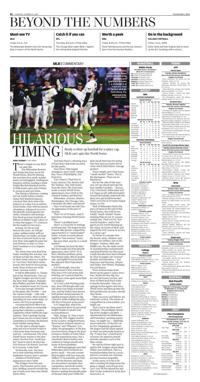
There's simply no way MLB can spin this. The Milwaukee Brewers and Tampa Bay Rays are in the World Series, directly defying the narrative that small-market teams are bedraggled, woebegone, hopeless entities needing a white knight like Rob Manfred and his 29 billionaires (plus John Fisher) to swoop in and save them.
The timing is hilarious, coming just six weeks before commissioner Rob Manfred imposes a lockout that shuts down the industry at a time it is in relative boom mode, what with increased attendance, enhanced access to the playoffs and desperate networks, streamers and monopolists lined up to pay hundreds of billions of dollars to get a piece of it when the league's TV contracts hit the market in two years.
Instead, for the second time in five years, we will get a plug-pulling winter with no transactions, no trades, no hope for fans of nascent teams to see how their club might become the next Brewers or Rays or Cleveland Guardians or Los Angeles Dodgers.
Yes, those were your final four teams standing this autumn, one of them not like the others. Yet in what surely came as a surprise to "Our Fans" that MLB continuously cites from its focus group work, three of them are of the lower-revenue variety.
It will be Milwaukee vs. Tampa Bay in the World Series. The Los Angeles Dodgers are free to join the New York Yankees, Philadelphia Phillies and New York Mets at the swankiest resort in Cancun.
If you pay enough attention to the game, this October — and the season at large — only reinforced your priors. Most notably: Spending on your roster helps, of course, but it is no guarantee.
A resourceful front office is no good, either, minus an ownership group that cultivates a creative, supportive culture within the organization. That is perhaps the biggest reason you see so many repeat contenders in October, the Brewers most notably among them.
Oh, the spin is already beginning and you're bound to hear it a few more times between now and Dec. 1 and beyond: The 2026 World Series winner is the aberration, the first true "small market" team to win it all since the 2015 Kansas City Royals. Just two in 12 seasons. Looks bad!
Technically, sure. Yet since we're now entering Arbitrary Endpoints Season, here's another — number of World Series appearances since 2008:
The Dodgers have five pennants. The Houston Astros have four, fielding a payroll outside the top 10 both years they won World Series titles.
And then there's a floating mass of franchises that looks an awful lot like parity.
Your three-time league champions since 2008: Tampa Bay, Texas, Philadelphia, San Francisco.
Two-timers? That'd be St. Louis, Kansas City, Boston and the Yankees. Yep, both teams from the Show-Me State have made as many World Series appearances since 2008 as the vaunted Yankees and Red Sox.
Milwaukee, Arizona, Atlanta, Washington, the Chicago Cubs, Cleveland, the Mets and Detroit — they've all made one Fall Classic appearance in the past 19 seasons.
That's 19 of 30 teams. And 12 franchises winning World Series titles.
There's a problem here?
Here's a crucial bit of verbiage worth parsing: The league insists it must offer greater competitive opportunities to "small market" teams. A more accurate phrase might be "low revenue" teams.
Because what, exactly, is a small market?
Is it Miami, because the Marlins have made one brief playoff appearance since 2003? Or is that a Marlins problem, given that Miami ranks 18th in market size, and eighth if you include the adjacent West Palm Beach market?
Is it Pittsburgh, since the Pirates haven't won a division title since 1993 and owner Bob Nutting can't seem to find the cash to pay a free agent more than $39 million?
Or is that a Bob Nutting problem, since Pittsburgh ranks one slot above San Diego in market size, and the Padres have proven both potent and prosperous in signing marquee players to big contracts while making the playoffs five of the past seven years?
Is it Tampa Bay, which has long punched above its perceived weight thanks to smarts and resourcefulness?
Well, Tampa-St. Pete is technically the 11th-biggest market in the country, wedged between those barren outposts known as "Boston" and "Phoenix." Certainly, the geographics of the Bay area have been a drag on the Rays' revenue as bodies of water bifurcate the population mass, but a sweetheart deal to build a new stadium in Tampa should solve many of those problems.
We will begrudgingly note that Milwaukee and Cincinnati are pretty small — the only current MLB markets with less than one million TV households, per Nielsen. Yet the Brewers and Reds are also perfect examples that competence and desire matter almost as much as revenue — the Brewers making the playoffs eight of the past nine years while the Reds mock their fans by noting that they have no choice but to come watch their below-average product.
There simply aren't that many "small-market" teams. This is the big leagues. There are no Mayberrys.
But for the sake of this exercise, let's go ahead and rope the four smallest markets — Kansas City, Cincinnati, Milwaukee and Las Vegas (a self-inflicted market wound MLB gladly endorsed) into their own special little bucket. That's just four of 30 major league teams, or 13%.
Well, if Milwaukee hoists the piece of metal at the end of this World Series, that will be two totally "small-market" teams winning titles in our 19-season sample size. That's 10.5%. Not exactly hopeless. And is that gap in access worth blowing up the salary structure of MLB, and imperil the 2027 season in service of a salary cap?
Far better to consider that the Royals, Reds, Athletics and Brewers are outliers, just as the Dodgers, Yankees, Mets and Phillies are. No, the wider swath of championships and pennants and playoff berths for these past couple decades have been claimed by what we might call "normal" markets and franchises — San Francisco and Houston, Atlanta and Dallas-Fort Worth, Washington and Boston.
None of those teams have blown up the game's salary structure. Rarely do they dip very far over the luxury tax line, and most of them duck back under it shortly thereafter. They can splurge on free agents and win a World Series and then go into the fetal position for six years, should they desire.
Their successes and failures are relatively cyclical. The nature of competition in a free market, you might say.
That's not to say there aren't problems. The profligate spending of the Dodgers and Mets — spearheaded by two billionaires with boundary-pushing reputations, we might say — rightfully raises eyebrows. In the last collective-bargaining agreement, the league and the union agreed to what was informally known as the "Cohen Tax," a fourth level of luxury tax aimed to punish extreme spenders such as the Mets owner.
He said he'd blow right past it, and he did. Dodgers owner Mark Walter soon followed. This is a baseball problem that in a sense mirrors a societal one: Extreme income/revenue inequality.
In this arena, it is the 0.1% that's creating the impression the game is rigged, even if Juan Soto can't stay off the injured list and Kyle Tucker looked lost in his first season in L.A.