

Into the trees
Forest bathing engages all of your senses and may help counteract stress
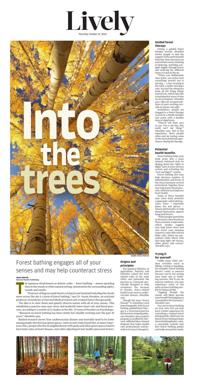
The Japanese ritual known as shinrin-yoku — forest bathing — means spending time in the woods or other natural setting, immersed in the surrounding sights, sounds and smells. "Even just sitting on a park bench or lying in your backyard watching the clouds move across the sky is a form of forest bathing," says Dr. Susan Abookire, an assistant professor of medicine at Harvard Medical School and a trained forest therapy guide.
The idea is to slow down and quietly observe nature with all of your senses. This mindfulness practice may ease stress and modestly lower heart rate and blood pressure, according to a review of 11 studies in the Feb. 10 issue of Frontiers in Psychology.
"Research on forest bathing has been slowly but steadily evolving over the past 45 years," Abookire says.
Related research shows that cardiovascular disease and mortality tend to be lower among people who live near green spaces. And a recent study found that, in many American cities, people who live in neighborhoods with parks and other green spaces tend to have lower rates of heart disease, even after adjusting for key health and social factors.
Origins and principles
The Japanese Ministry of Agriculture, Forestry and Fisheries coined the term shinrin-yoku in the early 1980s and promoted the practice as a measure specifically designed to help counteract the increase in chronic, stress-related health issues such as cardiovascular disease, Abookire says.
Though the term "forest therapy" is sometimes used interchangeably with forest bathing, guided forest therapy is a structured practice that involves trained guides, says Abookire, who created a program accredited by Harvard-affiliated Mass General Brigham that trains health care professionals nationwide to be forest therapists.
Guided forest therapy
During a guided forest therapy session, Abookire invites people to feel the support of the earth beneath their feet. Next, they focus on each of their senses, listening to birdsong, watching sunlight dapple through leaves and noticing the different layers of scent in the air.
"When you deliberately slow down, you notice how everything around you is moving — a tree swaying in the wind, a spider weaving a web. You feel the vibrations from all the living things around you, which taps into a fundamental sense of who we are as humans," Abookire says. After all, we spent millions of years evolving outside in nature, she adds.
Sometimes, people are dragged to a forest therapy session by a family member and arrive with a healthy dose of skepticism.
"They'll roll their eyes or say, 'I'm a city boy, this really isn't my thing,'" Abookire says. But in her experience, those people often end up having some of the most profound experiences during the therapy.
Potential health benefits
Forest bathing helps your body move into a more relaxed, balanced state by dialing down the "fight or flight" part of your nervous system and activating the "rest and digest" system.
Forest bathing also may help decrease markers of inflammation and levels of the stress hormone cortisol in the blood. Together, these may help lower blood pressure, which in turn improves heart health.
Some of these benefits may stem from aromatic compounds called phytoncides. Trees — especially pines, firs and spruce — release phytoncides to help defend themselves against fungi and insects.
"When people spend time in the forest, they breathe in these aromatic compounds, which studies suggest may help lower stress and also boost your immune response, especially natural killer cells, which are specialized white blood cells that help fight off viruses, other germs and cancer," Abookire says.
Trying it for yourself
Unlike many other outdoor activities (such as hiking, cycling or kayaking, for example), forest bathing doesn't count as exercise because you're not raising your heart rate or building muscles. But if you do exercise outdoors, you may experience some of the perks of forest bathing simply by being outside.
"Jogging though the woods will likely provide more benefit than jogging on a treadmill in the basement," Abookire says.
You can try forest bathing on your own, but you may have a better experience by consulting a trained forest therapy guide, which you can find at Forest Bathing Finder (forestbathingfinder.com), a searchable website that lists forest bathing guides and walks around the world.