
Five events in North Carolina that changed the course of the American Revolution
North Carolina played a significant role in the American Revolution. From being the first to call for freedom to being the site of pivotal battles that shifted the trajectory of the war, North Carolina was influential before, during and after America’s call for independence.
Check out these five key events below to learn more about North Carolina’s revolutionary past.
First Provincial Congress
This meeting, held in 1774, was the first independent assembly of North Carolinians not approved by royal authority and the first Provincial Congress in any of the colonies. The three-day congress was held in New Bern.
Despite their close range to Tryon Palace, the 71 delegates did not receive much resistance from the royal governor as they discussed principles of self-government. The three-day congress resulted in support for a larger Continental Congress, and the attendees selected William Hooper, Joseph Hewes and Richard Caswell as delegates to such a convention.
Moores Creek Bridge
In early 1776, British authorities in London approved exiled Gov. Josiah Martin’s plan to restore royal authority in North Carolina. On Feb. 27, 1776, in the first battle of the American Revolution that took place in North Carolina, the Patriot forces in the region were able to stifle those plans.
The Patriots' success at the Battle of Moores Creek Bridge not only allowed Patriot forces to control North Carolina but also encouraged the colony to fight for separation from the British. With boosted confidence, the members of North Carolina’s Fourth Provincial Congress in April 1776 authorized its delegates at the Continental Congress to support American independence.
Halifax Resolves
Written and unanimously adopted by the 83 delegates at the Fourth Provincial Congress in April 1776, these resolves authorized North Carolina delegates to the Continental Congress to vote for American independence from Britain. In doing so, they created the first official government document calling for separation from the British, leading to the claim of “First in Freedom” for North Carolina.
It was the Halifax Resolves that eventually led to the Declaration of Independence in July 1776 — when the United States declared itself a free and independent nation.
March to Kings Mountain
The Battle of Kings Mountain is known to many as a turning point in the American Revolution, as the Patriot victory marked the beginning of the end of Loyalist control in the Southern colonies.
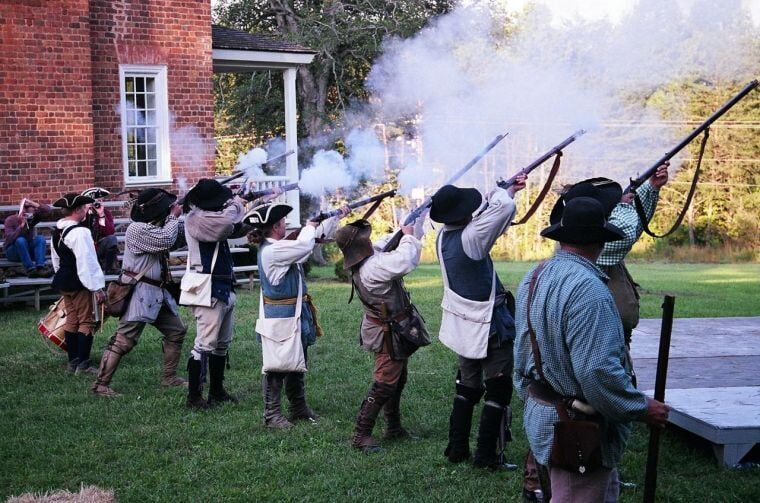
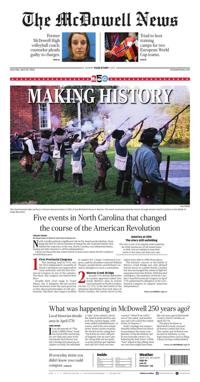
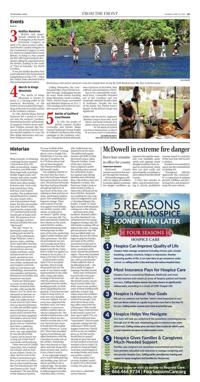
The Overmountain Men perform a firearm demonstration in 2011 at the McDowell House in Marion. The event commemorated the march through western North Carolina to the Battle of Kings Mountain.
In 1780, British Major Patrick Ferguson led a group of Loyalists into the western Carolinas, threatening frontier settlements. In response, Patriots from southwest Virginia, present-day Tennessee, and western North Carolina banded together to cross the Blue Ridge Mountains and confront Ferguson’s men.
Calling themselves the Overmountain Men, these Patriots traveled through challenging terrain for many weeks before reaching Kings Mountain, South Carolina. There, Patriot troops surrounded and defeated Ferguson on Oct. 7, 1780, dealing a heavy blow to Loyalist morale in the region.
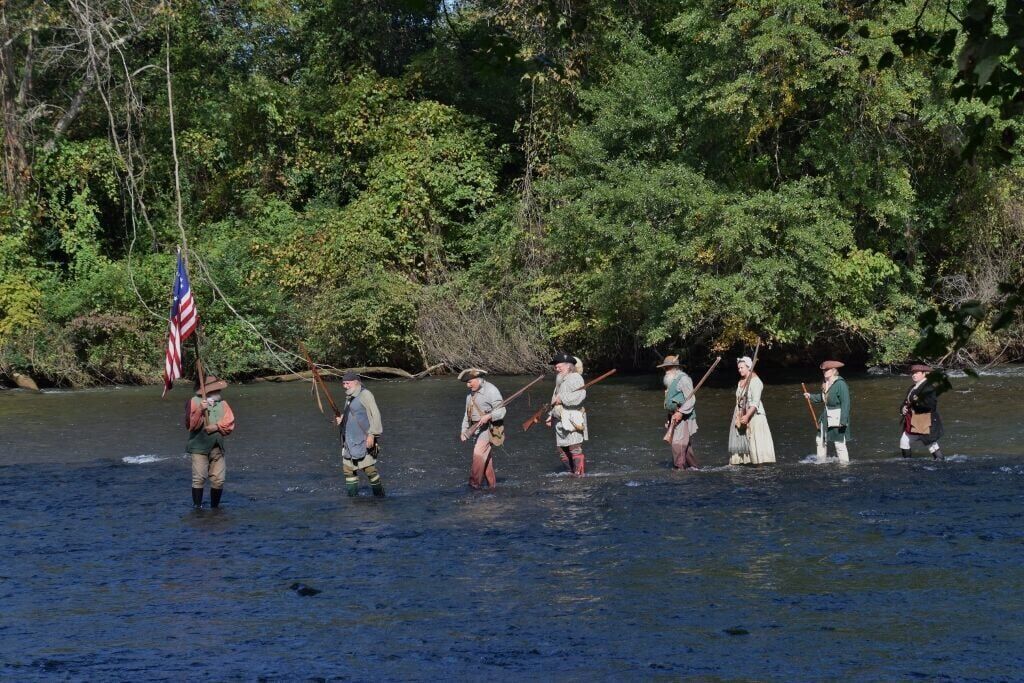
Revolutionary War patriot reenactors cross the Catawba River during the 2020 Revolutionary War Days in Burke County.
Battle of Guilford Courthouse
In 1781, the armies of British General Charles Cornwallis and Patriot Major General Nathanael Greene fought at Guilford Courthouse after a long campaign in the Southern colonies. Though the British ultimately were victorious at the battle, they suffered a devastating loss of lives.
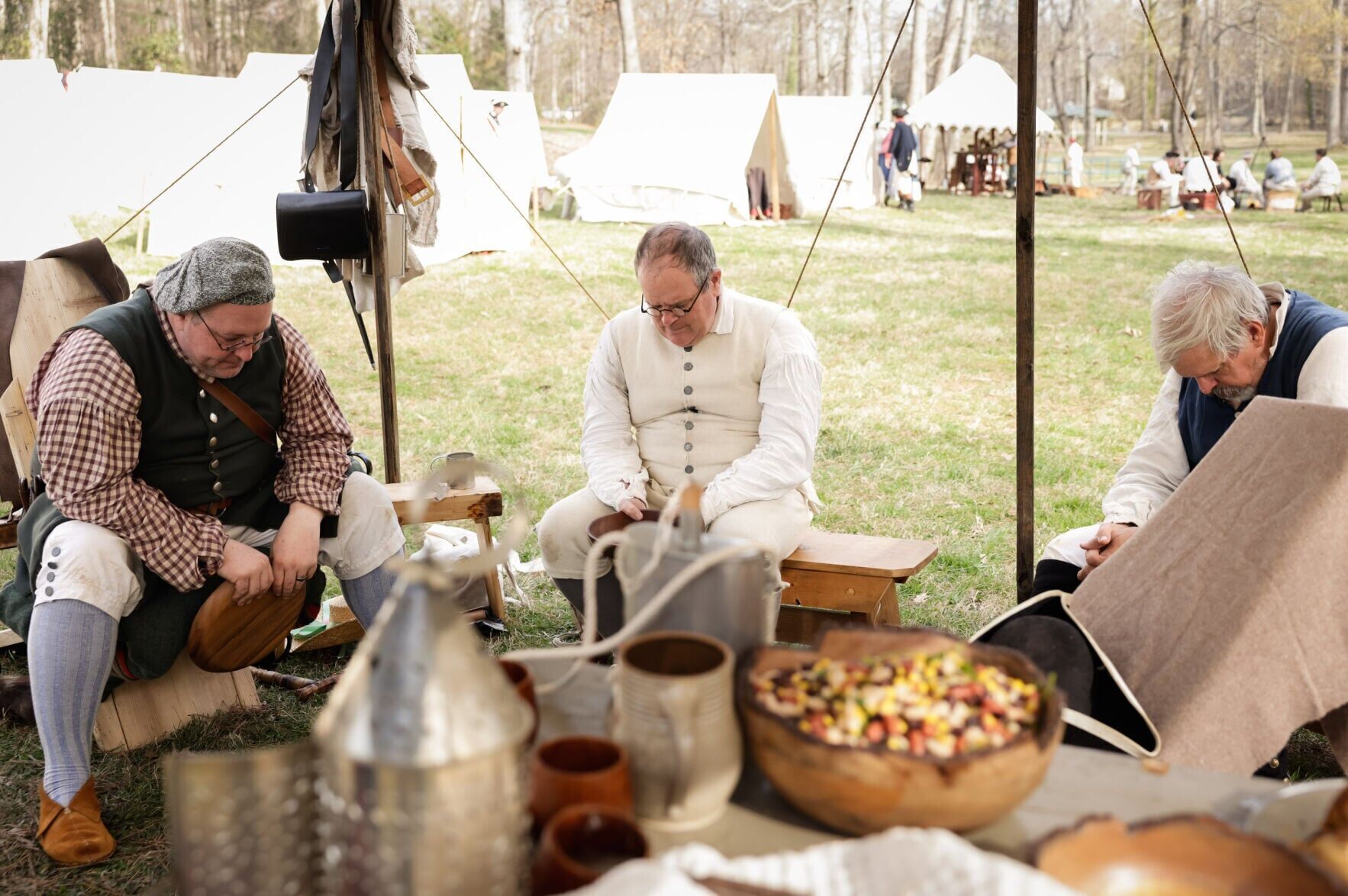
Soldiers with the 6th N.C. Regiment, Matthew Comprix (from left), David Nelson and Daniel Schlueter pray before eating at the encampment for the Battle of Guilford Courthouse Reenactment on Saturday, March 14, 2026, at Country Park in Greensboro.
Due to his substantially weakened force, Cornwallis retreated out of the Carolinas and was eventually defeated months later at Yorktown. Despite the loss of the battle, the Patriot forces’ impact on the British troops was significant.