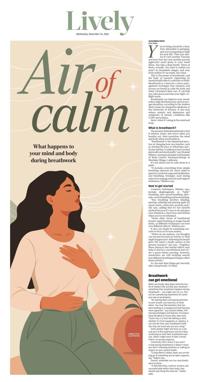


Air of calm
What happens to your mind and body during breathwork
You're being chased by a bear. Your adrenaline is pumping, and you're preparing to fight for your life. Then you realize it's just another Tuesday and your boss has sent another passive aggressive nasty-gram to your email inbox. You take a deep breath. Three of them, actually. You start to realize you aren't in immediate danger, and your body realizes it's an email, not a bear.
This is the power of breathwork, and the body of research supporting its mental health effects continues to build. Breathwork is a term for a stress management technique that channels and focuses on breath to calm the body and mind, Cleveland Clinic says. It can help you calm down and relax your fight-or-flight mode.
Breathwork can improve your mood, reduce high blood pressure and encourage relaxation, according to the Andrew Weil Center for Integrative Medicine at the University of Arizona. It also may reduce anxiety and depression and symptoms of chronic conditions like COPD and asthma.
Here's what it's doing in the mind and body.
What is breathwork?
The premise behind breathwork is that it releases toxins and stress when you breathe out, then nourishes the mind and body when you breathe in.
"Breathwork is the intentional practice of changing how you breathe, such as slowing the pace or following a particular rhythm, to influence how you feel physically and emotionally," says Shannel Elhelou, neuropsychologist and founder of Brain Centric Neuropsychology in Westlake Village, California.
It's not always just to calm down in a panic.
"It includes everything from simple breathing exercises for stress relief to practices rooted in yoga and meditation, and breathing strategies used during exercise to manage exertion and support endurance," Elhelou says.
How to get started
Common techniques, Elhelou says, include diaphragmatic or "belly" breathing, slow-paced breathing, alternate-nostril breathing and box breathing.
"Box breathing involves inhaling, pausing, exhaling and pausing again for equal counts, often four seconds each," she says, adding that it's her favorite method because it's easy to do and gives your attention a clear focus and rhythm when you're overwhelmed.
"Some other forms of breathwork involve rapid breathing or longer breath holds, so different techniques can have very different effects," Elhelou says.
It also can simply be something concrete to focus on to ease anxiety.
"When we are anxious, our thoughts can become focused on worries or what might happen next. Following the breath gives the mind a steady anchor in the present moment," she says. "Together, these physical and mental effects may help us feel less overwhelmed and create a pause before reacting. However, researchers are still studying exactly how different breathing techniques affect brain activity."
So, the next time things get stressful, take a deep breath. Or three.
Breathwork can get emotional
When you finally slow down amid the hustle of modern life and feel your emotions — something that sometimes happens during breathwork — you might start to cry. This can be a perplexing experience for someone new to breathwork.
"By slowing down and paying attention to your breath, you have less to think about. You may feel emotions that you were holding at a background level become more apparent," says Sanam Hafeez, NYC neuropsychologist and director of Comprehend the Mind in Forest Hills, New York. "Some may cry from the feeling as well, whether it's from happiness or sadness. It can also be from your breathwork itself. You may not know why you are crying."
Some people might see tears as a natural part of the experience and let it flow, continuing on with their breathwork exercise. Others might want to take a break. There's no wrong response.
Conversely, don't stress if you aren't crying during breathwork; it doesn't mean you aren't releasing emotions or making an impact on your mental health.
"Crying doesn't always mean you are letting go of something you've been suppressing," Hafeez says.
Overall, remember you can stop breathwork anytime.
"If they feel dizzy, numb or anxious and uncomfortable within their body, they should stop doing the exercise," Hafeez adds.