
Tightening their belts
Cobblers, tailors are seeing uptick in customers driven by weight loss drug boom
BUSINESS
Lorraine Scott has spent at least $300 to tailor her pants and jeans since losing 60 pounds on weight-loss drugs over the past year.
"Most of the things in my closet didn't fit anymore," the 42-year-old Atlanta resident said. Known as Lorraine Kamesha to her YouTube followers, she opted to alter her favorite pairs of pants instead of investing in new ones as her weight fluctuated, while turning to fast fashion for the rest of her wardrobe.
U.S. consumers taking weight-loss drugs like Novo Nordisk's Ozempic and Eli Lilly's Mounjaro turn to cobblers and tailors to save money while shedding pounds, motivated in part by a cost-of-living squeeze and rising out-of-pocket costs for the drugs as U.S. employers increasingly drop GLP-1 coverage.
Over the past year, leather repairers saw a spike in requests for their services due to rapid weight loss — not just for belts, but also for shoe and bag strap adjustments tailored to customers' trimmer bodies.
The uptick in demand for alterations underscores how weight-loss drugs upend the retail sector, with some corners of the industry well-positioned to benefit while others struggle to adapt. About 11% of U.S. adults are on GLP-1 drugs to lose weight, according to Gallup, forcing millions of consumers to look for affordable ways to revamp their wardrobes.
High demand
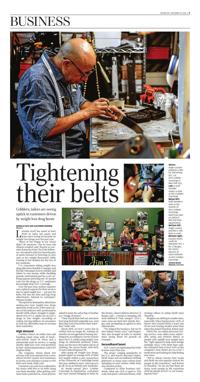
Cobblers Direct, an online shoe and handbag repair shop with 25 brick-and-mortar stores in Texas and a nationwide mail-in service, is seeing double-digit year-over-year growth in its belt-shortening business, said CEO Stephen Kelly.
The company, whose about 100 artisans will soon operate from a new, almost 30,000-square-foot warehouse in Austin, now shortens as many as 500 belts each week, Kelly said.
Customers, he said, have walked into the stores with five or six belts slung over their shoulder. After getting a few more holes punched in, some patrons asked to keep the extra flap of leather as a "badge of honor."
"They'll pull their belt out and show how long their belt originally was. And then they tuck it back into their waistline," Kelly said.
About 80% of GLP-1 users live in clothes that no longer fit, waiting six months on average before buying anything new, according to a survey of more than 700 U.S. adults using weight-loss drugs by telehealth platform Trimi. Jeans are the most disrupted article of clothing, the survey found, with 90% of users lamenting poor fit.
After going off weight-loss drugs, people regain on average 60% of their lost weight within a year, researchers at the University of Cambridge found this year, adding to users' reluctance to go all-in on an entirely new wardrobe.
At family-owned Jim's Cobbler Concierge in Manhattan, customers last year started bringing in belts by the dozens, client relations director CJ Burgos said — a trend so sweeping, the store dubbed it "belt-zempic." GLP-1 users even see their feet shrink, Burgos said, prompting an uptick in shoe adjustments.
"It's helped the business, but we've also helped clients save," said Burgos, who also brought in belts to shorten since losing about 60 pounds on Ozempic.
Secondhand boost
GLP-1 users are tightening their belts in more ways than one.
The drugs' surging popularity in the U.S. also boosts discount chains, thrift shops and secondhand clothing platforms as many users refrain from splurging on new clothes while their size remains in flux.
Compared to other business tailwinds, what sets GLP-1s apart is "the scale and speed," said Alon Rotem, chief strategy officer at online thrift store ThredUp.
Shoppers are shifting to smaller sizes, especially when buying jeans: 43% of buyers who started above a waist size 28 are now buying smaller jeans than when they joined ThredUp, Rotem said.
Stitch Fix, an online personal styling service, now offers more adjustable sizing and stretchy fabrics so people who rapidly lose weight have the "right apparel to help them bridge multiple sizes," CEO Matt Baer said. He estimated that at least 20% of the company's new clients are on a GLP-1 medication and looking for help finding new sizes.
"We've always known that resale and thrift are very popular choices for people in life transition," said Rotem of ThredUp. "As we see that there are many more people in life transition with the advent of GLP-1s, we're leaning into that."