
Green lıvıng
Climate-focused project brings hope to Rome suburb
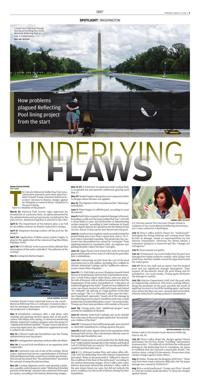
Left: A child performs a wheelie past murals reading "Market" and "No Fear" in Italian at Rome's Corviale housing complex.
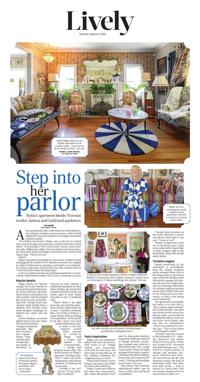
Above: Local printmaker Alessandro Fornaci examines a printing plate in his Corviale workshop on July 15.
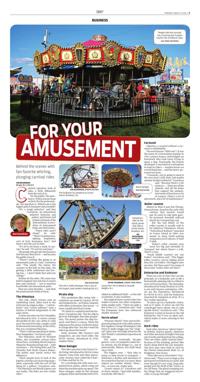
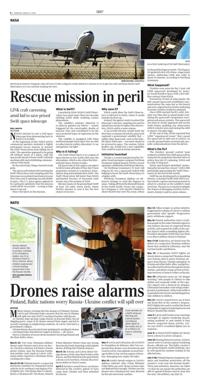
Rome's kilometer-long Corviale housing complex, nicknamed "Il Serpentone" or "The Big Snake," is part of an EU-backed project that is refurbishing public buildings, green areas and communal spaces to improve climate resilience and social inclusion for about 4,500 residents.
Local printmaker and longtime resident Alessandro Fornaci walks through a corridor at Corviale in Rome on July 15.
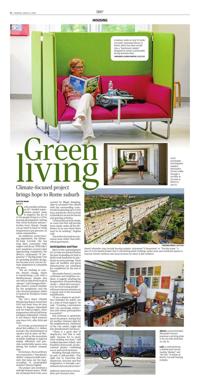
A woman reads on July 15 inside Corviale's renovated library in Rome, which has been turned into a "bioclimatic shelter" designed to remain comfortable during extreme heat.
HOUSING
On the outskirts of Rome, an EU-funded regeneration project seeks to improve the lot of 4,500 people living in a 1970s housing development, betting that social inclusion and protection from climate change can go hand in hand as rising temperatures put pressure on urban communities.
An ambitious social housing experiment, the kilometer-long Corviale site has long been associated with neglect and decay. With Italy's post-pandemic recovery plan approaching completion, the district, nicknamed "Il Serpentone" ("The Big Snake") for its sprawling Brutalist design, has become a test case for climate adaptation in vulnerable city areas.
"We are working to combat climate change, which is transforming a city with a Mediterranean climate into one with an objectively tropical climate," said Giuseppe Battaglia, Rome's council member for the peripheries and the city's recovery program, which is backed by European Union funding.
The city's latest Climate Monitoring Report found that 2025 had more than 40 days above 95 degrees Fahrenheit and 101 tropical nights, when temperatures did not fall below 68 degrees Fahrenheit. Overall, it was Rome's third warmest year since 1991, after 2024 and 2022.
In Corviale, an investment of about $66 million U.S. dollars includes the refurbishment of squares and an open-air theater, as well as the renovation of public buildings to improve energy efficiency and provide comfortable spaces even during the hottest summer days.
For instance, the local library was turned into a "bioclimatic shelter" using recyclable materials that keep out the heat, according to municipality architect Alessia Peghini.
The project also involved a redesign of green spaces. While the reclaimed West Park, once scarred by illegal dumping, aims to reconnect the suburb with the surrounding countryside by planting up to 9,500 trees and shrubs, the East Park is intended as an area for leisure and sporting activities.
"A bench placed in the shade, or a new tree that will provide more shade, make all the difference in an area where there used to be nothing," Peghini said.
The work is focused on communal areas rather than individual apartments.
Anticipation and fear
Most of the redevelopment in Corviale was finished before the June 30 deadline for Italy to finish work funded by its pandemic recovery package. Some open-air facilities and green infrastructure are scheduled for completion by the end of August.
Alessandro Fornaci, a master craftsman and longtime resident, is eagerly awaiting the inauguration. His printmaking studio — which also runs projects for local young people — will move into new premises in a square next to the renovated amphitheater.
"It was a shame to see facilities intended for public use in a state of total neglect," he said. "Creating a mechanism that can encourage interaction and citizen participation is essential."
Not everyone is optimistic about the project, fearing that yet another visionary plan for the neighborhood, southwest of the city center, might fall into abandonment and decay.
"There is a great deal of skepticism, but that is only right, because for so many years nothing was done," said resident Massimo Vallati, who founded Calciosociale, an educational project combining soccer and social inclusion.
Breaking through mistrust, he said, is still possible: "The right way to overcome that skepticism, that fear and that resignation, is through commitment and concrete actions."
Additional reporting by Antonio Denti and Vincenzo Livieri.