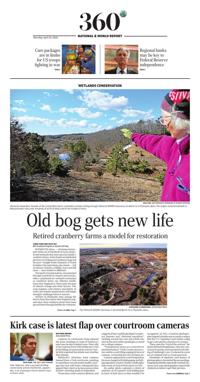

QUESTION OF INDEPENDENCE
Regional districts may be key front in Trump battle for central bank

Renovations continue at the Federal Reserve Board building in Washington, D.C.

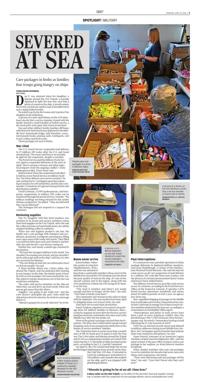
U.S. President Donald Trump, left, and Federal Reserve Chair Jerome Powell speak during a July 24 tour of the Federal Reserve Board building, which is under renovation.
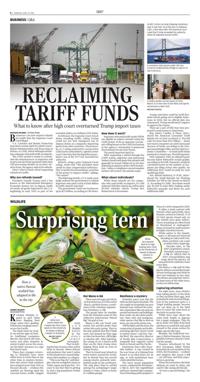
Cook
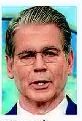
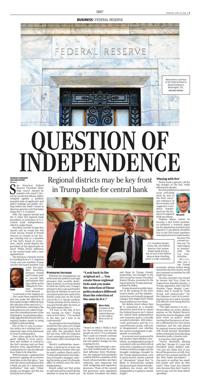
Bessent
BUSINESS| FEDERAL RESERVE
San Francisco Federal Reserve President Mary Daly wasn't elected by popular vote, wasn't chosen by an elected official, didn't compete against a publicly revealed slate of applicants and didn't undergo any public vetting before her bank's board of directors gave her a job that helps shape the U.S. economy.
Still, she regards herself and the 11 other Fed regional bank presidents as mainstays of U.S. central bank independence, which is under threat.
President Donald Trump this month said he would fire Fed Chair Jerome Powell if Powell chooses to remain in his longer-running role as a member of the Fed's Board of Governors, which would deprive the president of the opportunity to boost White House influence at the central bank with a new appointment.
The Fed faces a historic test in its standing from a U.S. Supreme Court case over whether Trump can fire Fed board member Lisa
Cook, the muddled transition between Powell and Trump's pick to succeed him and reforms that may still be in the offing from Treasury Secretary Scott Bessent.
"Look back to the original act … You create these regional Feds and you make the selection of those policymakers different than the selection of the ones in D.C.," Daly told Reuters, referring to the Federal Reserve Act's effort to balance the centralized power of the Washington-based and presidentially appointed Fed board with 12 regional leaders meant to bring insight to policymaking.
Five of the 12 vote on monetary policy on a rotating basis — important votes a Fed chief needs to sway in setting policy.
They often speak of the time spent talking to local executives and workers as central to the Fed's mission and say their distance from appointment or confirmation by elected officials frees them to be objective.
With the Senate-confirmed Fed governors signing off on reserve bank hires in the first place, "you have the checks and balances that I think are part of a democratic institution," Daly said. "Other people can disagree, but this has stood the test of time."
Pressures increase
Whether the arrangement can withstand the political and legal pressures that recently developed, however, is an issue related to both the battle over Trump's attempt to fire Cook and Powell's decision on whether to serve out a board term that lasts until 2028. Powell could stay on the board even if the U.S. Senate confirms Trump nominee Kevin Warsh to succeed Powell after his term as Fed chief expires May 15.
"I'll have to fire him if he's not leaving on time," Trump said on Fox News. "I've wanted to fire him, but I hate to be controversial."
An attempt to fire Powell likely would face the same sort of legal challenges that left Cook in her seat after the president fired her last year, with the Supreme Court seemingly poised to leave her in place after a hearing in the case.
Warsh's confirmation, meanwhile, is held up by at least one key Republican senator who says he won't confirm Warsh until a Trump administration investigation of Powell is dropped, viewing the probe as part of a broader effort to whittle away the Fed's independence.
Powell called out that probe as well and said he would decide whether to keep his board seat "based on what I think is best for the institution and for the people we serve." It is a rationale that could see Powell continue at a Warsh-led Fed as an ongoing vote against changes he sees as going too far.
Though hired through a process that traditionally has minimal influence from Washington, the regional Fed presidents could be fired by a majority of the board, whose members also have authority over important Fed staff, budgeting and regulatory decisions. Three of the current Fed governors were appointed by former President Joe Biden and three by Trump. Powell, meanwhile, was brought to the Fed's board by former President Barack Obama, promoted to the top position by Trump and reappointed by Biden.
Trump showed no public interest in the makeup of the Fed's reserve banks, and the administration has not formally proposed changes that might boost White House influence over them.
Yet debate about where they fit is enmeshed in a broader discussion about how to square the Federal Reserve Act's intent for central bank independence over monetary policy, a broadly accepted principle, with democratic governance and the U.S. constitutional system, with lots of disagreement over whether the current arrangement is adequately accountable.
At a recent event sponsored by the Shadow Open Market Committee, an independent group of economists who are often critical of the Fed, Columbia Law School Professor Kathryn Judge said she thought challenges brought by the Trump administration, even if unsuccessful, meant a period of "disruption" ahead that "is likely to dramatically weaken the ground upon which Fed independence has stood, and that independence is going to remain fragile."
'Playing with fire'
Warsh made a generic call for big changes at the Fed, while offering few details.
Bessent published an extensive essay criticizing what he sees as the Fed's excessive influence in the economy, and suggested a residency requirement for the hiring of its regional Bessent bank presidents.
Stephen Miran, before he became a Fed board member, co-authored a research paper for the Manhattan Institute that argued U.S. presidents should be free to fire Fed board members and regional reserve bank leaders because the current system was "in some degree of tension" with the U.S. Constitution.
Miran, who was a top Trump economic adviser before being elevated to the Fed's board, would not comment on whether he still holds that view.
The idea, however, was echoed by former Fed Vice Chair for Supervision Randall Quarles, a Trump appointee who told the Shadow Open Market Committee that it would be "both wrong and unnecessary" for the Supreme Court in its pending decision on Cook to insulate Fed officials from being fired by the president.
"The right answer is to say … the president can, in fact, dismiss anyone on the Federal Reserve Board because he disagrees with their views on policy," while trusting that the process of Senate confirmation for new board nominees and the role played by regional reserve bank leaders still would prevent immediate political demands from hijacking monetary policy, Quarles said.
A response came quickly.
"You're absolutely playing with fire," former St. Louis Fed President James Bullard said. "Do you not think that if you fire all the governors at will, they will just turn around and fire all the (Fed bank) presidents? … One party or another has swept into power and what do they want? They want low interest rates because they don't want to have to pay a lot for their deficit spending."
"Look back to the original act … You create these regional Feds and you make the selection of those policymakers different than the selection of the ones in D.C."
Mary Daly, president of the san Francisco Federal reserve, on the Federal reserve act of 1913