
MINES FOR THE TAKING
How the US could clear explosives from the Strait of Hormuz

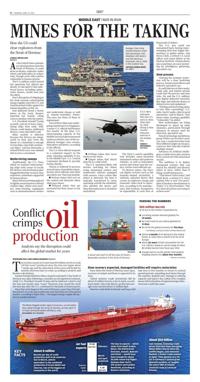
Avenger-class mine countermeasure ships USS Devastator, USS Gladiator, USS Sentry and USS Dextrous maneuver July 6, 2019, in the Arabian Sea.

A U.S. Navy helicopter flies over U.S. and U.K. Navy ships Sept. 10, 2018, during a mine countermeasures exercise in the Arabian Sea.
MIDDLE EAST| WAR IN IRAN
As the United States embarks on clearing mines from the Strait of Hormuz, it could draw on drones, explosive-laden robots and helicopters to reduce risks, though crews still could be vulnerable to Iranian attacks.
The U.S. military said it started the operation but off ered few details. It said April 11 that additional forces, including underwater drones, would soon join the effort.
Iran's disruption of shipping in the strait severely curbed global energy supplies since the U.S. and Israel launched strikes against the Islamic Republic on Feb. 28.
Iran deployed about a dozen mines in the strait, Reuters reported last month, citing sources familiar with the matter.
U.S. President Donald Trump recently said all of Iran's minelaying ships were sunk. Still, Tehran could deploy additional devices, some specialists said.
Mine warfare is effective because the devices are cheap, costly to clear and "even the threat of a minefield is enough to stop ships, especially commercial ships," said Jon Pentreath, a retired British navy rear admiral who is now a consultant.
Modernizing sweeps
Traditionally, the U.S. Navy relied on manned minesweeping ships with sonars to locate the devices and mechanical gear dragged behind the vessel to clear explosives, sometimes supported by human divers.
Many of those are being replaced by lighter vessels known as littoral combat ships, which carry modern mine-hunting equipment such as semiautonomous surface and underwater drones as well as remote-controlled robots. The navy has three of these in deployment.
Two of those ships were undergoing maintenance in Singapore, a senior U.S. off cial told Reuters last month. At the time, U.S. minesweeping capacity in the Middle E ast included unmanned undersea vehicles, four of the traditional Avenger-class vessels, helicopters a nd divers, according to the off cial.
The U.S. Navy did not respond to a comment request on the mine-clearing capability it has in the Middle East. U.S. Central Command declined to provide further details.
Tehran is believed to possess several types of maritime mines, former naval off cials and other specialists say. They may include:
■ Bottom mines that rest on the seabed and detonate when ships pass above.
■ Tethered mines that are anchored but float closer to the surface.
■ Drifting mines that move freely on the water.
■ Limpet mines that attach directly to a ship's hull.
The U.S. operation likely will involve searching for mines using unmanned surface and underwater vehicles equipped with sensors. Once a mine-like object is detected, the data is typically transferred to crews operating outside the minefield, who identify the device and then determine how it should be neutralized.
The Navy's search capability now includes sonar-mounted unmanned surface and undersea vehicles, as well as helicopters used to spot mines near the surface, former naval off cials say.
To destroy mines, the Navy can deploy systems such as the torpedo-shaped Archerfish, a remotely operated device that carries an explosive charge and transmits video back to operators, according to its manufacturer, BAE Systems. Designed to be expendable, it costs tens of thousands of dollars.
The U.S. also could use unmanned boats towing minesweeping sleds that trigger detonations or gather mines, said Bryan Clark, a retired U.S. naval off cer and senior fellow at the Hudson Institute. Human divers also sometimes are used, including for intelligence gathering, specialists say.
Slow process
Clearing the strategic waterway will be a slow, multistep process, former naval off cers and industry specialists say.
It could take two or three weeks, Clark said, and Iranian attacks could slow the process and raise risks. He said the U.S. military may deploy defensive measures like ships and airborne drones to defend crews and equipment.
"Finding and destroying mines is very time consuming," U.S. Adm. Daryl Caudle, chief of naval operations, said in March. That leaves mine-clearing capability "vulnerable," he added.
New technologies are being developed to speed up mine clearance, particularly through advances in sensors used for detection, specialists say.
French technology and defense group Thales says its latest sonar can scan a suspected mine from three different angles in one pass, a process that typically requires multiple sweeps.
Advances in artificial intelligence enable more data analysis to be carried out with unmanned vessels.
The ambition is to deploy unmanned systems that can search for, identify and destroy mines at once, rather than it being a multistep process.
"That doesn't exist today," said Mark Bock, a retired U.S. Navy captain who is now vice president of business development at Thales' U.S. Navy business. "But it is what all nations are trying to achieve now."