
THE TRUTH BEHIND TICKET QUOTAS
In some cities, officers face pressure to meet 'performance goals'
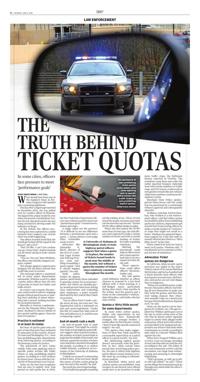
The patchwork of laws prohibiting ticket quotas varies widely, with some applying only to specific police actions like traffic tickets or only prohibiting explicit quotas.
LAW ENFORCEMENT
What should have been one of the happiest times in Brianna Longoria's life spiraled into a yearslong nightmare.
The day after Longoria got married in December 2024, she was pulled over by a police officer in Phoenix. She figured the ordeal would be over when she passed a breathalyzer test, but she was shocked to learn she was being arrested for driving under the influence of drugs.
At the station, the officers processing her were captured in a candid moment that Longoria says reveals what was really happening.
One officer worried aloud that she would get kicked off the squad if she doesn't "get a DUI."
"But I'm like, I can't just conjure one up. I have tried," Anette Hannah can be heard saying in body camera footage.
"You can. You can," Mary Metheny, the officer who initially stopped Longoria, replied.
The charges against Longoria were dropped, but she filed a lawsuit that could take years to resolve.
The exchange reflects a sentiment felt in many police departments nationwide. Whether or not it's called a quota, police officers face all sorts of pressure to hand out tickets and make arrests.
In a worst-case scenario, the pressure could result in officers stopping people without good reason or making strict policing of minor infractions into a money-making machine for local governments.
Mercedes A. Fortune, a spokesperson for the Phoenix Police Department, declined to discuss details of the case but said the agency "does not have DUI quotas."
Practice is outlawed in at least 26 states
But fears of quotas gone awry are part of why they have been outlawed in some parts of the country. At least 26 states and Washington, D.C., have laws prohibiting police departments from enforcing quotas, according to the Brennan Center for Justice.
The patchwork of laws varies widely, with some applying only to specific police actions like traffic tickets or only prohibiting explicit quotas, according to a 2021 analysis by Shaun Ossei-Owusu with the University of Pennsylvania Law School.
Some say the laws have loopholes that are easy to exploit. New York passed an anti-quota law in 2010, but New York Police Department officers were still pressured to meet new "performance goals" around arrests, tickets and stops.
A judge called out the practice: "It is difficult to see any difference between a performance goal and a quota …" former district court judge Shira Scheindlin wrote in 2013.
Advocates like Alexandra K. Block, director of the ACLU's Criminal Legal System and Policing Project, want anything resembling a quota ended: "And it should happen quickly," she said.
Some police leaders do oppose quotas, particularly those intended to generate money for local governments. But others say banning quotas would prevent them from setting clear expectations and evaluating their employees, a point recently illustrated by the Central Ohio Chiefs Association.
"Say an officer hasn't made a single arrest all year, not even one," the organization said in a statement on new anti-quota legislation. "Under this bill, if a supervisor takes note of that and addresses it, it could be seen as imposing a quota."
End-of-month rush a myth
An end-of-month rush to meet ticket quotas? That might be a myth. One study of state highway patrol officers suggests when a quota is in place, the number of tickets issued tends to peak near the middle of the month, but without a quota the number of tickets stays relatively consistent throughout the month, according to co-author Griffin Edwards, a professor of economics at the University of Alabama at Birmingham.
"I think our research is interesting in that it does, at the very least, dispel this rumor of ticket counts going up near the end of the month," he said.
The myth has been longstanding. "I'd actually have people screaming out the window at me, 'Oh no, it's the end of the month, everyone move their cars because the cops are out,'" former NYPD officer Jillian Snider recalled.
When she first joined the NYPD more than 20 years ago, she said officers were expected to make a certain number of arrests and write a certain number of tickets for traffic or parking violations.
Meeting the benchmark could help an officer move into a more specialized unit or secure a request for time off, she said.
Those expectations could affect officers' decisions, Snider said.
She said quotas could influence whether an officer chooses to respond to a low-level offense with a stern warning or a full-fledged arrest, particularly during slow street crime months in the winter. And the practice put a strain on the community's relationship with police, said Snider, who has since retired.
Quotas a 'dirty little secret' for some departments
As more states outlaw quotas, Snider said expectations in law enforcement have dramatically changed. Her younger brother, a rookie officer in Westchester County, "doesn't have like specific numerical targets," she said.
"His agency, they make suggestions of what they think should be a reasonable expectation of a patrol officer in a given month," she said.
But eliminating explicit quotas doesn't necessarily solve the problem. In fact, when several states passed laws restricting police quotas, the rate at which state highway patrol officers issued citations actually went up, according to Edwards' recent analysis.
In Maryland, where arrest and citation quotas are prohibited, state troopers in one barrack were offered candy bars as an incentive to make more traffic stops, the Baltimore Banner reported in October. The revelation came three years after the outlet reported troopers statewide were told certain numbers of traffic stops and DUI arrests could result in even greater rewards like new vehicles while lower numbers could mean disciplinary action.
Maryland State Police spokesperson Elena Russo said the candy box was purchased by a commander without approval and subsequently removed.
In Illinois, state Rep. Patrick Sheehan, who worked as a law enforcement officer, said that while current law prohibits police from establishing quotas for citations, departments get around that by pressuring officers to make a certain number of "contacts," or stops that might not result in a ticket. Sheehan has garnered bipartisan support for a law that seeks to remedy what he described as a "dirty little secret" in the state.
When asked if he had ever had to meet such quotas, Sheehan said, "I would prefer not to comment on that, just for fear of retaliation."
Advocates: Ticket quotas are dangerous
In California, where an anti-quota provision was added to the state's vehicle code in 1976, lawyer Matthew McNicholas said he has handled half a dozen lawsuits from officers who faced quotas in recent years. McNicholas said quotas are not only illegal, they're dangerous.
"When you establish quotas, under the law, then police officers start falling all over themselves to make sure they write the quotas, and then they start taking chances they otherwise wouldn't take on a motorcycle because their livelihood now depends on it," he said.
Some say the quotas can be dangerous for civilians, too. Chicago resident Eric Wilkins said he goes out of his way to avoid certain areas of the city that he knows police regularly target to satisfy their alleged traffic stop quotas. Black and Latino drivers are more likely to be stopped and subjected to use of force than their white counterparts as a result, according to data cited in a lawsuit Wilkins filed against the city.
Police have stopped Wilkins once or twice a year on average, including at least one time after he sued the city, according to the suit. The father of two and community activist said the encounters can range from embarrassing and annoying to downright frightening.
"Will I go home, or will I go to jail, or will I get killed?" he said. "Those are the things that instantaneously go through your mind while the officer's behind you."
A University of Alabama at Birmingham study of state highway patrol officers suggests that when a quota is in place, the number of tickets issued tends to peak near the middle of the month, but without a quota the number of tickets stays relatively consistent throughout the month.