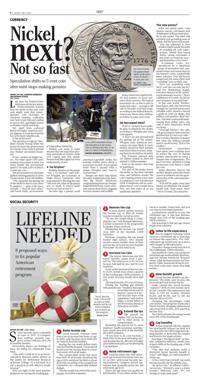


Nickel next? Not so fast
Speculation shifts to 5-cent coin after mint stops making pennies

For every nickel, the government spent 13.78 cents, a loss of nearly 9 cents per coin.

A U.S. Mint employee places the last penny to be struck into a coining press Nov. 12 at the U.S. Mint in Philadelphia.
CURRENCY
Last year, the United States Mint pressed the last penny. Preservationists warned that the death of the one-cent coin might seed dire consequences: coin shortages at checkout counters, confusion over how to pay bills not ending in zero or five, and higher prices as retailers would round up.
Yet, apart from scattered penny shortages, American society appears to have survived the loss of its least valuable coin.
Is the nickel next? The question is logical: President Donald Trump killed the penny because the government lost money every time it pressed one. Nickels are money-losers, too.
In fact, nickels are bigger losers. The mint spent 3.69 cents making every penny in 2024. For every nickel, the government spent 13.78 cents, a loss of almost 9 cents per coin.
The government lost about $18 million minting pennies in 2024. On the nickel, it lost $85 million.
"The argument for getting rid of the nickel is that it costs more to produce — quite a bit more, actually — than its face value," said David Smith, an economist at Pepperdine University. Nickels cost more to make because they are larger than pennies and made of costlier stuff: 75% copper and 25% nickel. Pennies look like copper but were made mostly of zinc.
A 'no-brainer'
Ridding America of the penny "was a no-brainer," said Robert Whaples, an economist at Wake Forest University who long argued for ditching the coin "because the value of the penny was so small, it wasn't really worth our time to use it."
Decades ago, a penny could purchase a gumball. Today, the average worker earns about a penny per second. If you spend more than a second with a penny, Whaples said, "you've wasted time."
Pennies ran short long before the mint stopped pressing them. One big reason: Americans stopped picking them up. Pennies languished between couch cushions and on closet floors, clogging vacuum cleaners and landfills.
Many Americans regard nickels and pennies as more nuisance than currency. The typical household sits on $60 to $90 in neglected coins — enough to fill one or two pint-size beer mugs, according to the Federal Reserve. Americans throw away millions of dollars in coins every year.
On borrowed time?
The U.S. Treasury has no public plan to eliminate the nickel, according to Whaples and other coin experts.
"I don't see any groundswell for getting rid of the nickel," Whaples said. American consumers are more likely to carry nickels around in their pockets and return them to stores, keeping them in circulation, he noted.
The Treasury pressed only 113 million nickels in 2024 but minted 3.2 billion pennies.
Even so, the nickel's days may be numbered.
The end of the penny leaves the nickel as the least valuable coin, and inflation erodes the coin's buying power every year. A stamp hasn't cost a nickel since 1968. A telephone call on a payphone hasn't cost a nickel since 1951, not that many of us use payphones anymore.
The new penny?
With the penny gone, coin experts reason, consumers and shopkeepers will lean more heavily on the nickel. The mint will probably end up making more of them, and the losses will mount. One big unknown is how retailers might handle the math of rounding off cash transactions. Would they round down, saving consumers a few cents, or round up, earning themselves a few cents?
A Common Cents Act, introduced by a bipartisan group of lawmakers last year, would round cash transactions to the nearest 5 cents, a potentially fairer solution. That bill hasn't progressed, but some states seek "rounding" laws on their own.
"Let's say something costs $4.91, and you can only pay $5," said Ute Wartenberg Kagan, executive director of the American Numismatic Society. "That's a difference of 9 cents. So, that is a lot of money if you add it up."
In the coin world, Wartenberg Kagan said, the Darwinian struggle for survival favors more valuable coins. America turned a profit in 2024 on dimes, $36 million, and quarters, $166 million. The mint could profit handsomely from dollar coins, she said, if more Americans would use them.
"Through history," she said, "all governments have had this problem that it's very cost-effective to make a big piece of money. But what the ordinary people need is small money. That is the conflict."
Government researchers have spent years studying ways to reduce the cost of making nickels, presumably by using a cheaper mix of ingredients. The goal, of course, would be to bring production costs below 5 cents per coin.
Some observers foresee the nickel's demise, given the steady march of inflation and the gradual erosion of the coin's purchasing power.
"It'll still be quite some time before we eliminate the nickel," Smith said. How much time? "Ten to 15 years," he estimates.