

NASA details moon base plans
Uncrewed missions will take supplies prior to astronauts' arrival

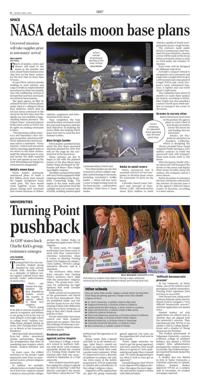
Artist's concept of astronauts working on the lunar surface.

Artist's rendering of a MoonFall drone operating near the lunar South Pole.
SPACE
Fleets of landers, rovers and drones will head to the moon in the months and years ahead before humans even step foot on the lunar surface for the first time in more than 50 years.
So says NASA, which is already working to send vehicles and cargo to build an unprecedented moon base less than two months since the trailblazing Artemis II mission that sent four astronauts on a historic lunar journey.
The space agency on May 26 outlined the first of three phases under what it's calling its Moon Base initiative, which aims to not just return astronauts to the moon for the first time since the Apollo era, but establish a longstanding human presence. The United States' renewed interest in the moon comes as NASA sets its sights on sending astronauts to Mars.
"The Moon Base will be America's and humanity's first outpost on another celestial world," NASA Administrator Jared Isaacman said in a statement. "Every mission, crewed and uncrewed, will be a learning opportunity as we return to the lunar surface, build the infrastructure to stay, and master the skills required to live and operate in one of the most demanding and dangerous environments imaginable."
NASA's moon base
NASA leaders previously announced plans to build a $20 billion moon base toward the largely unexplored lunar south pole. The base would come together across three phases during both uncrewed and crewed missions to deliver vehicles, equipment and infrastructure to the moon.
Once completed, the base would be where astronauts could live and work long term with the dual objectives of studying the moon while also helping NASA learn how best to send the first humans to Mars.
Blue Origin lander
NASA leaders unveiled details about the first three uncrewed missions planned for 2026 that will set the stage for the construction of the moon base.
Those ventures are due to begin in fall with the planned launch of the Blue Moon lunar lander being developed by billionaire Jeff Bezos' Blue Origin spaceflight company.
The Mark 1 variant of the lander will carry NASA equipment while targeting a landing on the Shackleton Connecting Ridge. The region in the lunar south pole can receive solar power from the sunlight and is in constant view of Earth, enabling uninterrupted communications, NASA said.
Two other landers are also due to launch in 2026 to deliver supplies and technology to the moon, including Astrobotic's Griffin lander — which will also carry a rover to begin testing travel on the lunar terrain — and Intuitive Machines' third Nova-C lunar lander.
NASA to send rovers
NASA announced that it awarded contracts to two companies to develop lunar rovers for astronauts to drive on the moon.
Colorado-based Lunar Outpost and Astrolab of Hawthorne, Calif., will each receive about $220 million to build vehicles capable of slowly navigating the moon's rough terrain.
The contract, made under NASA's Commercial Lunar Payload Services initiative, ensures a rover will be ready on the moon before astronauts return as early as 2028 under the Artemis IV mission.
Each rover will be designed for different objectives.
Astrolab's compact vehicle is designed to carry astronauts and cargo with a weight limit of up to 2,000 pounds and a top speed of 6 mph, NASA said. Lunar Outpost's rover, nicknamed Pegasus, is lighter and can travel about 3 mph faster.
The companies have about 18 months to ready their landers for launch, according to NASA. Blue Origin was also awarded a contract worth up to $468 million to transport the rovers to the moon.
Drones to survey sites
Before NASA puts boots back on the ground, the agency plans to send a fleet of four drones in 2028 to survey the moon for safe landing sites for astronauts.
NASA's Jet Propulsion Laboratory in Southern California, which is designing the drones, awarded Texas-based company Firefly Aerospace a $75 million contract to build the spacecraft that will transport them from Earth orbit to the moon.
After the launch, Firefly's Elytra spacecraft will transport the drones to the moon and deploy them about 30 miles above the surface, the company said in a news release.
NASA also plans to announce the four astronauts selected for the Artemis III mission June 9 at the agency's Johnson Space Center in Houston, according to a news release.