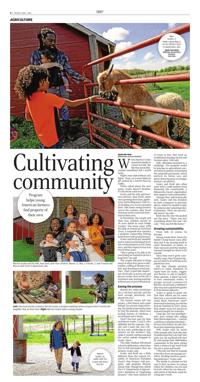


Cultivating community
Program helps young American farmers find property of their own

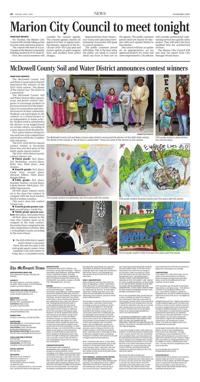
Mason Scales, 11, walks with his 2-year-old sister, Harriet.
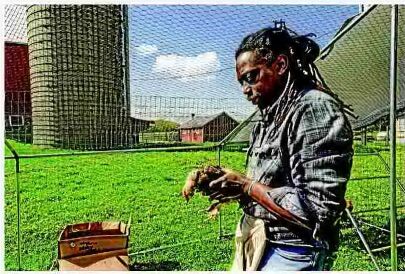
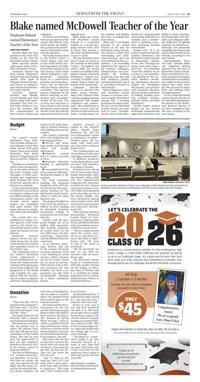
Right: Martice Scales holds a young rooster.
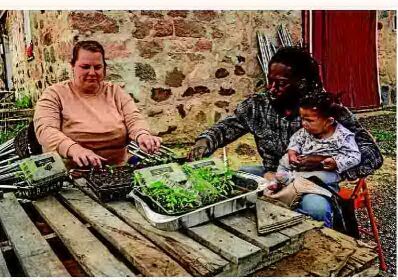
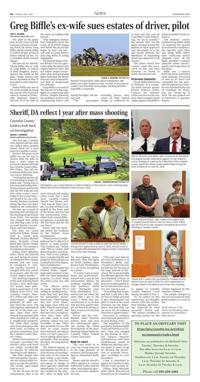
Left: Amy Kroll and her husband, Martice Scales, transplant seedlings while caring for their 9-month-old daughter, Rue, on their farm.

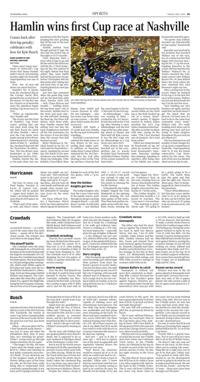
Martice Scales and his wife, Amy Kroll, with their children, Mason, 11, Max, 7, Harriet, 2, and 9-month-old Rue on their farm in Watertown, Wis.

Max Scales, 7, feeds a goat May 6 on his family's farm in Watertown, Wis.
AGRICULTURE
When Martice Scales moved his family to a farm last fall, the life they led in Milwaukee sometimes felt a world away.
Nights were dark without city lights. Their car is more likely to get slowed by a tractor than by traffic.
When asked about the new norm, Scales doesn't hesitate: It's his dream come true.
Scales and his wife and business partner, Amy Kroll, spent years growing their farm, apothecary and healing space, Full Circle Healing, on 2.5 acres of rented land. Like many young farmers across the country, they faced obstacles in the search for farmland of their own.
In November, the couple and their four children moved to 14 acres delete in rural Dodge County. The move came with the help of American Farmland Trust, a nonprofit that operates a program connecting retiring landowners with young farmers.
Scales and Kroll pay monthly rent to American Farmland Trust but run the property as if it's their own, and they expect to buy it in two to three years.
"We're going to be able to do everything we wanted to do for a long time," he said.
The couple still plan to bring much of what they grow to Milwaukee, selling at farmers markets and donating to food pantries. That's especially important, Kroll said, as prices rise and grocery stores close on the city's northwest side, leaving residents without easy access to fresh food.
Easing the process
Behind the white farmhouse sits a red barn and silo, and the back acreage previously was planted in corn.
The former owner left two ponies, a few llamas and a goat behind. On a recent sunny morning, the family traversed the farm to visit the animals, which now include dozens of chickens, a second goat and a sheep.
That's the best part for Max and Mason Scales, 7 and 11, who skillfully fed the animals. Harriet, just 2 years old, was a little less sure, preferring to stay hoisted on her mother's hip, while 9-month-old Rue watched the action unfold strapped to Scales' chest.
The older children still attend school in Milwaukee, where they love to tell classmates they are farmers, Scales said.
Scales and Kroll are a little different from the typical clientele of American Farmland Trust's Buy-Protect-Sell program, said program director Alison Volk. Though they still fit the U.S. Department of Agriculture's definition of "beginning farmers," who have farmed for 10 years or less, they have an established farming record and business plan, Volk said.
Still, affording farmland is a challenge. The program works by placing an agricultural conservation easement on farmland the nonprofit purchased, which restricts its future uses and drives down the price so younger farmers can afford it.
Scales and Kroll also often meet with a staff member from Renewing the Countryside, a Minnesota-based organization that supports rural communities.
Though they still technically rent, Scales said the freedom he feels compared to previous places, where he needed to play by someone else's planting rules, is immense. "Here, we can actually invest," he said.
Kroll was the one who picked out the farm. "There was just something about this one," she said. "This one felt like home."
Growing sustainability
There will, of course, be hiccups.
Strong winds blew down the family's hoop house soon after they put it up, leaving Kroll to stash thousands of plants in their sunroom until the weather warmed enough for them to be outside.
Since they won't grow commodity crops, they'll need to figure out what to do with the acres planted in corn.
But they already envision what's to come: Hundreds of raised beds for fruits, veggies and flowers to sell at markets. More animals. A fixed-up barn to host community events. A garage-turned-commercial kitchen. An orchard, a children's play area and a spiral herb garden to treat human ailments.
Scales is quick to point out that their efforts are for more than just a successful business. Some Black Americans aren't interested in farming, he told the Journal Sentinel in 2023, given that similar work was forced on enslaved people for centuries.
Long ago, his own grandparents were tricked into selling their Mississippi farm — land he could have someday inherited — for just a few dollars, he said. He's faced discrimination himself.
Still, Scales said, he wants other people who look like him to understand they can chart this path, too. He and Kroll will start by welcoming their Milwaukee community to the farm, giving them a chance to get away from the city's noise and bustle.
"The only way that we're going to be OK is if we can manage ourselves. Feeding ourselves, growing medicines," Scales said.
The family is certainly on the way to that, he feels, in a place where his children can run and be loud, where he can step outside and be at the farm, ready for a long day's work.