

PREP & PAMPER
Update your routine with these skin and hair products for men
Men's grooming has quietly become part of the daily routine, and not for the reasons you might think. This isn't about chasing trends or filling a shelf with products. It's about creating a few smart habits that make a difference.
A simple system works best: cleanse, treat, protect and repeat. Men's skin tends to be thicker and oilier, making targeted products and consistency more effective than an overcomplicated regimen.
The goal isn't perfection. It's looking rested, feeling confident and putting your best face forward every day. Consider it a practical approach to self-maintenance, one that has become less of a luxury and more of an expectation.
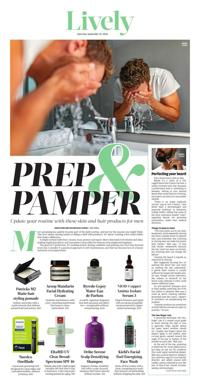
Patricks M2 Matte hair styling pomade
Defines and styles with a matte formula that delivers natural hold and texture. $60
Aesop Mandarin Facial Hydrating Cream
Hydrates and balances with a fast-absorbing moisturizer that leaves a clean, matte finish. $56
Byredo Gypsy Water Eau de Parfum
A subtle, signature fragrance that feels personal and effortless—recognizable without overpowering. $245
NIOD Copper Amino Isolate Serum 3
Targets firmness and repair with an advanced peptide serum powered by copper amino technology. $110
Norelco OneBlade
A precision grooming tool designed for clean edges and controlled stubble, without irritation. $40
EltaMD UV Clear Broad-Spectrum SPF 46
Shields skin with a lightweight, invisible SPF that won't clog or feel heavy. A key step in preventing premature aging. $45
Oribe Serene Scalp Densifying Shampoo
Supports thicker, healthier hair with a scalp-focused shampoo that boosts density without residue. $52
Kiehl's Facial Fuel Energizing Face Wash
Kicks off the routine with a clean, energizing face wash that removes oil and buildup without stripping the skin. $28
Perfecting your beard
Every beard starts with an idea.
Maybe it's a vision of a full, rugged beard that frames the face, a neatly trimmed style that sharpens a professional look or something in between. Getting to your desired beard often comes down to trimming, but experts say there isn't one perfect method.
"There is no single medically 'correct' way to trim a beard," says Dmitri Wall, a dermatologist and associate professor at University College Dublin, adding that some of the most commonly quoted "rules" regarding beards are grooming conventions, rather than medical directives.
Things to keep in mind
"The main points are to use clean equipment, avoid repeatedly shaving too close in people prone to ingrown hairs and remember that trimming or shaving does not make hair grown back thicker," Wall says. "It may look thicker temporarily because the hair shaft has been cut bluntly, but trimming does not change the follicle."
Cleaning the beard is equally as important as shaving.
Wall suggested focusing less on washing the beard hair and more on washing the skin underneath. A gentle wash routine is usually sufficient for people with healthy skin, he says, though certain indicators, like redness or dandruff on the beard, scalp, eyebrows or chest, could require additional steps.
An anti-dandruff shampoo once or twice weekly could help, but if the hair follicle is inflamed, Wall says it could be worth checking whether grooming tools like razors, clippers or ointments are perpetuating the problem.
"Greasier products can sometimes occlude follicles and worsen spots or pustules," he says.
The two-finger rule
A grooming technique, the two-finger rule is a simple visual guide to avoid shaving too high or low. It generally helps decide where the lower beard neckline should sit: "roughly two fingers above the Adam's apple in the midline, then curving gently upward toward the angle of the jaw or bottom of the earlobe on each side," Wall says.
At the end of the day, grooming is important for visual appearances, but keep an eye out for problems that could signal something deeper. Wall says a patchy beard or sideburn loss could be a sign of a scarring hair disorder, and added anyone with sudden, patchy, inflamed or scar-like loss of beard hair should consider seeing a dermatologist.
— Gavin Escott, USA Today