

5 days in Seoul
Must-see places in South Korea include palaces, gardens and the DMZ
Gangnam business district
Lotte World Tower skyscraper
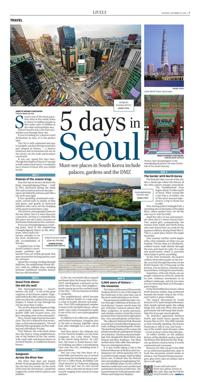
Throne room Geunjeongjeon in the Gyeongbokgung palace, the main throne hall of the Joseon Dynasty
Hanyangdoseong fortress wall
A North Korean soldier observes the DMZ.
TRAVEL
Seoul is one of the most populous cities in the world, home to about 10 million people in the center, plus 25 million in the wider metropolitan area. And yet Seoul is not a city that overwhelms you through sheer size. If you're looking for a diverse travel destination in Asia, it is the perfect spot.
The city is well-organized and easy to navigate, nestled among mountains and steeped in history — a history found not only in museums but out on the streets, on city walls and in palace courtyards.
If you can, spend five days here. Though this length of time isn't enough to fully understand Seoul, it would give you a chance to know why you should revisit.
DAY 1
Palaces of the Joseon kings
Your first day in Seoul is all about the kings. Gyeongbokgung Palace — built in 1395, destroyed during the Imjin War and reconstructed over decades — opens up behind its entrance gate like a city in its own right.
It has sprawling ceremonial courtyards, curved roofs in shades of blue and green, and guards in historical uniforms who carry out the changing of the guard several times a day.
The ritual is choreographed down to the last detail. But it is more than just a spectacle, serving as a reminder that this place was the center of power on the Korean Peninsula for five centuries.
If you use Gyeongbokgung as a starting point, head to the neighboring Changdeokgung Palace in the afternoon, which many historians consider to be the more architecturally accomplished of the two.
A guided tour of the Secret Garden is a must: ponds, pavilions and ancient trees set within grounds that were reserved for the king and his court for centuries.
Spend the evening strolling through Bukchon, the neighboring Hanok district with its cobbled lanes winding between traditional wooden houses that are still inhabited.
DAY 2
Seoul from above: the old city wall
The Hanyangdoseong — Seoul's historic city wall — is one of the great surprises of the Korean capital. Originally built in the 14th century to enclose what was then the capital of the Joseon Empire, it winds its way through the city for more than 11 miles.
The section along the Bugaksan ridge is particularly impressive. Between granite cliffs and secured areas, you get a sweeping view of the metropolis.
Here, Seoul's logical layout becomes clear. The city is framed by four mountains, as if by natural ramparts. The wall followed this topography, and the walking trail still follows it today.
Over Naksan, the route leads down into the Ikseon-Dong neighborhood, one of the liveliest in the city center, with small cafés and Korean bistros in restored hanoks, or traditional Korean houses.
DAY 3
Gangnam: Across the River Han
The River Han does not merely divide Seoul geographically but splits the city into two worlds. To the north of the river lies the historic, somewhat rugged city center with its palaces and markets.
As the city was barely able to expand northward after the Korean War (19501953), development continued on the other side of the river. New neighborhoods sprang up on the southern bank of the Han — the best known of which is Gangnam.
The neighborhood, which became world-famous thanks to a pop song, is a hub of wealth, lifestyle and ambition. The COEX underground complex is home to the Starfield Library, whose multi-story walls of bookshelves make it one of the city's most photographed interiors.
In addition to its coffee bars, galleries and fashion boutiques, Gangnam also is the hub of Korean nightlife. Head here after midnight for a new side of the city.
And then there's the ultimate test of your head for heights, not far from Gangnam: the Lotte World Tower in the Jamsil-dong district. At 1,821 feet, the tower is South Korea's tallest building and offers a breathtaking view over the city, including from a glass platform.
You can cross the Han River on a rental bike and head for one of several spots along the riverbank that are perfect for a coffee break, including Cafe Vinyl Hanriver in Ttukseom Hangang Park. Each spot has its own record player, with a selection of about 5,000 records ranging from classical to pop and jazz.
DAY 4
5,000 years of history — the museums
The National Museum of Korea in the Yongsan district is one of the largest in the world and, at the same time, one of the most underrated places in Seoul.
The permanent exhibition takes visitors through 5 millennia of Korean cultural history: bronze swords from the pre-Christian Gojoseon period, Buddhist sculptures of serene precision, and celadon ceramics from the Goryeo period in their characteristic light green hue. Give yourself plenty of time here.
The adjacent National Folk Museum reconstructs everyday life in bygone eras: tools, clothing, household goods, rituals. The fourth day finishes at the Leeum, the private museum of contemporary Korean art in Itaewon. The three museum buildings were designed by Mario Botta, Jean Nouvel and Rem Koolhaas. The three architectural styles offer three perspectives on contemporary Korea.
It is also worth taking a trip to the National Museum of Modern and Contemporary Art, which opened in 2013. It is architecturally unique. Built by Mihn Hyun-jun, it blends into the historic area surrounding Gyeongbokgung Palace and skilfully plays on the contrast between traditional court architecture and modern museum architecture. The museum features both permanent exhibitions and temporary displays.
DAY 5
The border with North Korea
The final day takes you out of the city, into a landscape where the history of the 20th century remains unresolved.
The Demilitarized Zone begins about 30 miles north of Seoul. What sounds like a day trip is, in reality, one of the most unusual experiences a trip to Korea has to offer.
to offer. Your starting point is Imjingak Park, a sprawling site on the banks of the Imjin River, where guided tours set off the only way to visit the DMZ.
Amid the relics of war and memorials, there also is a statue of peace here. Two seated girls commemorate the women from South and North Korea who were forced into sex work by the Japanese military during World War II. This is a quiet place before the larger excursion.
Your journey further north begins with a first reminder of where you are heading. The bus stops at a checkpoint, soldiers board, walk silently through the rows and check ID cards. It is calm and professional, which is precisely what makes it pretty unsettling.
At the Dora viewpoint, the nearest civilian observation point on the border, you look through binoculars at the North Korean city of Kaesong on the horizon. You see houses, chimneys and, beyond them, nothing but uncertainty.
Sometimes, with a bit of luck, you see people: someone on a bicycle, someone on foot. Ordinary movements in an ordinary landscape, and yet you sense you are observing them as if through a pane of glass.
In the third infiltration tunnel, which North Korean soldiers dug southward beneath the border strip in the 1970s, each visitor is given a helmet.
The tunnel, discovered by South Korea in 1978, leads steeply downward, then steeply upward again; the ceiling hangs low, and even those who aren't particularly tall will bump their heads. Skip this if you get claustrophobic.
An armistice agreement between North and South Korea paused the Korean War in 1953. The DMZ reminds us that, formally speaking, the Korean Peninsula is still at war, and Seoul — one of the world's most dynamic cities —is just an hour's drive from this line.
To reflect further on the military history of this divided country, head to the Korean War Memorial in the Yong-san-gu district, back in Seoul. It is both a memorial and a museum.
Because you only can go to the DMZ on an authorized guided tour, plan to book the excursion several weeks in advance. You'll need to bring your passport, plus strict rules of conduct and a dress code apply.