
VOTING 101
Election Day is fast approaching. Here's what to know about casting a ballot
SPOTLIGHT| ELECTION 2026
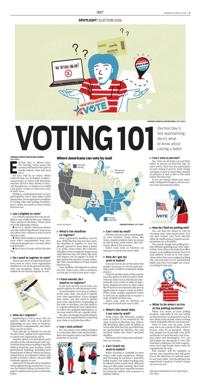
Election Day is almost here. On Tuesday, voters across the country will head to the polls to decide federal, state and local races. All eyes will be on states where edistricting has reshaped congressional maps, as voters will determine whether district lines drawn to benefit Republicans or Democrats fulfill each party's hopes to flip more seats in their favor.
Voting is a fundamental part of civic participation, but it often takes a little preparation. From registration deadlines to voting rules and polling locations, here's what you need to know before Election Day.
Am I eligible to vote?
U.S. citizens registered to vote are eligible to cast a ballot in this year’s federal, state, and local elections. Voters must meet the following criteria:
■ Be a U.S. citizen. American citizens can vote while living abroad. Some areas also allow non-citizens to vote in local elections only.
■ Meet state residency requirements. Each state’s requirements may vary. Unhoused people also can meet these requirements.
■ Be at least 18 years old by Election Day.
► Do I need to register to vote?
Americans must be registered before their state or area’s voter registration deadline to vote in the general election, with one exception: Voters in North Dakota do not need to register to vote.
► How do I register?
Registering to vote is easy. You can register online, by mail or in person, depending on your state or territory. Registration requirements and deadlines vary by location.
Visit vote.gov to register to vote for the first time, update your registration or check your registration status.
Another option is to download, print and fill out the national mail voter registration form before mailing it into the address listed for your location. Some government buildings including local Department of Motor Vehicle locations, armed forces recruitment centers and public assistance offices can also help residents register to vote.
Americans living abroad or members of the military living outside the U.S. can use the Federal Voting Assistance Program to register and request an absentee ballot.
► What’s the deadline to register?
Voter registration deadlines vary by area. With Election Day just days away, the deadline to register to vote has already passed in more than a dozen U.S. states. Some states, like Colorado, will allow voters to register in person up until Election Day, but others like Iowa will require you to register at least 15 days before the election. In some states, like Ohio, the deadline is 30 days before Election Day.
Your deadline will depend on where you live. Select your state or territory on vote.gov to check your area’s rules.
► I have moved, do I need to re-register?
If you have moved out of state, you need to register to vote in the new state.
If you moved to a new area or address in the same state, you need to update your voter registration. If you changed your name, you also need to update your voter registration. Depending on the state or territory, you may need to re-register entirely for your registration to reflect the updated information, or you may need to fill out a specific form.
You also can change the political party listed on your registration by contacting your state or local election office.
► Can I vote online?
No. You cannot vote online in federal U.S. elections. Most state and local elections also require voters cast their ballot in person or by mail.
► Can I vote by mail?
Whether you can vote by mail depends on your location. Some states, like Texas, require residents have an excuse to vote by mail, while others, like California, allow it for everyone.
Select your state or territory on vote.gov to check your area’s rules.
► How do I get my mail-in ballot?
If you are not in one of the states that require an excuse to vote by mail, getting a mail-in ballot is a relatively simple process.
Voters in all other parts of the country have the option to vote by mail in 2026. Voters in states such as Nevada are automatically sent a mail-in ballot if registered. Registered voters in other states like Wisconsin are automatically sent an application to request a mail-in ballot. Other states require registered voters to seek out an application to request a mail-in ballot on their own.
Select your state or territory on vote.gov to check your area’s rules.
► What’s the latest date I can vote by mail?
Some states, like Missouri, require mail-in ballots to be received by the close of polls on Election Day. Others, like Maryland, allow mail-in ballots to arrive after Election Day, provided they are postmarked by Election Day and received within the state’s specified deadline.
Find your local voting rules and deadlines on vote.gov.
► Can I track my mail-in ballot?
Ballot tracking is available in most states, with some exceptions. Illinois and Wyoming do not have a statewide ballot tracker, but ballot tracking may be offered at the county level. Missouri does not offer ballot tracking. New York and Texas both have separate trackers for domestic ballots and overseas or military ballots.
► How do I find my polling site?
You can find out where to vote by checking your voter registration. You can also contact your local election office for clarification or request accommodations for a disability.
You cannot change your polling location without updating your voter registration. Your state or local election office assigns your polling location based on your address. If you try to vote somewhere other than your assigned polling site, you may have to cast a provisional ballot and your vote might not count, according to vote.gov.
► What to do when I arrive at the polling location?
When you arrive at your polling location, especially if you are voting on Election Day, be prepared to wait in line. Most states require voters to bring a form of identification to vote in person.
Voter ID laws vary by state. Some may ask to see a photo ID like a driver’s license, state ID, or passport. Others may require you to provide your birth certificate or Social Security card. Fourteen states and Washington, D.C., do not require any document to vote. The National Conference of State Legislatures (ncsl.org) breaks down voter ID requirements by state.
Poll workers will be available to answer your questions and will point you in the direction of a private space to cast your ballot. You should have the opportunity to grab an “I voted” sticker on your way out.
Vote.gov contributed to the reporting of this story.