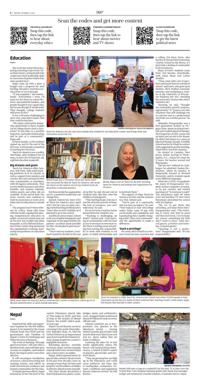
One of the most exciting things that happens during the fall semester is our GEAR UP sixth-grade tours. In partnership with McDowell County Schools, we experientially ask sixth-grade students, “What do you want to be when you grow up?”
These are not typical tours where students simply walk through buildings and look at classrooms. They are hands-on experiences led by the college’s experts. Students explore everything from nursing skills to refrigeration and law enforcement. At that age, we want them to dream about what their futures could look like.
As our high school seniors prepare for College Application Week and begin thinking seriously about “what’s next,” it can be tempting to jump immediately to choosing a college. College may be an important step toward a career, but it isn’t the first step.
Dreaming about the future is the beginning of planning for a career.
Recently, I read an article about the rising cost of college. Like many of you, that subject gets my attention. The thought of college costs can quickly burst some of those dreams. According to an Aug. 16 USA Today article published in The McDowell News, college costs have been increasing faster than inflation. At McDowell Tech, however, tuition has not increased in more than a decade. Even with increases in books, supplies and fees, the value of education is well documented.
But it isn’t simply that more education equals more money. Choosing the right course leads to pursuing the right credential and prepares you for the right career.
Education is an investment. It requires money, but it also requires something we can never get back: our time. Whether you are a parent thinking about your child’s future, a high school senior considering what comes next, or an adult contemplating a career change, it is reasonable to ask: Is the investment worth it?
I believe the answer is a resounding yes.
Education continues to provide a strong financial return over a lifetime. But there is another return that can be harder to measure. Education can open doors, build confidence, uncover abilities we didn’t know we had and help us find work that gives us purpose and satisfaction.
The challenge is choosing our educational path wisely.
Three words can help: Course. Credential. Career.
Course is an interesting word in education. We normally think of a course as a class we take. But it can also mean the direction we choose to travel.
Sometimes students begin with, “Where am I going to college?” Better questions might be: What am I good at? What interests me? What do I enjoy? What opportunities are available?
Recent employment projections give us some clues about that last question. The U.S. Bureau of Labor Statistics projects the American economy will add about 5.9 million jobs over the next decade. Healthcare, technology, construction, engineering and skilled occupations offer promising opportunities. Registered nursing alone is projected to add nearly 195,000 jobs nationally by 2035.
Closer to home, North Carolina’s Star Jobs data identify promising regional careers in industrial maintenance, electrical work, nursing, engineering technology, construction and other fields. Job opportunities and potential earnings are important when considering the return on our educational investment, as long as we balance them with our interests and abilities.
Setting a course doesn’t mean a 17-year-old needs to know exactly what he or she will do for the next 50 years. Most of us would probably admit that our own careers didn’t follow such a straight line. It simply means beginning with some direction and finding the intersection of our interests, abilities and opportunities.
Once we have a course, we can consider the second word: Credential.
Not every good career requires a bachelor’s degree. And not every good career can be entered with only a high school diploma.
The right credential might be an industry certification, apprenticeship, diploma, associate degree or bachelor’s degree.
For some careers, it will eventually mean a master’s or doctoral degree. The key is matching the credential to the destination.
Consider a few examples from North Carolina’s 2026 Star Jobs data. In our region, median annual wages are approximately $54,000 for electricians and $61,000 for industrial machinery mechanics. Registered nurses have a regional median wage of about $80,000, while electrical and electronic engineering technicians are around $79,000.
Construction managers, which typically require a bachelor’s degree, exceed $100,000.
Different careers require different educational paths. One path isn’t inherently more valuable than another.
A recent study of the City University of New York’s ASAP program makes that point particularly interesting. ASAP has been remarkably successful at helping more community college students graduate. Yet researchers studying participants over 14 years found that the additional degrees earned did not result in a statistically significant increase in earnings for that group.
There are several possible explanations, but there is an important lesson for us: finishing a credential matters, but that credential must also connect to what comes next.
McDowell Tech is one of the North Carolina colleges participating in NC BOOST, a student-success initiative modeled after ASAP. An important distinction is that BOOST focuses on students pursuing high-demand, workforce-aligned programs.
That brings us to our final word: Career.
Graduation is worth celebrating. I love commencement day. But graduation isn’t the finish line. Education should lead somewhere.
The idea of Impact is built into McDowell Tech’s new strategic plan. We aren’t satisfied simply counting how many students enroll or even how many graduate. We want to know what happens next. Did the student transfer? Find employment? Advance in a career? Improve his or her economic circumstances? Build a better life?
There is certainly a financial return on education. McDowell Tech’s M3 Good Jobs project works to align credentials with careers. People need good jobs that allow them to support themselves and their families. But I don’t want us to forget the other return.
A good career can provide dignity and purpose. There is satisfaction in repairing a machine that keeps a local manufacturer running, caring for a frightened patient, wiring a new home, teaching a child, building a business, protecting your community or solving a difficult technical problem.
A paycheck matters. So does waking up knowing your work matters.
That’s why I believe deeply in education as an investment, not simply in earning power, but in people.
So, the next time a young person tells us they are thinking about their future, instead of immediately asking, “Where are you going to college?”, perhaps we can begin with different questions.
What are you good at? What opportunities interest you? What education will help you get there?
Set your course. Earn the right credential. Build your career.
That’s an investment worth making. Explore your potential course at the McDowell Tech Career Center (https://mcdowelltech.edu/career-center/). With those questions in mind, you may discover that McDowell Tech is Right Where You Belong.