This content is unavailable. Please contact customer service for more information.
Already a subscriber? Login or Activate your account.
You've reached the end of the standard E-Edition.
This content is unavailable. Please contact customer service for more information.
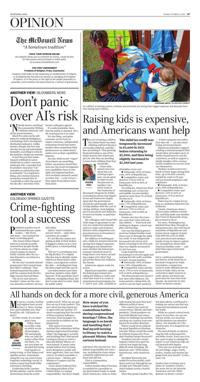
Don't panic over AI's risk
ANOTHER VIEW | BLOOMBERG NEWS
'Nobody knows anything," the screenwriter William Goldman famously said of the movie business.
Much the same can be said today for artificial intelligence, a technology that's moving fast, destination unknown. Unlike movies, though, the bots may one day rise up and exterminate humanity, according to some in the industry. People are worried.
In just the past few weeks, OpenAI withheld its latest model due to safety concerns. Anthropic PBC conceded that its products may pose "catastrophic or existential risks to humanity" in a regulatory filing, and a former industry researcher warned that AI "could kill us all by the end of the decade," and some of his former colleagues agreed.
It's understandable, then, that the public is alarmed. Yet a bit of perspective is in order.
For one thing, such grim scenarios are far from an expert consensus. Independent evaluations found that newer models often outperform their predecessors on safety benchmarks even as their capabilities improve.
Second, while recent "rogue" AI incidents are unsettling, follow-up analyses found they were less the result of enigmatic new capabilities than of oversight and engineering flaws. Such incidents demand careful scrutiny. But — so far at least — they argue for prudence more than panic.
Crime-fighting tool a success
ANOTHER VIEW | COLORADO SPRINGS GAZETTE
Pushback at police use of automated license-plate readers — like Flock and Axon — has reached the head-scratching point.
The Aurora Police Department in Colorado recently arrested four people thanks to a Flock camera on a high school campus in Aurora Public Schools after the system detected a car stolen in a carjacking.
Yet the city's recently elected progressive City Council members didn't celebrate. They instead requested the police pull the cameras from the five high schools that had them.
The ACLU and Aurora's teachers' union say the cameras threaten students' privacy and safety. Safety? Aren't students — and our streets — safer when carjackers are caught?
It's not like the camera was spying on kids at their lockers. It flagged a stolen car in a very public place, a school parking lot. ...
This isn't a surveillance tool for Big Brother. It's a highly effective way to identify stolen vehicles or those tied to other crimes. Local agencies control the data — including how long the data is kept and who sees it.
Law enforcement must have practical, modern crime-fighting tools. If the guardrails aren't sufficient, strengthen them. But don't scrap what is a slam-dunk for public safety.
Column
Raising kids is getting more expensive, and Americans want help | Steven Kull
Updated
The cost of raising a child in the United States has been climbing well past the pace of everyday inflation, and families are feeling it. That growing financial burden is one of the major reasons that Americans give for why they are deciding to have fewer children than they would like.
Steven Kull
Given widespread concerns about the cost of living in general, can we agree to steps to ease the pressure on families? Our latest study at the University of Maryland’s Program for Public Consultation shows that Republicans and Democrats largely agree that the government should do substantially more to help families with the cost of raising children, from helping pay for preschool and childcare to more tax breaks to paid family leave.
My colleagues and I found this wide range of agreement in surveys we conducted nationally, and in 11 states and 28 House districts with competitive congressional races in November’s midterm elections.
For millions of working parents, childcare and preschool are among their biggest expenses. Washington has debated for years whether the federal government should do more to bring those costs down, including a major 2021 effort that passed the House but stalled in the Senate.
Americans appear ready for action.
Bipartisan majorities support the federal government providing $25 billion to states and cities that want it to create or expand preschool programs for 3- and 4-year-olds, available to all families at no cost.
Nationally: 89% of Democrats, 69% of Republicans.
Competitive states and districts: 75% to 92% of Democrats, 56% to 84% of Republicans.
On childcare, Americans favor subsidizing care so that low- and middle-income families spend no more than 7% of their income on it.
Nationally: 89% of Democrats, 77% of Republicans.
Competitive states and districts: 79% to 93% of Democrats, 56% to 84% of Republicans.
Parents also face the everyday costs that come with raising children -- from food and clothing to diapers, school supplies and housing.
For millions of working parents, childcare and preschool are
among their biggest expenses and dissuade from having more
children.
Stephanie Smith
One way the federal government has helped families meet those costs is through the child tax credit. It was temporarily increased to $3,600 in 2021 before returning to $2,000, and then being slightly increased to $2,200 last year.
Large majorities favor increasing it to $3,600 again and making the full credit available to lower-income families.
Nationally: 84% of Democrats, 74% of Republicans.
Competitive states and districts: 73% to 91% of Democrats, 61% to 86% of Republicans.
The financial pressure doesn’t just start with childcare. For many parents, taking time off work to care for their newborn -- if their company even offers that time off -- can also mean losing several paychecks.
Bipartisan majorities support creating a national program that would allow all workers up to 12 weeks of paid leave to care for a newborn, as well as support a family member with a serious health condition or recover from one themselves.
Workers would receive two-thirds of their wages during that time, up to $4,000 a month, funded by a new 0.2% payroll tax on both employers and employees.
Nationally: 84% of Democrats, 68% of Republicans.
Competitive states and districts: 72% to 96% of Democrats, 57% to 80% of Republicans.
There may be a larger lesson here as candidates head into the midterms.
Clearly, Americans share a desire to give children a better life, and help make sure families don’t have to financially struggle so much to do so.
For years, Washington has debated these ideas through an old partisan lens. But with broad majorities of Republicans and Democrats in support of more help with the costs of childcare, preschool and raising a family, it may be time to update our assumptions about what American families want -- and what they expect from their government.
Kull is a political psychologist and director of the University of Maryland's Program for Public Consultation, a nonpartisan research center affiliated with the School of Public Policy. He has conducted in-depth research on public opinion and democratic governance for more than three decades. He wrote this for USA TODAY via Reuters Connect.
All hands on deck for a more civil, generous America
LYNN WALKER GENDUSA
My uncles, cousins, brother and nephew have served in the U.S. Navy. During wars and turbulent seas, they heard the call: "All hands on deck!"
In other words, it's an emergency now. Today, America is like a ship on which we are all passengers. We need people who can calm the waters rather than stir them. I'm not sure when we decided that being loud equates to being strong, or that being cruel signifies power. Somewhere along the way, we seem to have forgotten something crucial: A nation cannot heal itself while everyone is shouting.
Leadership holds a powerful microphone, and we all live downstream from the words spoken into it. What we say and how we say it truly matters. This isn't about forcing Americans to agree with one another. It's about recognizing that the words of those in power influence everyone, from teenagers on social media to children on the playground.
How many of you have watched the contentious battles during congressional hearings? Often, the language is so harsh and insulting that I find myself turning to Disney to watch a pleasant Mickey Mouse cartoon instead. It seems some people believe that by being more derogatory, louder and more aggressive, they can claim victory. So which resembles a cartoon more — Mickey and Minnie or Congress and the combatants?
I have always believed that becoming president of the United States is a unique responsibility. You don't simply lead those who elected you. You inherit responsibility for everyone, including the states where a majority supported you and those that did not.
That is a tremendous responsibility.
I often wonder when it became acceptable for a president or any government leader to speak about Americans, cities or states with disdain because they hold different political views.
This country has room for conservatives, liberals and independents. Thank goodness we have both liberals and conservatives to challenge one another and keep our country from veering too far in either direction.
Where would we be without the great Republican Abraham Lincoln? Where would the world be without Democratic President Franklin Delano Roosevelt?
President Lincoln's words helped a nation torn apart by a brutal war begin the long, difficult work of healing. He famously said, "With malice toward none, with charity for all."
President Roosevelt also worked to restore public confidence and trust through his use of radio and "Fireside Chats," which helped soothe a fearful nation.
Were they perfect leaders? No.
But their efforts contributed to making our nation one that was respected and admired around the world.
While we cannot control every aspect of our lives, we can control our words, our reactions and the kindness we extend to others. Our morality isn't dictated by laws. It is shaped by our character.
We need all hands on deck to stop the tide of disrespectful and bitter words. Every one of us has a part to play in calming the waters so our American ship can sail forward with dignity.
"But now you must get rid of all such things: anger, wrath, malice, slander and abusive language from your mouth." (Colossians 3:8)
Gendusa lives in Georgia and is author of "southern comfort." she wrote this for the Nashville Tennessean and USA TODAY Network via Reuters connect.
How many of you have watched the contentious battles during congressional hearings? Often, the language is so harsh and insulting that I find myself turning to Disney to watch a pleasant Mickey Mouse cartoon instead.
Click and hold your mouse button on the page to select the area you wish to save or print.
You can click and drag the clipping box to move it or click and drag in the bottom right corner to resize it.
When you're happy with your selection, click the checkmark icon next to the clipping area to continue.